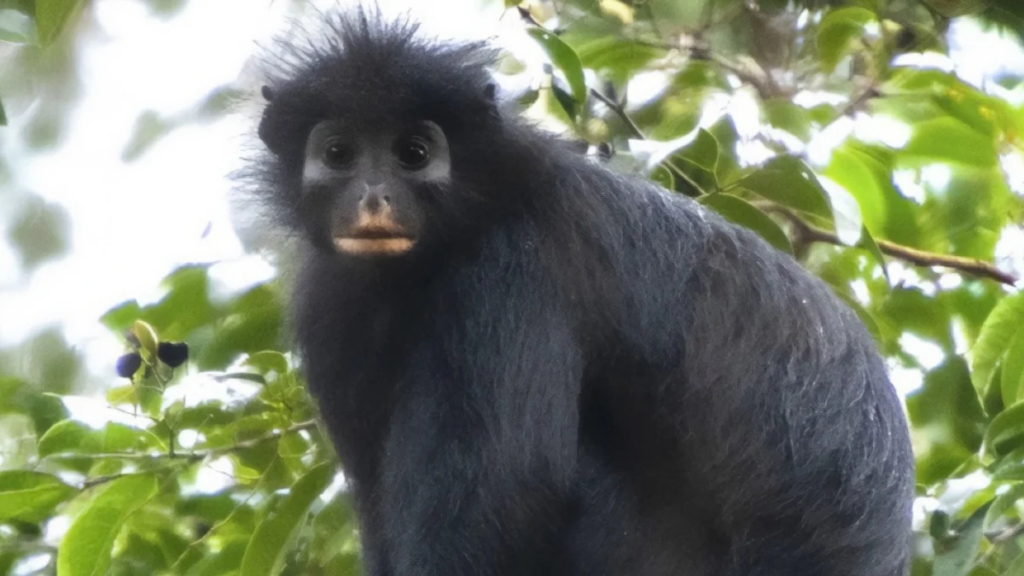
A remarkable new monkey species has officially joined the scientific record. Researchers have confirmed the existence of Colobus congoensis, a shy black-furred primate with striking orange-pink lips, bright facial hair, and an unusual lack of thumbs, living deep within the rainforests of the Democratic Republic of Congo (DRC).
The discovery marks one of the rarest additions to Africa’s known primate diversity. Scientists first photographed the monkey in 2008 but lacked enough evidence to classify it as a separate species. After nearly two decades of fieldwork and repeated sightings, researchers have now confirmed its unique identity in a study published in PLOS One.
The finding is significant not only because it expands Africa’s known biodiversity but also because it could help protect an animal already facing threats from hunting and habitat loss.
What Is Colobus congoensis?
Colobus congoensis is a newly recognized species of black-and-white colobus monkey found in the tropical forests between the Lomami and Lilo rivers in central Democratic Republic of Congo.
Locally known as Likweli, the monkey belongs to a group of African primates known for their tree-dwelling lifestyle and specialized leaf-based diet. Unlike many monkeys, members of the colobus family either lack thumbs entirely or have greatly reduced thumbs, an adaptation that helps them move swiftly through the forest canopy.
Researchers say the newly identified species stands out because of its:
- Bright orange and pink lips
- Distinctive facial hair and markings
- Glossy black fur
- Reduced or absent thumbs
- Powerful, far-reaching vocal calls
These characteristics clearly separate it from previously known colobus species.
Why Did It Take So Long to Confirm the Species?
The story of Colobus congoensis highlights just how challenging wildlife discoveries can be in remote tropical forests.
First photographed in 2008
Conservationists first captured a blurry photograph of the mysterious monkey during an expedition in Lomami National Park in 2008.
The image suggested the animal might represent an undescribed species, but researchers never encountered it again during that expedition.
Years passed without confirmation
The monkey resurfaced roughly a decade later, prompting scientists to launch dedicated surveys across its suspected habitat.
Between four years of intensive fieldwork, researchers recorded:
- 114 confirmed sightings
- Populations living between the Lomami and Lilo rivers
- Distinct behaviors unlike neighboring colobus monkeys
Combined with physical observations, vocal recordings, and genetic analysis, the evidence became strong enough to formally describe the species.
What Makes This Monkey Unique?
Several characteristics distinguish Colobus congoensis from other African monkeys.
Bright orange and pink lips
Perhaps the most eye-catching feature is the monkey’s colorful lips and vivid facial markings.
Researchers believe these markings may serve several purposes, including:
- Helping individuals recognize one another
- Attracting mates during breeding season
- Signaling social status within groups
While the exact function remains under study, facial coloration is an important communication tool in many primate species.
It Doesn’t Have Thumbs
Unlike humans and many monkey species, Colobus congoensis lacks functional thumbs.
This isn’t a defect—it’s an evolutionary adaptation shared by members of the colobus family.
Without protruding thumbs, these monkeys can:
- Swing more efficiently through tree branches
- Grip branches with hook-like hands
- Move quickly across the forest canopy
Their specialized anatomy reflects millions of years of adaptation to life high above the forest floor.
A Loud, Distinctive Roar
Researchers say one of the easiest ways to locate the species isn’t by sight—it’s by sound.
The monkeys produce deep, resonant calls that travel long distances through the rainforest.
According to the research team, these vocalizations are acoustically different from those of every other known colobus monkey.
“You often hear them, but don’t see them,” researchers noted, emphasizing how elusive the animals remain despite their powerful calls.
A Shy but Curious Forest Resident
Despite their elusive reputation, researchers observed an unusual behavior during field studies.
Instead of immediately fleeing when humans approached, the monkeys often climbed higher into the trees and quietly watched the researchers below.
Scientists described the animals as:
- Quiet
- Shy
- Highly observant
- Cautious rather than aggressive
One researcher remarked that studying the species often felt like “we’re studying each other,” reflecting the monkeys’ tendency to carefully observe human visitors.
This behavior may partly explain why the species remained scientifically undocumented for so long despite being known to some local communities.
Local Communities Already Knew About the Monkey
Although the scientific community only recently confirmed the species, local residents had long recognized the animal.
Researchers interviewed people in 52 nearby villages.
Interestingly:
- Residents in eight villages reported seeing the monkey.
- The species is locally known as Likweli.
- Traditional ecological knowledge helped researchers narrow down survey locations.
This demonstrates the value of combining scientific fieldwork with Indigenous and local knowledge when studying biodiversity.
Why This Discovery Matters
The confirmation of Colobus congoensis is important for several reasons.
One of Africa’s rarest recent primate discoveries
Researchers say it is only the fifth African monkey species officially discovered in the past 75 years.
That statistic highlights both Africa’s extraordinary biodiversity and how much remains unknown in remote rainforest ecosystems.
Conservation protection becomes easier
Official species recognition has practical consequences.
Without formal scientific classification, conservation laws often cannot specifically protect an animal.
Researchers hope the designation will help secure:
- Greater legal protection
- Increased conservation funding
- Habitat preservation
- Stronger anti-poaching measures
The monkeys are already hunted for bushmeat in parts of their range, making conservation efforts increasingly urgent.
What Does This Discovery Tell Us About Biodiversity?
The discovery serves as a reminder that even large mammals remain undiscovered in some of Earth’s least-explored ecosystems.
The Congo Basin is the world’s second-largest tropical rainforest after the Amazon and supports thousands of plant and animal species, many of which scientists believe remain undocumented.
Advances in genetic analysis, acoustic monitoring, camera traps, and long-term ecological surveys are helping researchers identify species that were previously overlooked because they closely resemble known animals.
The Bottom Line
The official recognition of Colobus congoensis marks an important milestone for primate science and African conservation. After nearly two decades of research, scientists have confirmed that the distinctive monkey with orange-pink lips, bright facial markings, powerful calls, and thumb-less hands is indeed a separate species.
Beyond adding another name to the primate family tree, the discovery underscores how much remains to be learned about Earth’s biodiversity. It also strengthens the case for protecting one of central Africa’s most unique—and elusive—forest inhabitants before habitat loss and hunting place it at greater risk.
TL;DR
- Scientists have officially identified a new monkey species named Colobus congoensis.
- The primate lives in the forests of the Democratic Republic of Congo.
- It has distinctive orange-pink lips, bright facial hair, black fur, and no thumbs.
- Researchers spent nearly 18 years gathering enough evidence to confirm it as a new species.
- The monkey’s unique vocalizations, appearance, and genetics distinguish it from other colobus monkeys.
- Official recognition could strengthen conservation efforts for the species.