
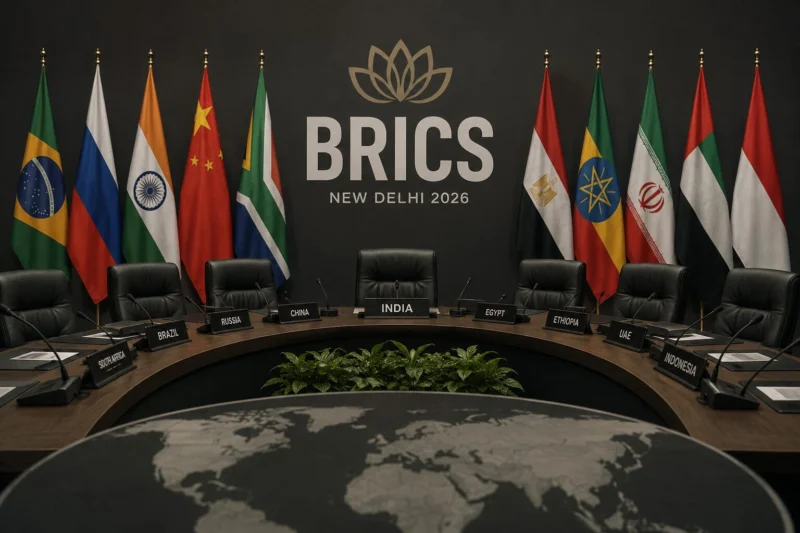
As India prepares to host the 18th BRICS Summit in New Delhi on September 12–13, 2026, the grouping is far removed from the four-country economic idea that inspired its name a quarter-century ago. Leaders from the 11 BRICS member countries, along with partner countries and outreach invitees, are expected at Bharat Mandapam for a summit centered on “Building for Resilience, Innovation, Cooperation and Sustainability.”
The meeting comes as BRICS enters a significant new phase. What began as an acronym coined by an investment economist has developed into a political and diplomatic forum for countries seeking greater cooperation—and a stronger voice for the Global South in international institutions.
India assumed the rotating BRICS chairship on January 1, 2026, its fourth time leading the grouping after 2012, 2016, and 2021. The year also marks 20 years since the group began functioning as a political forum.
What is BRICS and why was it created?
BRICS is a political and diplomatic coordination forum whose members cooperate across economic, financial, political, technological, and people-to-people issues.
The group currently consists of 11 countries:
- Brazil
- Russia
- India
- China
- South Africa
- Egypt
- Ethiopia
- Indonesia
- Iran
- Saudi Arabia
- United Arab Emirates
The grouping’s stated objectives include strengthening economic, political and social cooperation, increasing the influence of Global South countries in international governance, and promoting more representative global institutions.
Unlike the European Union, BRICS is not a supranational organization with a common parliament, single currency or binding political structure. It is better understood as a forum where governments coordinate positions and pursue practical cooperation while retaining their individual foreign and economic policies.
That distinction matters. BRICS can bring together countries with very different political systems, economic models and geopolitical interests. Its strength lies partly in its ability to provide a platform for cooperation without requiring members to create a tightly integrated political bloc.
How did BRIC begin?
The story starts not with governments, but with an economist and an investment report.
In 2001, Jim O’Neill, then an economist at Goldman Sachs, coined the term BRIC to describe Brazil, Russia, India and China. His argument was fundamentally economic: these large emerging economies were positioned to become increasingly important to the global economy.
At first, BRIC was therefore more of an analytical and investment concept than an international organisation.
But the four countries eventually saw a strategic reason to turn the idea into a forum for government-to-government cooperation.
Their interests overlapped in several areas:
- Reforming international financial institutions
- Giving emerging economies greater representation in global decision-making
- Expanding trade and investment
- Coordinating positions on international economic issues
- Increasing cooperation among developing economies
The 2008 global financial crisis reinforced some of these arguments. BRIC countries increasingly coordinated within institutions such as the G20, IMF and World Bank and pushed for international financial governance to better reflect the growing economic weight of emerging countries.
When did BRIC become an official political grouping?
The transformation from an economic acronym into a government-led forum began in 2006.
Foreign ministers from Brazil, Russia, India and China met on the sidelines of the United Nations General Assembly in New York. This was the first formal BRIC ministerial meeting.
Three years later, the leaders themselves met for the first BRIC summit in Yekaterinburg, Russia, in June 2009.
That meeting gave the grouping a more permanent political identity. The leaders discussed the international financial system, global economic governance and the role of emerging economies in international affairs.
BRIC was no longer simply a Wall Street acronym describing four promising economies. It had become a forum through which those countries could collectively express their interests.
Why was South Africa added to BRICS?
The next major change came in 2010, when the four BRIC countries invited South Africa to join.
South Africa participated in its first leaders’ summit as a member in 2011, held in Sanya, China. The addition of South Africa transformed BRIC into BRICS, with the “S” representing South Africa.
The decision also gave the grouping a stronger geographic reach across the Global South.
South Africa brought an African perspective to a group that had previously been dominated by the major economies of South America, Eurasia and Asia.
The expansion demonstrated an important feature of BRICS: membership was not simply about economic size. Geographic representation and the broader political interests of developing countries also mattered.
How did BRICS expand beyond five countries?
For more than a decade, BRICS remained a five-member grouping.
That changed after the 2023 BRICS Summit in Johannesburg, where leaders agreed to a major expansion. Six countries—Egypt, Ethiopia, Indonesia, Iran, Saudi Arabia and the United Arab Emirates—subsequently joined, bringing membership to 11.
Indonesia formally accepted the invitation to join in 2024, while the broader expansion took effect beginning in 2024–25.
The expansion significantly changed the character of BRICS.
The original five members already represented major emerging economies. Adding countries from the Middle East, Africa and Southeast Asia gave the grouping a wider geographic footprint and expanded its economic and strategic interests.
It also made BRICS more representative of the developing world—but potentially more difficult to coordinate because the members have increasingly diverse priorities.
What does BRICS actually do?
The group’s work broadly falls into three areas: politics and security, economics and finance, and people-to-people cooperation.
Economic and financial cooperation
Economic cooperation remains central to BRICS.
Members discuss trade, investment, financial cooperation, industrial development and ways to strengthen economic ties among emerging markets.
The group has also sought a larger role for developing countries in international financial institutions such as the IMF and World Bank.
The goal is not necessarily to replace those institutions. Instead, BRICS has consistently argued that global economic governance should better reflect the economic weight and interests of emerging economies.
The New Development Bank
One of BRICS’ most concrete institutions is the New Development Bank (NDB).
The bank was established by Brazil, Russia, India, China and South Africa in 2015 to mobilize financing for infrastructure and sustainable development projects in emerging markets and developing countries.
Its focus includes areas such as:
- Clean energy
- Transport infrastructure
- Water and sanitation
- Digital infrastructure
- Environmental protection
- Social infrastructure
The NDB provides something more tangible than diplomatic declarations: financing for development projects. Its creation was therefore one of the clearest examples of BRICS turning political cooperation into an institution.
Technology, energy and sustainable development
BRICS cooperation has also expanded well beyond traditional trade and finance.
Members work on energy, science and technology, digital cooperation, health, agriculture, climate issues and sustainable development.
India’s 2026 chairship has placed particular emphasis on resilience and innovation. Sectoral meetings during the year have covered areas ranging from energy and urban development to communications, industrial cooperation and space.
For example, India hosted a BRICS meeting of space-agency heads in June 2026 involving representatives from all 11 member countries.
The approach reflects how the group’s agenda has evolved. BRICS is no longer focused only on questions of economic growth. It is increasingly addressing technologies and infrastructure that could shape future development.
Why does BRICS matter to the Global South?
BRICS matters because its members collectively represent a substantial portion of the world’s population, resources and economic activity.
But its importance is not simply a matter of adding up GDP figures.
The group provides emerging and developing economies with another diplomatic platform from which to discuss global governance, development financing and international economic rules.
Its members have repeatedly called for a more representative international system, including reforms to institutions such as the United Nations, IMF and World Bank.
This is why BRICS is often associated with the idea of a more multipolar world—one in which influence is distributed among a wider group of countries rather than concentrated primarily in traditional Western institutions.
Still, BRICS should not be portrayed as a unified anti-Western alliance.
Its members have significant differences over foreign policy, trade, security and bilateral relationships. BRICS itself operates through consensus and remains an informal coordination mechanism rather than a military or political alliance.
That makes the group’s ambitions significant, but also places limits on how far its members can act collectively.
What is India trying to achieve with the 2026 BRICS Summit?
India’s 2026 chairship places resilience, innovation, cooperation and sustainability at the center of the agenda.
The official theme—“Building for Resilience, Innovation, Cooperation and Sustainability”—reflects India’s stated people-centric approach and the broader “Humanity First” vision associated with its chairship.
India has spent the year organizing more than 350 meetings and high-level engagements across more than 25 Indian cities, covering the group’s political, economic and people-to-people pillars.
The September leaders’ summit is expected to bring together the work carried out throughout the year and provide political direction for the group’s next phase.
For New Delhi, the summit is also an opportunity to emphasize areas where India sees practical room for cooperation—from technology and energy to development, trade and digital infrastructure.
Why is the 2026 summit significant?
The New Delhi summit arrives at a moment when BRICS is both larger and more ambitious than it was when India last hosted its leaders in 2021.
The grouping has expanded from five to 11 members. It has developed institutions such as the New Development Bank. And its agenda now stretches across finance, technology, energy, health, infrastructure and sustainable development.
At the same time, expansion creates a new challenge: Can a larger and more diverse BRICS turn broad political ambitions into concrete cooperation?
That may be the most important question facing the group in New Delhi.
The 18th summit will therefore be more than a gathering of leaders. It will offer a test of whether BRICS’ expansion can translate into greater institutional influence and practical economic cooperation—and whether countries with very different interests can maintain a common agenda.
BRICS at a glance
| Milestone | What happened |
|---|---|
| 2001 | Jim O’Neill coined the term BRIC for Brazil, Russia, India and China |
| 2006 | BRIC foreign ministers held their first meeting |
| 2009 | First BRIC leaders’ summit in Yekaterinburg, Russia |
| 2011 | South Africa joined, creating BRICS |
| 2014–15 | BRICS countries created the New Development Bank |
| 2023 | Leaders agreed to a major membership expansion |
| 2024–25 | Six additional countries joined BRICS |
| 2026 | India assumed the chairship and will host the 18th summit in New Delhi |
The historical milestones are documented in BRICS’ official records and the New Development Bank’s institutional history.
TL;DR
BRICS began in 2001 as an economic acronym created by Goldman Sachs economist Jim O’Neill to describe Brazil, Russia, India and China. Governments later turned the concept into a political forum, holding their first ministerial meeting in 2006 and their first leaders’ summit in 2009.
South Africa joined in 2011, creating BRICS. A much larger expansion followed in 2024–25, bringing membership to 11 countries.
Today, BRICS focuses on economic and financial cooperation, global governance reform, technology, energy, sustainable development and people-to-people exchanges. The New Development Bank is its most prominent financial institution.
India’s 2026 chairship culminates with the 18th BRICS Summit at Bharat Mandapam in New Delhi on September 12–13, under the theme “Building for Resilience, Innovation, Cooperation and Sustainability.”