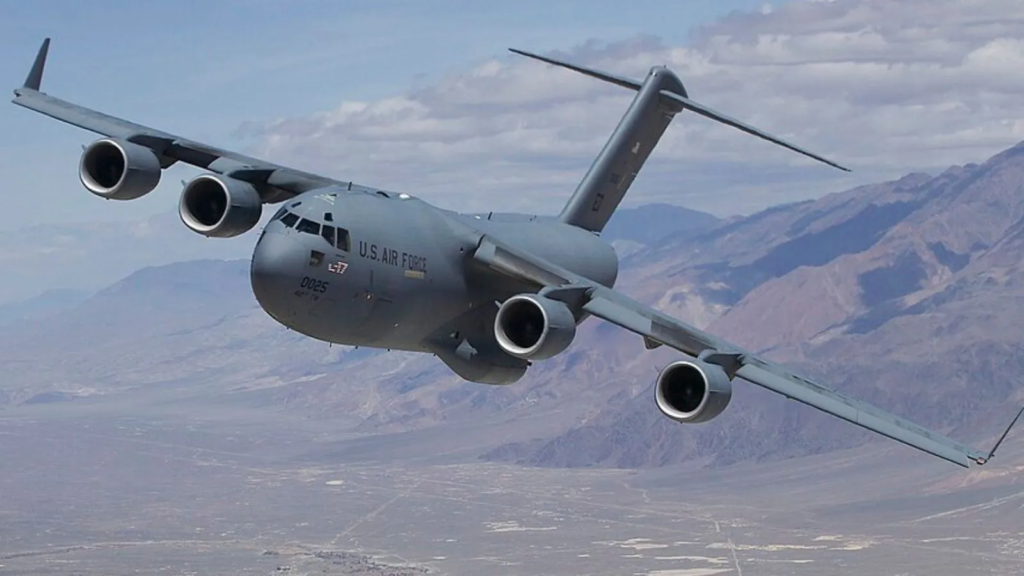
A massive US military C-17 Globemaster III transport aircraft reportedly flew into Moscow on Tuesday, August 25, carrying CIA Director John Ratcliffe for an unannounced visit to Russia.
The aircraft’s arrival at Moscow’s Vnukovo International Airport drew attention because the Boeing-built C-17 is not an ordinary passenger aircraft. Designed to move troops, tanks and other heavy military equipment around the world, it is one of the US Air Force’s most capable strategic airlift platforms.
The reported use of a C-17 for Ratcliffe’s trip also highlighted the unusual nature of the visit, which US officials have not publicly detailed. The Kremlin said it had no information about the aircraft’s arrival or Ratcliffe’s reported meetings.
Here are eight things to know about the aircraft.
What is the C-17 Globemaster III?
The Boeing C-17 Globemaster III is a strategic and tactical military transport aircraft operated by the US Air Force.
Its primary mission is to move large quantities of troops, vehicles, weapons, equipment and supplies over long distances. Unlike aircraft designed exclusively for strategic airlift, however, the C-17 can also operate from relatively short and austere runways.
That combination gives the aircraft unusual flexibility.
The C-17 can perform several missions, including:
- Strategic and tactical airlift
- Transport of troops and military equipment
- Airdrops of paratroopers and cargo
- Medical evacuation
- Humanitarian relief operations
Its ability to combine long-range transport with operations from smaller airfields makes it particularly valuable for missions where conventional large transport aircraft may not be practical.
How much can a C-17 carry?
The C-17 has a maximum payload of about 170,900 pounds, or approximately 77,500 kilograms.
That gives it enough capacity to carry extremely heavy military equipment, including the M1 Abrams main battle tank.
Its cargo hold was designed around the realities of moving large military vehicles and equipment rather than simply maximizing passenger capacity.
The aircraft can also transport troops alongside their equipment. Depending on configuration, a C-17 can carry up to 102 troops or paratroopers.
For an aircraft whose main job is moving military forces and equipment, that versatility is central to its design.
How big is the C-17 Globemaster III?
The C-17 is enormous.
It measures approximately 53 meters (174 feet) long, with a wingspan of nearly 52 meters (170 feet). It stands about 16.8 meters (55 feet) tall.
Those dimensions make the aircraft one of the most imposing planes in the US military’s airlift fleet.
Yet its size does not prevent it from operating in environments that would be challenging for many other heavy transport aircraft.
The C-17’s design incorporates a high-wing configuration, a large rear cargo ramp and landing gear built to handle operations from less-developed airfields.
What engines power the C-17?
The aircraft is powered by four Pratt & Whitney F117-PW-100 turbofan engines.
Each engine produces roughly 40,440 pounds of thrust.
One of the more unusual features is the aircraft’s thrust-reverser system. The engines can redirect thrust forward after landing, helping the C-17 slow down rapidly.
The system can also assist the aircraft in backing up on the ground — an unusual capability for an aircraft of this size.
The combination of powerful engines, advanced flight controls and robust landing gear is what allows the C-17 to operate from runways that would be unsuitable for many other heavy aircraft.
Can the C-17 land on short runways?
Yes. This is one of the aircraft’s defining capabilities.
The US Air Force says the C-17 can operate from runways as short as 3,500 feet and as narrow as 90 feet.
That capability matters because military airlift missions do not always end at major international airports.
A C-17 may need to deliver personnel or equipment to an airfield close to a conflict zone, disaster area or remote military installation.
Its ability to land, unload and take off again from comparatively short runways allows commanders to move supplies much closer to where they are needed.
The aircraft can also perform short-field landings and use its rear cargo ramp for rapid loading and unloading.
How fast can a C-17 fly?
Despite its huge size, the C-17 is a relatively fast military transport aircraft.
Its cruising speed is approximately 450 knots, or around Mach 0.74.
It can operate at altitudes of roughly 45,000 feet.
Its range varies depending on payload, fuel and mission requirements. The aircraft can also receive fuel from aerial tankers, allowing it to undertake longer-range global missions.
That aerial-refueling capability is particularly important for a strategic transport aircraft because it reduces the need for intermediate fuel stops.
How many people operate a C-17?
The standard C-17 flight crew consists of three people:
- A pilot
- A co-pilot
- A loadmaster
The loadmaster has a particularly important role on transport missions.
Rather than simply managing passengers, the loadmaster oversees cargo loading, weight distribution and securing equipment inside the aircraft.
On military missions involving vehicles, pallets, troops or specialized equipment, correct cargo placement is essential to keeping the aircraft balanced and within operational limits.
The C-17 can carry up to 102 troops or paratroopers, depending on its configuration.
It can also be converted for medical evacuation missions, allowing it to carry patients, medical personnel and associated equipment.
Why would a C-17 be used for a high-profile visit to Moscow?
This is where the aircraft’s appearance becomes particularly noteworthy.
A C-17 is fundamentally a military transport aircraft, not a VIP jet. Its reported presence in Moscow therefore attracted attention because Ratcliffe’s visit was described as unannounced and involved sensitive contacts between Washington and Moscow.
However, the aircraft itself does not establish what Ratcliffe was carrying, who accompanied him or what was discussed during the visit.
US officials have not publicly disclosed the precise purpose of Ratcliffe’s Moscow trip or the contents of the aircraft’s cargo.
The C-17’s normal mission profile means it can carry personnel and mission equipment, but there is no public evidence establishing that the aircraft transported anything unusual.
That distinction matters when interpreting the flight.
Why is the C-17 important to the US military?
The aircraft gives the United States a rare combination of global reach and tactical flexibility.
A conventional strategic airliner can move large numbers of people over long distances, but the C-17 is designed around military requirements.
It can:
- Carry heavy armored vehicles.
- Move troops and equipment together.
- Land on relatively short runways.
- Deliver cargo by airdrop.
- Conduct medical evacuation missions.
- Receive fuel in the air.
- Operate from locations with limited infrastructure.
That makes the C-17 a crucial component of US military logistics.
Modern military operations depend not only on fighter jets, bombers and ships but also on the ability to move people and equipment quickly across continents. Heavy transport aircraft provide that logistical backbone.
What makes the Moscow flight unusual?
The unusual element is not necessarily that a C-17 can fly to Russia. It is that one reportedly appeared at Moscow’s Vnukovo International Airport amid a highly sensitive diplomatic and intelligence-related visit.
Ratcliffe’s reported trip represents one of the highest-level US visits to Russia since the Trump administration returned to office.
The aircraft’s arrival consequently became another piece of an otherwise opaque story.
But there is an important limitation: the C-17’s presence does not reveal the purpose of the visit.
Until Washington or Moscow provides more information, the most that can be established is that a US military transport aircraft reportedly arrived in Moscow and that Ratcliffe was reported to be in the Russian capital.
The rest remains a matter for official confirmation.
C-17 Globemaster III at a glance
| Specification | C-17 Globemaster III |
|---|---|
| Manufacturer | Boeing |
| Role | Strategic and tactical airlift |
| Maximum payload | About 170,900 lb / 77,500 kg |
| Length | About 53 m |
| Wingspan | About 52 m |
| Height | About 16.8 m |
| Engines | 4 Pratt & Whitney F117-PW-100 turbofans |
| Thrust per engine | About 40,440 lb |
| Cruise speed | About 450 knots / Mach 0.74 |
| Service ceiling | About 45,000 ft |
| Standard crew | Pilot, co-pilot, and loadmaster |
| Troop capacity | Up to 102 troops/paratroopers |
| Key capabilities | Heavy airlift, airdrop, medical evacuation, short-field operations |
The bottom line
The Boeing C-17 Globemaster III is essentially a flying heavy-duty logistics system. It was built to move the US military’s largest and heaviest equipment across the world while retaining the ability to operate from comparatively austere airfields.
Its reported arrival in Moscow, therefore, attracted attention not because the aircraft is inherently associated with intelligence operations, but because of the circumstances surrounding this particular flight.
With the purpose of John Ratcliffe’s visit still largely undisclosed, the C-17 offers few definitive answers. What it does demonstrate is the scale and flexibility of the US military’s global airlift capability, and why the sight of one operating in Moscow was unusual enough to become part of the story.