
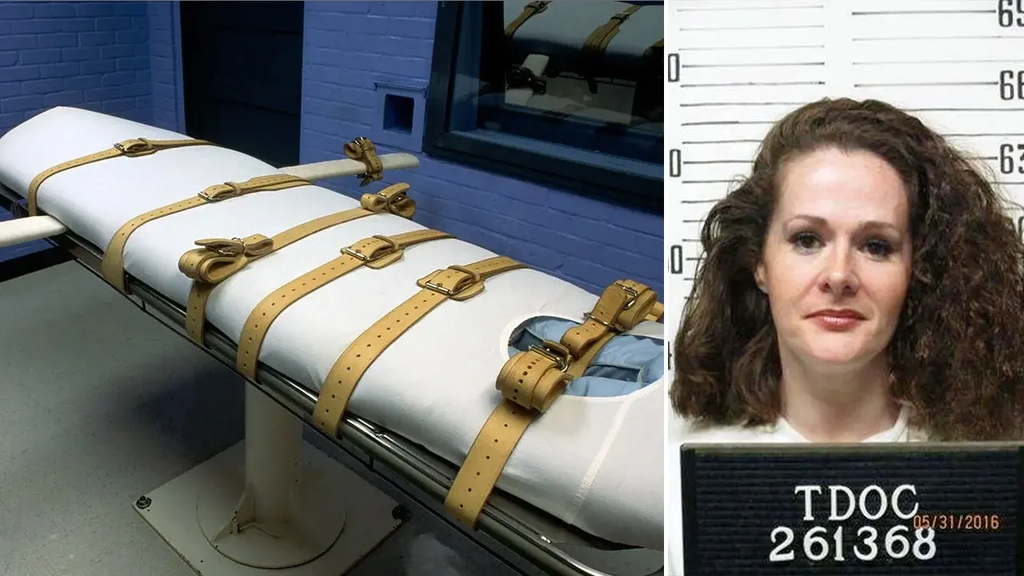
Christa Pike was supposed to become the first woman executed in Tennessee in more than two centuries. Instead, the September 30 execution turned into a prolonged medical emergency after officials administered two doses of the lethal drug pentobarbital without killing her.
Pike, 50, survived the attempted lethal injection and was taken from Riverbend Maximum Security Institution in Nashville to a hospital. Nearly a week later, her attorneys said she had regained consciousness and was able to speak, although she remained in critical medical care with severe injuries to her arms.
The incident is believed to be unprecedented in the United States: the Death Penalty Information Center said Pike is the first known person to survive after execution drugs were actually administered during a lethal injection.
The circumstances have raised questions about the execution team’s handling of intravenous lines, whether Pike’s known medical issues created additional complications, and what happens to her death sentence after an execution attempt has already taken place.
Here are five key details about the failed execution
1. Christa Pike survived two doses of pentobarbital
Tennessee uses pentobarbital as its single-drug lethal-injection method.
During Pike’s execution attempt, officials administered two doses of the drug. Yet Pike remained alive.
The execution began at approximately 7:30 p.m. on September 30 after Pike was allowed to make a final statement. Witnesses later reported that she remained responsive during part of the procedure and complained that her arm was hurting.
By approximately 8:26 p.m., the second dose had reportedly been administered. Pike could still be heard breathing after the execution was halted, and an ambulance eventually transported her to a hospital.
The failure is particularly unusual because previous botched executions involving difficulties accessing a vein have generally involved problems before the lethal drugs could be administered.
In Pike’s case, the drugs were administered, yet the execution did not result in death.
The Death Penalty Information Center described the circumstances as singular and unparalleled.
2. Pike complained that her arm was hurting minutes after the execution began
The execution did not proceed quietly.
Witnesses said Pike raised her head several minutes after the procedure began and complained about pain in her arm.
According to an account carried by the Associated Press, she asked whether her arm was supposed to feel that way. Later, she appeared to lose consciousness, but witnesses could still hear her breathing.
The execution continued for more than an hour.
At approximately 8:53 p.m., the microphone transmitting sounds from the execution chamber was cut off, and media witnesses were escorted away. An ambulance arrived at the prison at about 9:14 p.m. to take Pike to a hospital.
The sequence has become central to the investigation because it raises questions about whether officials recognised that something had gone wrong while the procedure was underway.
Pike’s attorneys have argued that the execution team failed to recognise problems with the intravenous lines.
3. Her arms were reportedly swollen, burnt and blistered
Perhaps the most visible evidence of what went wrong was the condition of Pike’s arms.
Her attorneys said in court filings that both arms became severely swollen, burnt and blistered during the attempted execution.
The suspected explanation involves extravasation — a medical complication in which an injected substance escapes from a blood vessel and enters the surrounding tissue.
Pentobarbital is highly alkaline and can cause serious tissue damage if it does not remain inside the vein. Medical experts consulted about the case have said the drug may have leaked into the tissue around Pike’s IV sites instead of reaching her bloodstream in the intended manner.
However, this remains an explanation under investigation rather than a definitive finding.
Pike’s attorneys have alleged that the execution team did not realize the IV lines were improperly placed or that the veins had “blown.” The Tennessee Department of Correction, meanwhile, said immediately after the incident that officials had followed the state’s established execution protocol.
Why would a failed IV matter?
A lethal injection depends on the drug reaching the bloodstream.
If the IV catheter is not properly positioned inside a vein, some or all of the medication may instead enter surrounding tissue. In that situation, the drug may cause significant local injury while failing to produce the intended systemic effect.
That is one of the main theories now being examined in Pike’s case.
4. Pike’s medical history had already raised concerns about the IV procedure
The difficulty may not have been entirely unexpected.
Pike’s attorneys had previously warned that her small veins and a blood disorder known as thrombocytosis could make establishing intravenous access difficult.
That detail has become especially important following the failed execution.
The question now is whether those known medical complications were adequately considered when Tennessee prepared to carry out the lethal injection.
Pike’s lawyers argue that the state had been warned about the difficulty of establishing reliable IV access and that the eventual complications were therefore foreseeable. The state’s independent investigation will have to determine whether those allegations are supported by the evidence.
This is also not the first time Tennessee has experienced problems establishing an IV during an execution in 2026.
In May, officials called off the execution of Tony DeWayne Carruthers after execution personnel spent more than an hour unsuccessfully attempting to establish intravenous access.
That earlier incident makes the Pike case particularly significant for Tennessee’s execution procedures.
5. Pike remained handcuffed and shackled while hospitalized
After surviving the execution attempt, Pike was taken to a hospital for emergency treatment.
Her attorneys later said she remained handcuffed and shackled to her hospital bed, even after regaining consciousness.
On October 6, Pike’s lawyers announced that she was conscious and speaking.
That represented a dramatic change from the days immediately following the failed execution, when her attorneys said she was unconscious, intubated and dependent on a ventilator.
Her prognosis remains unclear, and her attorneys say she faces a lengthy recovery.
What happened to Christa Pike after the failed execution?
Pike’s case has now shifted from an execution proceeding to a combination of medical, legal and investigative proceedings.
Her attorneys are seeking information and evidence from the Tennessee Department of Correction, including records relating to the drugs, needles, and execution procedure. They have also asked the courts to ensure that evidence from the attempted execution is preserved.
The Tennessee attorney general’s office has argued that existing obligations already require the preservation of relevant evidence.
Meanwhile, Tennessee Gov. Bill Lee ordered a comprehensive third-party review of the failed execution and postponed the state’s remaining scheduled execution for 2026.
Tennessee Department of Correction officials have maintained that the execution team followed the state’s established protocol.
Can Tennessee execute Christa Pike again?
That is one of the biggest legal questions now facing the state.
Pike’s death sentence has not simply disappeared because the first execution attempt failed. But whether, when, and how Tennessee could attempt another execution could become the subject of significant litigation.
Her attorneys are already challenging the circumstances surrounding the execution and arguing that what happened amounted to unconstitutional cruel and unusual punishment.
The legal questions could include:
- Whether a second execution attempt would violate the Eighth Amendment.
- Whether the failed procedure amounted to cruel and unusual punishment.
- Whether Tennessee’s execution protocol was properly followed.
- Whether the state’s handling of Pike’s known medical conditions was adequate.
- Whether Pike’s current medical condition affects any future execution proceedings.
- Whether the state must modify its lethal-injection protocol before attempting another execution.
There is no simple answer yet.
The courts will ultimately have to determine what legal effect the failed execution has on Pike’s death sentence and whether another execution attempt would be constitutionally permissible.
Why is the Pike case attracting national attention?
The incident has become larger than one inmate’s execution because it has exposed questions about the reliability of lethal injection itself.
The U.S. has experienced botched executions before, including cases involving prolonged attempts to establish IV access, unexpected physical reactions and failures in drug administration.
But Pike’s case is unusual because she survived after receiving two doses of the execution drug.
The Death Penalty Information Center has identified previous cases in which execution teams struggled to access a vein, but Pike is believed to be the first known U.S. prisoner to survive after lethal-injection drugs were actually administered.
The case also comes at a particularly consequential moment for Tennessee.
The state had already encountered another failed execution attempt earlier in 2026. Now, following Pike’s case, the governor has ordered an outside review and halted the state’s remaining execution for the year.
What happens next?
The immediate priority is determining exactly what happened inside the execution chamber.
Investigators will likely examine:
- The execution team’s logs and timeline.
- The IV equipment and needles used.
- Drug lot numbers and doses.
- Medical records from before and after the execution.
- The positioning and condition of the IV lines.
- Video or audio evidence, where available.
- Communications between prison officials and medical personnel.
- Pike’s treatment at the hospital.
Those findings could determine whether the failure resulted from an isolated medical complication, an equipment problem, human error, a protocol failure or a combination of factors.
The investigation could also have consequences beyond Pike.
If officials find systemic problems with Tennessee’s execution procedures, the state could face pressure to revise its protocols before carrying out another lethal injection.
The bottom line
Christa Pike went into Tennessee’s execution chamber on September 30 expecting to die.
Instead, she survived two doses of pentobarbital and was transported to a hospital with serious injuries. Her attorneys say problems with the IV lines may have caused the drug to enter surrounding tissue rather than properly entering her bloodstream, but an independent investigation has yet to establish exactly what happened.
Nearly a week later, Pike was conscious and speaking.
What happens next is far less certain.
Her medical recovery, the state’s investigation and the courts will determine whether Tennessee can legally attempt another execution — and whether the Pike case will ultimately force the state to rethink how it carries out the death penalty.