
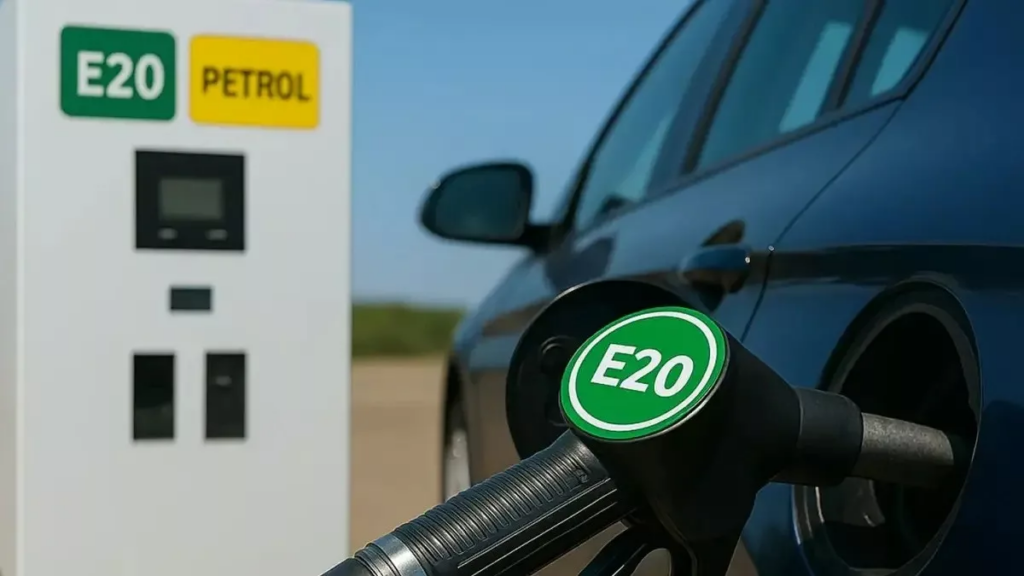
India has officially made E20 petrol, a blend of 20% ethanol and 80% petrol, available nationwide as part of its broader push to reduce dependence on imported crude oil and promote cleaner transportation. The move marks a significant shift in the country’s fuel strategy, but it has also left many motorists wondering: Will E20 fuel affect their vehicle’s performance or damage the engine?
The short answer is that most modern vehicles designed for E20 compatibility should operate normally, although drivers may notice a slight drop in fuel economy. The science behind E20 reveals why that happens, and why the trade-off could still benefit both the environment and India’s energy security.
Here’s what you need to know.
TL;DR
- E20 petrol contains 20% ethanol and 80% petrol.
- It burns cleaner than regular petrol, reducing harmful tailpipe emissions.
- Most E20-compatible vehicles will experience a 3–4% drop in fuel efficiency.
- Performance differences are minimal in modern engines.
- Older vehicles not designed for higher ethanol blends may experience gradual wear in fuel system components over time.
- The government aims to reduce crude oil imports, support farmers, and lower emissions through wider ethanol use.
What is E20 petrol?
E20 is a fuel blend consisting of:
- 20% ethanol, an alcohol-based renewable fuel produced from crops such as sugarcane, maize, and other biomass.
- 80% conventional petrol.
Unlike petrol, ethanol is produced from plant-based sources, making it a renewable component of the fuel mix. Increasing ethanol blending helps reduce India’s dependence on imported crude oil while creating additional demand for agricultural feedstocks used in ethanol production.
The nationwide rollout is part of India’s long-term strategy to improve energy security and reduce emissions from the transport sector.
How does E20 fuel burn differently?
Although ethanol and petrol are blended, they do not behave identically during combustion.
Ethanol molecules contain oxygen within their chemical structure. This built-in oxygen allows the fuel-air mixture to burn more completely inside the engine cylinder.
As a result, E20 fuel generally produces the following:
- More complete combustion
- Lower carbon monoxide emissions
- Reduced unburnt hydrocarbons
- Fewer particulate emissions
Another important characteristic is ethanol’s higher octane rating.
A higher octane fuel is more resistant to premature combustion, commonly known as engine knocking. This allows engines to maintain smoother combustion, particularly under higher loads or temperatures.
However, ethanol has one major limitation.
Why does E20 reduce mileage?
The biggest difference drivers are likely to notice is a slight reduction in fuel economy.
The reason comes down to energy content.
Each litre of ethanol contains less chemical energy than a litre of petrol. Even though E20 burns efficiently, it delivers less total energy per litre.
That means the engine must burn slightly more fuel to produce the same amount of work.
Most studies and real-world testing suggest:
- Fuel efficiency typically drops by 3–4% in E20-compatible vehicles.
- The reduction is gradual rather than immediately noticeable.
- Drivers may simply find themselves refuelling a little more often over weeks or months.
Importantly, this does not indicate that the engine is malfunctioning.
It is simply consuming a fuel with slightly lower energy density.
Will E20 change the way your car drives?
For most motorists, the answer is no.
Modern vehicles equipped with electronic engine management systems automatically adjust ignition timing and fuel delivery to accommodate ethanol-blended fuels.
As a result:
- Acceleration remains largely unchanged.
- Highway cruising feels normal.
- City driving is unaffected.
- Engine responsiveness stays consistent.
Some drivers may even notice marginally smoother operation because ethanol’s higher octane rating reduces knocking during combustion.
However, these differences are subtle and unlikely to be noticeable during everyday driving.
Is E20 safe for older vehicles?
Compatibility depends largely on the vehicle’s age and design.
Newer vehicles
Most recently manufactured petrol vehicles sold in India have been engineered with E20 compatibility in mind.
These vehicles typically feature:
- Ethanol-resistant fuel lines
- Improved seals
- Compatible fuel pumps
- Engine calibration designed for higher ethanol blends
Manufacturers have extensively tested these systems for long-term durability.
Older vehicles
Older petrol vehicles may require more caution.
Higher ethanol concentrations can gradually affect:
- Rubber hoses
- Plastic components
- Fuel system seals
- Certain metallic parts are susceptible to corrosion
These effects usually develop over time rather than causing immediate mechanical failures.
Owners of older vehicles should consult their manufacturer’s compatibility guidelines before routinely using E20 fuel.
What are the environmental benefits of E20?
One of the government’s primary reasons for adopting E20 is its environmental impact.
Because ethanol promotes more complete combustion, vehicles emit lower levels of:
- Carbon monoxide (CO)
- Unburnt hydrocarbons (HC)
- Fine particulate matter
Cleaner combustion translates into cleaner exhaust emissions.
Beyond tailpipe emissions, ethanol also offers broader climate benefits.
Since it is produced from renewable plant material rather than fossil fuels, ethanol can reduce lifecycle greenhouse gas emissions, depending on how it is cultivated, processed, and transported.
The overall environmental impact varies based on agricultural practices and production methods, but replacing a portion of petrol with renewable fuel helps reduce reliance on fossil energy.
Why is India promoting E20 petrol?
The nationwide rollout serves multiple policy objectives.
Reducing crude oil imports
India imports the majority of its crude oil requirements.
Increasing domestic ethanol production allows part of that demand to be replaced with locally produced renewable fuel, improving energy security.
Supporting farmers
Ethanol production creates an additional market for crops such as:
- Sugarcane
- Maize
- Damaged food grains
- Agricultural biomass
This provides farmers with new income opportunities while strengthening the domestic biofuel industry.
Lowering emissions
Cleaner-burning fuel supports India’s broader efforts to reduce urban air pollution and lower transport-related carbon emissions.
Are there any disadvantages?
Like any fuel, E20 comes with trade-offs.
Pros
- Cleaner combustion
- Lower harmful emissions
- Reduced engine knocking
- Renewable fuel source
- Less dependence on imported crude oil
- Supports India’s agricultural economy
Cons
- Around 3–4% lower fuel economy
- Older vehicles may not be fully compatible
- Drivers may experience slightly higher fuel consumption over time
For most owners of E20-compatible vehicles, these drawbacks are relatively minor.
The bottom line
E20 petrol is neither a revolutionary new fuel nor a cause for alarm. Instead, it represents a practical compromise between performance, environmental benefits, and energy security.
Drivers of compatible vehicles are unlikely to notice significant changes in how their cars perform. The most visible effect will typically be a modest reduction in mileage, driven by ethanol’s lower energy content rather than any loss of engine efficiency.
In return, E20 offers cleaner combustion, lower emissions, reduced reliance on imported fossil fuels, and greater support for India’s biofuel economy. As the country expands its ethanol blending programme, E20 is expected to become the new normal for millions of motorists.