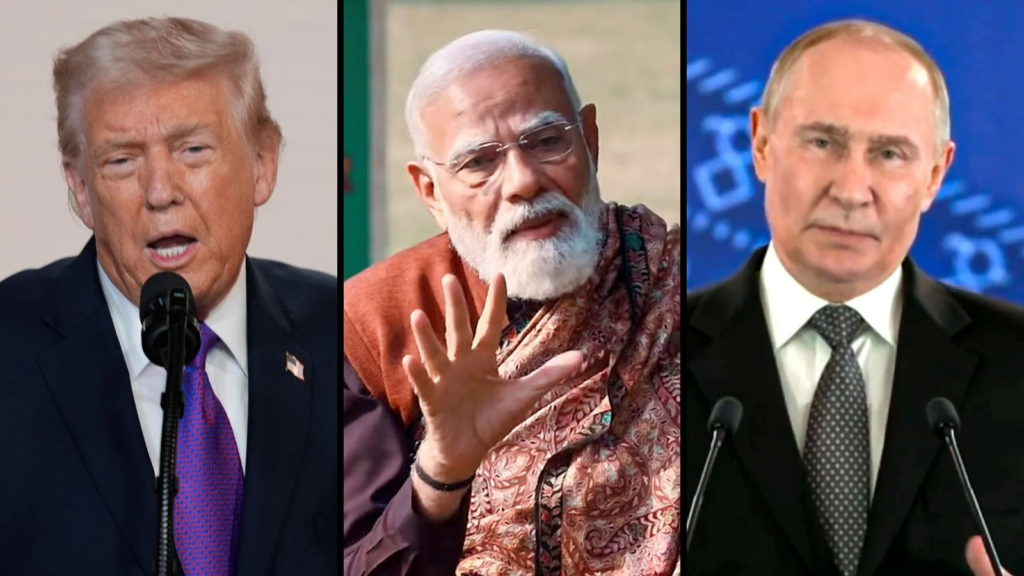
When the United States and India announced an interim trade framework this week, one line from US President Donald Trump quickly dominated headlines: India, he said, would stop buying Russian oil.
The claim sparked immediate debate in New Delhi, energy markets, and diplomatic circles. A closer look at the actual documents, however, tells a more nuanced story, one that leaves India significant room to maneuver.
Did the US–India trade framework mention Russian oil?
The short answer: not directly.
The official joint statement released by India and the United States on the interim trade framework does not refer to Russia or oil imports. Instead, it focuses on tariffs, market access, and long-term trade commitments.
The reference to Russian oil appears in a separate White House executive order titled “Modifying duties to address threats to the United States by the government of the Russian Federation.” That document states that the US lifted a 25% penalty tariff on Indian goods after India allegedly committed to stopping “directly or indirectly” importing Russian oil.
Crucially, India has not issued any public confirmation supporting that claim.
What exactly did Trump say and why it matters
When Trump announced the deal on Truth Social, he said India would stop buying Russian oil as part of the agreement. The statement was categorical and unqualified.
But government sources in New Delhi later told CNN-News18 that India’s energy strategy remains unchanged. Officials reiterated that India follows a “people-first approach” and buys oil from non-sanctioned entities offering the best commercial terms.
This gap between public messaging from Washington and official silence from New Delhi is at the heart of the confusion.
What has India’s position been on Russian oil?
India’s stance has been consistent since the start of the Russia–Ukraine war.
Officials have repeatedly said that:
- India will buy oil from the cheapest available sources
- Purchases will comply with international sanctions
- Energy security and affordability remain top priorities
As a country that imports roughly 85–88% of its crude oil needs, India has argued it cannot afford politically driven supply disruptions.
Russian crude, particularly Urals grade, has been available at discounted prices and suits many Indian refineries without costly reconfiguration.
Can India realistically stop buying Russian oil right now?
From a practical standpoint, an immediate halt would be extremely difficult.
According to reporting by The Times of India and The Indian Express, Indian refiners have already booked Russian oil cargoes through March and April. These contracts are signed weeks or months in advance and are not easily canceled without penalties or logistical complications.
There are also technical constraints:
- Russian Urals crude matches Indian refinery configurations
- Switching to lighter US crude may require blending
- Alternative sources can raise costs and reduce efficiency
Because of this, industry officials say any sudden ban would disrupt supply chains and raise fuel prices domestically.
What is the US really pushing for?
Rather than an abrupt stop, US officials appear to be aiming for gradual diversification.
According to Reuters, India is already expanding oil purchases from:
- The United States
- Middle Eastern producers
- African suppliers
India has also signaled openness to resuming oil imports from Venezuela if commercially viable—a move US officials have quietly supported as a way to reduce reliance on Russian crude without causing market shocks.
This suggests the US goal may be directional rather than absolute.
What does the interim trade framework actually cover?
The framework announced on Saturday is wide-ranging and largely focused on trade liberalization rather than geopolitics.
Key commitments from India include:
- Reducing or eliminating tariffs on US industrial goods
- Cutting duties on farm and food products such as nuts, fruits, soybean oil, wine, and spirits
- Providing preferential access in agreed sectors
India has also committed to purchasing $500 billion worth of US goods over five years, including:
- Energy supplies
- Aircraft and aviation components
- Technology products
- Coking coal and precious metals
Technology trade is another pillar, with emphasis on GPUs and data center equipment.
What does the US offer in return?
Under the framework, the US will:
- Apply an 18% reciprocal tariff on most Indian goods, down from 25%
- Remove tariffs entirely on select Indian exports once implementation is complete
Sectors expected to benefit include:
- Generic pharmaceuticals
- Gems and diamonds
- Aircraft parts
India has also protected sensitive domestic sectors. Union Commerce Minister Piyush Goyal said dairy, fruits, vegetables, spices, and grains were excluded to safeguard farmers and local agriculture.
So, will India stop buying Russian oil?
Based on the available evidence, there is no immediate obligation for India to halt Russian oil imports.
What appears more likely is:
- Gradual diversification of crude sources
- Increased US energy exports to India
- Reduced dependence on Russian oil over time, driven by market forces rather than bans
India has not endorsed the White House claim, and officials continue to stress that purchasing decisions will be guided by price, availability, and sanctions compliance—not political directives.
Why this matters beyond oil
The debate highlights a broader shift in US–India relations. Trade ties are deepening, but India is still determined to preserve strategic autonomy—especially on energy security.
For Washington, the challenge is balancing geopolitical pressure with economic realism. For New Delhi, it’s about keeping fuel affordable for millions while navigating great-power expectations.
The interim framework shows alignment on trade. On Russian oil, the story is far from settled.
TL;DR
- Trump claimed India would stop buying Russian oil under the new trade deal
- The official US–India framework does not mention Russia
- A White House executive order makes the claim, but India has not confirmed it
- India says it will buy oil based on price and sanctions compliance
- Immediate stoppage is impractical due to contracts and refinery needs
- Gradual diversification, not a sudden ban, is the most likely outcome