
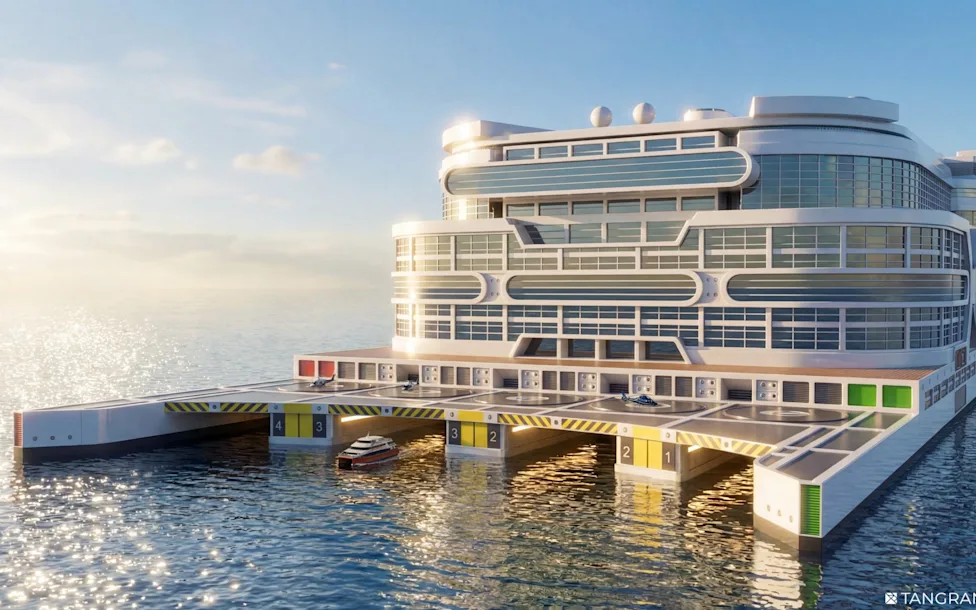
A vision that has drifted through engineering circles for decades is making waves once again. Developers behind the ambitious Freedom Ship project say they are reviving plans to build what could become the world’s first true floating city, a mile-long vessel designed to house up to 80,000 people while continuously traveling around the globe.
If completed, the proposed ship would dwarf every cruise vessel currently in operation and function less like a tourist attraction and more like a permanently inhabited urban center at sea.
Supporters describe it as a self-contained city that happens to float.
Critics, meanwhile, question whether the economics, engineering, and logistics can ever match the scale of the vision.
What is the Freedom Ship?
The Freedom Ship is a proposed floating city designed to remain at sea indefinitely while circumnavigating the world.
Unlike conventional cruise ships that operate on fixed itineraries, the project envisions a permanent residential community complete with homes, schools, businesses, healthcare facilities, entertainment venues, and transportation systems.
According to project backers, the vessel would continuously travel international waters while allowing residents to live, work, study, and retire onboard.
Key proposed specifications
The current concept includes:
- Capacity for approximately 80,000 people
- Housing for roughly 50,000 permanent residents
- Accommodation for 10,000 tourists
- Crew of about 20,000
- Length of approximately one mile
- Nuclear-powered propulsion
- Global circumnavigation every two to three years
If built, it would become one of the largest moving structures ever created.
How large would the floating city be?
The scale of the proposal is difficult to overstate.
For comparison, the world’s largest cruise ships carry fewer than 10,000 people when combining passengers and crew.
Freedom Ship vs. modern cruise ships
The proposed Freedom Ship would accommodate:
- More than 10 times the population of many luxury cruise vessels
- A population comparable to a small city
- Enough residents to rival some American municipalities
For perspective, a capacity of 80,000 people would exceed the population of numerous county seats and suburban communities across the United States.
The project essentially proposes placing a small city onto a floating platform.
What would life on board look like?
Developers argue that daily life aboard the vessel would resemble life in a modern urban community.
The goal is not to create a perpetual vacation environment but a functioning city.
Residential and educational facilities
Plans include:
- Apartments and residences
- Schools
- Colleges
- Libraries
- Healthcare facilities
- Banking services
Residents could theoretically spend years on board without requiring permanent relocation to land.
Entertainment and recreation
The proposed amenities read more like a city development plan than a ship blueprint.
Highlights include:
- A 15,000-seat sports stadium
- A water park
- Museums
- Music venues
- Parks and green spaces
- Convention centers
- Nightclubs
- Restaurants and food halls
Project leaders say the objective is to create an environment that feels familiar rather than futuristic.
A city with its own transportation system
Because of its enormous size, moving around the vessel could become a challenge.
To address that issue, designers have proposed an internal tram or rail network connecting different sections of the ship.
Why transportation matters
At nearly a mile in length, walking from one end of the vessel to the other could take significant time.
An onboard transit system would effectively function like public transportation in a traditional city.
The proposal highlights how the project increasingly resembles urban planning rather than shipbuilding.
Why the ship would stay in international waters
One of the most unusual aspects of the proposal is its operating model.
Developers say the vessel would remain primarily in international waters because its size would make docking at existing ports virtually impossible.
How passengers would reach land
Instead of docking, the floating city would rely on:
- Ferries
- Water taxis
- Support vessels
- Helicopter transport
Current plans include eight helipads positioned on the upper levels of the ship.
Passengers and residents would transfer to smaller vessels whenever they wanted to visit coastal destinations.
The role of nuclear power
The project proposes using nuclear energy to power the floating city.
Supporters argue that nuclear propulsion would provide sufficient energy for a vessel of this scale while reducing dependence on traditional marine fuels.
Why nuclear power is being considered
The floating city would require enormous amounts of energy for:
- Propulsion
- Air conditioning
- Water treatment
- Food storage
- Lighting
- Communications infrastructure
A conventional fuel system would likely face significant operational challenges over long voyages.
However, nuclear-powered civilian vessels remain rare, meaning regulatory approval could become one of the project’s biggest hurdles.
The biggest challenge: funding
While the concept captures imaginations, financing remains the central obstacle.
Developers estimate the project would cost roughly $16 billion.
That figure places it among the most expensive private infrastructure projects ever proposed.
Why investors may hesitate
Potential concerns include:
- Construction risk
- Regulatory approvals
- Environmental reviews
- Insurance requirements
- Long-term operating costs
- Demand uncertainty
Even supporters acknowledge that securing capital will determine whether the project advances beyond the concept stage.
Freedom Cruise Line CEO Roger Gooch has stated that funding remains the critical factor in making the project a reality.
A concept decades in the making
The Freedom Ship idea is not new.
Engineer Norman Nixon first proposed the concept during the 1990s.
Over the years, the project attracted periodic attention but failed to secure sufficient investment to move forward.
Following Nixon’s death in 2012, the concept largely faded from public discussion.
The latest revival represents the most significant push in years to bring the floating city concept back into the spotlight.
Could a floating city actually work?
The answer depends on whom you ask.
From an engineering standpoint, many experts believe large-scale floating structures are technically possible.
Offshore energy platforms, floating airports, and large naval vessels demonstrate that massive marine structures can be built and operated successfully.
The larger question is economic viability.
Questions that remain unanswered
Among the key issues:
- How would governance work?
- What legal jurisdiction would apply?
- How would healthcare systems operate long term?
- Could emergency services function effectively?
- Would enough residents commit to permanent life at sea?
- How would environmental concerns be addressed?
Until those questions are resolved, the Freedom Ship remains more vision than reality.
Why floating cities are attracting renewed interest
Interest in floating urban environments has grown in recent years due to concerns over:
- Urban overcrowding
- Rising sea levels
- Housing shortages
- Sustainable development
- Remote work trends
Some futurists see floating communities as a potential solution to future population pressures.
Others view them as luxury developments for wealthy residents seeking unconventional lifestyles.
The Freedom Ship sits at the intersection of both ideas.
TL;DR
- Developers have revised plans for the Freedom Ship, a proposed floating city capable of carrying 80,000 people.
- The vessel would be approximately one mile long and powered by nuclear energy.
- Plans include homes, schools, parks, a sports stadium, museums, and a public transportation system.
- The ship would remain primarily in international waters and use ferries and helicopters for access to land.
- Construction costs are estimated at roughly $16 billion.
- Funding remains the biggest obstacle to making the project a reality.
- While technically ambitious, significant economic, legal, and regulatory questions remain unresolved.