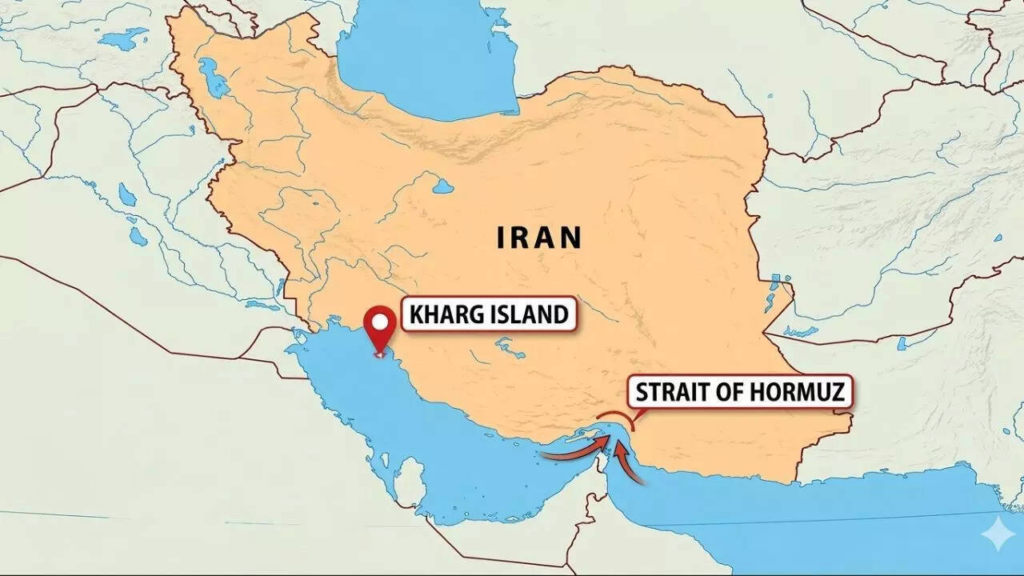
Weeks after large-scale airstrikes, the administration of Donald Trump is weighing a far more consequential step: a potential operation to occupy or blockade Kharg Island.
According to reporting cited by Axios, the goal would be to pressure Iran into reopening the Strait of Hormuz—one of the world’s most critical energy corridors.
If approved, the move would mark a major escalation, potentially placing U.S. troops directly in harm’s way and reshaping the geopolitical balance in the Persian Gulf.
Why Is Kharg Island So Important?
Kharg Island may be small, but its role in Iran’s economy is outsized.
The Backbone of Iran’s Oil Exports
- Handles around 90% of Iran’s crude oil exports
- Serves as the main storage and loading hub for tankers
- Connects inland oil fields to global markets
Oil is transported from Iranian fields to Kharg Island, stored in large tanks, and then shipped via tankers that pass through the Strait of Hormuz toward major buyers—especially in Asia.
Why It’s a Strategic Target
- Economic pressure point: Disrupting Kharg could sharply reduce Iran’s revenue
- Military leverage: Oil income supports key institutions, including security forces
- Negotiation tool: Control over exports could be used as bargaining power
What Would a U.S. Operation Look Like?
While no final decision has been made, officials are reportedly discussing two primary options:
1. Occupation
- Deploy ground forces to seize and hold the island
- Establish control over oil infrastructure
- Use physical presence as leverage in negotiations
2. Blockade
- Surround the island with naval forces
- Prevent oil tankers from loading or departing
- Apply economic pressure without direct occupation
Why It’s Risky
An operation of this scale would:
- Require additional troop deployments (including Marine units already en route)
- Expose U.S. forces to direct Iranian retaliation
- Risk escalation into a broader regional conflict
How Does This Relate to the Strait of Hormuz?
The Strait of Hormuz is the world’s most important oil chokepoint.
Why the Strait Matters
- Roughly 20% of the global oil supply passes through it
- Connects Persian Gulf producers to international markets
- Any disruption sends shockwaves through energy prices
Recent tensions have already driven oil prices upward, highlighting how sensitive global markets are to instability in the region.
The Strategic Logic
The reported U.S. thinking appears to be:
- Pressure Iran economically (via Kharg Island)
- Force reopening of Hormuz
- Restore global energy flow
What Has Happened So Far?
Before considering an operation on Kharg Island, the U.S. had already taken military action.
Recent Developments
- U.S. forces conducted strikes on military installations on Kharg Island
- Targets reportedly included:
- Missile storage facilities
- Naval mine depots
- دفاع-related infrastructure
Importantly, oil export facilities were deliberately avoided, suggesting a calibrated approach aimed at weakening military capacity without triggering an immediate النفط shock.
Why Would the U.S. Escalate Now?
The timing reflects both military and economic calculations.
Key Drivers
- Energy security: Keeping global oil markets stable
- Deterrence: Preventing further disruption in Hormuz
- Negotiation leverage: Forcing Iran to the table
A source cited in the report suggested the U.S. may first seek to further degrade Iran’s military capabilities before attempting any operation on Kharg Island.
What Are the Risks of Targeting Kharg Island?
This is not a low-risk move.
1. Direct Military Escalation
Iran could respond with:
- Missile strikes on U.S. forces or allies
- Attacks on shipping in the Gulf
- Proxy actions across the region
2. Global Oil Shock
Even a limited disruption to Kharg Island could:
- Spike oil prices dramatically
- Disrupt supply chains worldwide
- Trigger economic ripple effects
3. Regional Conflict Spillover
Neighbouring countries and global powers could be drawn in, turning a targeted operation into a broader confrontation.
How Would Global Markets React?
Markets are already sensitive to developments in the region.
Likely Impacts
- Oil prices: Immediate surge due to supply fears
- Shipping costs: Increased insurance and risk premiums
- Investor sentiment: Volatility across energy and equities
Consider adding a chart here tracking oil price movements during past Strait of Hormuz disruptions to provide historical context.
What Are Analysts Watching Next?
Several indicators will signal whether this plan moves forward:
- Additional troop deployments to the region
- Naval positioning near Kharg Island
- Official statements from the White House or Pentagon
- إيران’s military posture around Hormuz
TL;DR
- The U.S. is considering occupying or blockading Kharg Island to pressure Iran.
- Kharg handles about 90% of Iran’s oil exports, making it a critical economic target.
- The move is tied to reopening the Strait of Hormuz.
- It would require more troops and carries high escalation risks.
- Global oil markets could be significantly impacted.