
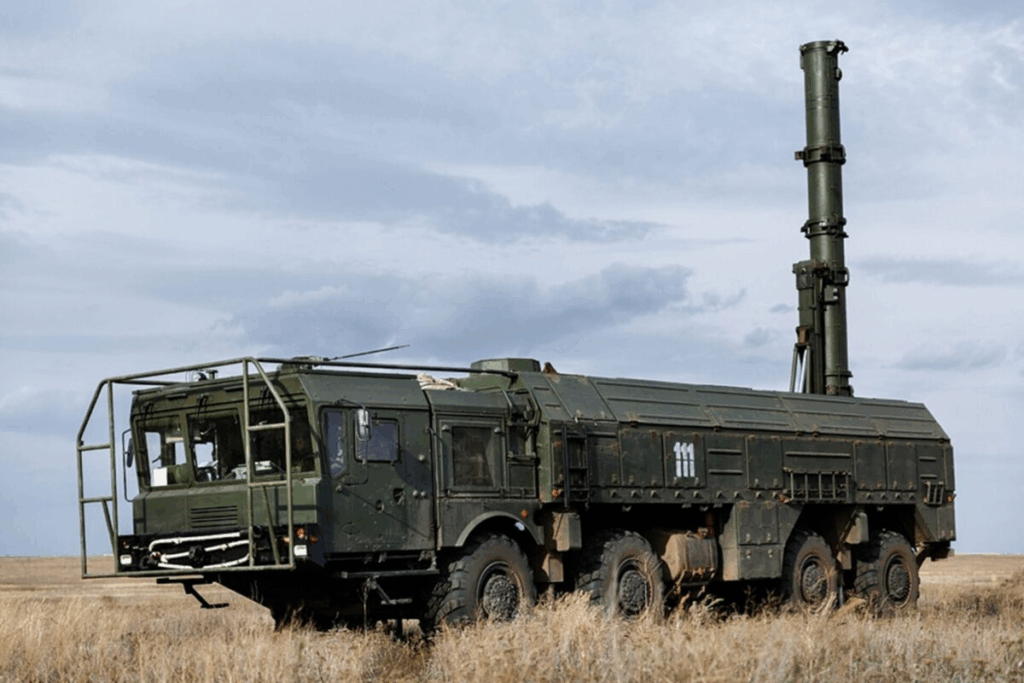
The 9M729 cruise missile, known to NATO as the SSC-8, is back in the headlines after Ukraine accused Russia of using it in the ongoing war. But this isn’t just another missile; it’s the weapon that effectively killed one of the most important arms control treaties of the Cold War era.
Developed secretly and capable of carrying nuclear warheads, the 9M729 has long been viewed by the West as a symbol of Moscow’s disregard for international arms limits. Here’s why this missile is so controversial, and why it matters again now.
What is the 9M729 cruise missile?
The 9M729 is a ground-launched cruise missile built by Russian defense manufacturer NPO Novator, part of the Almaz-Antey conglomerate. It is believed to be a land-based variant of the Russian Navy’s ship-launched 3M-54 Kalibr missile, which has been used extensively in Ukraine since 2022.
While Russia has released little official data, U.S. and NATO sources estimate that:
- Range: Likely between 2,000 and 2,500 kilometers, exceeding the limit set by the 1987 INF Treaty.
- Payload: Capable of carrying both conventional and nuclear warheads.
- Design: Uses a terrain-following flight profile, flying close to the ground to evade radar detection.
- Launch system: Can be fired from mobile ground-based launchers, increasing its survivability and flexibility in combat.
The missile reportedly combines high precision with stealthy flight, allowing it to strike deep into enemy territory with little warning.
Why is the 9M729 so controversial?
The controversy surrounding the 9M729 centers on its range and secrecy, and how both led to the collapse of the Intermediate-Range Nuclear Forces (INF) Treaty.
The INF Treaty, signed in 1987 by the U.S. and the Soviet Union, banned all ground-launched ballistic and cruise missiles with ranges between 500 and 5,500 kilometers.
However, beginning in the mid-2000s, U.S. intelligence agencies accused Russia of secretly developing and testing a new missile that violated the agreement. That missile was the 9M729.
- The U.S. first raised concerns in 2014, stating that Russia had breached the INF by testing the weapon.
- Russia denied the allegations, insisting the missile’s range was under 500 kilometers.
- By 2019, after years of failed diplomatic talks, then-President Donald Trump withdrew the U.S. from the INF Treaty, citing Russia’s repeated violations.
The move effectively ended a decades-long framework that had kept nuclear-tipped intermediate missiles out of Europe, a cornerstone of post-Cold War security.
How does the 9M729 work and why is it dangerous?
Unlike ballistic missiles that travel in a high, arching trajectory, cruise missiles like the 9M729 fly low and steady, hugging the terrain to avoid radar detection.
The 9M729’s terrain-following guidance system allows it to “hide” from radar coverage by flying below radar horizons. Combined with its mobility, it becomes extremely difficult to track or intercept.
At potential ranges exceeding 2,000 km, the missile could hit major European cities if launched from western Russia. Its ability to carry a nuclear payload adds to its strategic risk, especially since the launcher can be moved and hidden easily.
That combination of mobility, stealth, and nuclear capability makes it one of the most destabilizing weapons in modern warfare.
Ukraine’s new claim: Russia using 9M729 against Kyiv
Ukraine’s Foreign Minister Andrii Sybiha recently alleged that Russian forces have deployed the 9M729 in strikes on Ukrainian territory, potentially marking the first confirmed use of the missile in combat.
If verified, this would represent a major escalation, as it would show Russia employing a weapon previously associated with nuclear deterrence in an active conflict.
Kyiv’s claim comes amid heightened tension over long-range warfare. Ukrainian President Volodymyr Zelensky recently denied using U.S.-supplied long-range systems to attack Russian soil, insisting Ukraine’s own domestic missiles have a range of up to 3,000 kilometers.
Russia’s official stance
Moscow continues to deny that the 9M729 violates any treaties or that it has been deployed against Ukraine. The Russian Defense Ministry insists the missile’s range is within INF limits and has accused Washington of fabricating allegations to justify its own weapons programs.
In 2019, Russia even held a rare public briefing showing a 9M729 launcher and components to journalists and diplomats, but provided no verifiable data on its actual range or testing history. Western experts called the display “a staged transparency exercise.”
Why the 9M729 still matters in 2025
Six years after the INF Treaty’s collapse, the 9M729 remains a symbol of strategic distrust between Russia and the West. Its alleged use in Ukraine underscores how the post–Cold War arms control system has eroded and how long-range, nuclear-capable weapons are again shaping European security.
For NATO, the 9M729 represents more than a single missile; it signals a new arms race where verification, transparency, and trust have all but disappeared.
The renewed focus on the 9M729 also pressures the next generation of arms control agreements, if any can still be negotiated, to account for mobile, multi-role, and dual-use systems that blur the lines between conventional and nuclear deterrence.
TL;DR
- 9M729 (SSC-8) is a Russian ground-launched cruise missile, possibly derived from the Kalibr family.
- It can carry nuclear or conventional warheads and may have a range exceeding 2,000 km.
- The missile violated the INF Treaty, prompting the U.S. withdrawal in 2019.
- Ukraine now claims Russia has deployed it in the ongoing war.
- Its use highlights the collapse of arms control norms and rising nuclear risks in Europe.