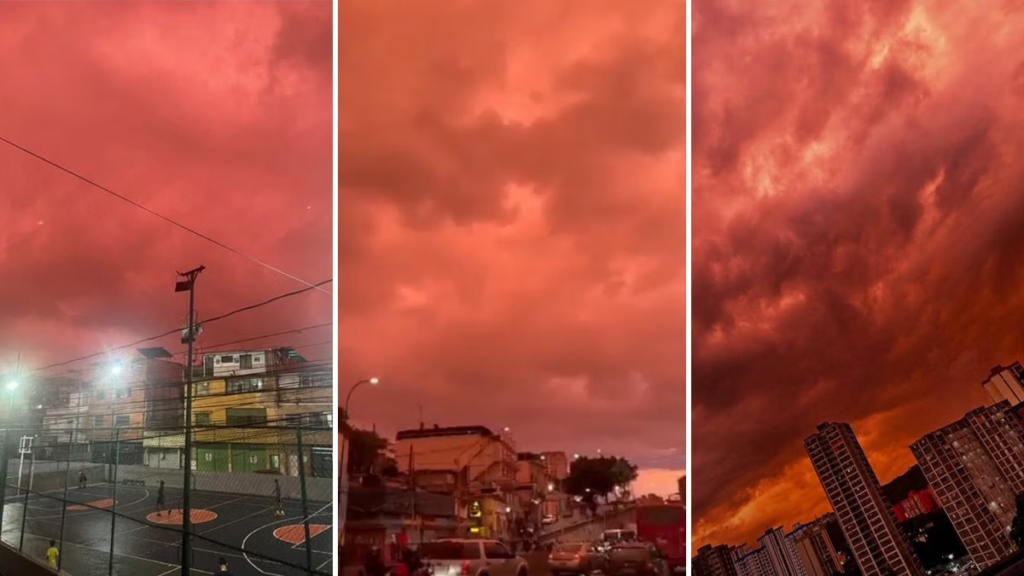
Residents of Caracas, Venezuela, were left stunned on Tuesday evening after the city’s sky turned a striking shade of reddish-orange, with low-hanging clouds adding to the dramatic scene. Videos of the unusual sky quickly spread across social media, prompting speculation that the phenomenon was linked to recent natural disasters or even apocalyptic predictions.
The timing fueled the rumours. Venezuela is still reeling from a series of devastating earthquakes, leading some online users to interpret the crimson sky as a bad omen. But atmospheric scientists say the explanation is far less mysterious.
The spectacular display was caused by a combination of Rayleigh scattering and a massive plume of Saharan dust drifting across the Atlantic—an atmospheric event that occurs regularly, though it can create unusually vivid sunsets under the right conditions.
TL;DR: The red skies over Caracas were not a supernatural sign or earthquake warning. They resulted from Saharan dust filtering sunlight and a natural optical process known as Rayleigh scattering, which allowed red and orange wavelengths to dominate the evening sky.
Why did the sky turn red over Caracas?
The unusual color was produced by two atmospheric phenomena working together:
- Rayleigh scattering, which determines how sunlight is scattered through Earth’s atmosphere.
- A large cloud of Saharan dust is traveling thousands of miles from North Africa to South America.
Together, these conditions filtered sunlight in a way that intensified red and orange hues during sunset, creating the dramatic skies seen across Caracas.
What is Rayleigh scattering?
Rayleigh scattering is the process by which tiny molecules in Earth’s atmosphere scatter sunlight.
Because shorter wavelengths of light—such as blue and violet—scatter much more efficiently than longer wavelengths like red and orange, the sky appears blue during the day.
At sunrise and sunset, however, sunlight travels through a much thicker layer of the atmosphere before reaching our eyes.
During that longer journey:
- Blue light is scattered away.
- Longer red and orange wavelengths continue traveling.
- The sky takes on warm colors ranging from gold to deep crimson.
This phenomenon is responsible for colorful sunsets around the world.
How did Saharan dust make the sunset even redder?
The second ingredient was a large plume of Saharan dust, a seasonal phenomenon in which fine mineral particles from the Sahara Desert are carried across the Atlantic Ocean by strong winds.
By the time the dust reached Venezuela, it acted like a giant natural filter.
Instead of allowing the full spectrum of sunlight to pass through, the suspended dust particles blocked and scattered much of the shorter-wavelength light.
The result was an atmosphere dominated by:
- Deep reds.
- Burnt orange hues.
- Copper-colored skies.
This combination produced the striking “blood-red” sunset that quickly went viral online.
What is the Saharan Air Layer?
The dust originated from the Saharan Air Layer (SAL), a vast mass of hot, dry, dust-laden air that forms over North Africa during the summer.
Each year, millions of tons of Saharan dust cross the Atlantic, affecting weather and air quality in parts of:
- The Caribbean.
- South America.
- Central America.
- The Gulf of Mexico.
- The southeastern United States.
Meteorologists had already forecast that this latest dust plume would continue moving westward, eventually reaching parts of Florida.
Besides producing colorful sunsets, Saharan dust can also:
- Reduce air quality.
- Lower visibility.
- Suppress tropical cyclone development by introducing dry air into the atmosphere.
Why did the red sky spark concern?
The dramatic skies appeared just days after Venezuela experienced devastating earthquakes, leading many people on social media to connect the two events.
Posts described the crimson sky as:
- A sign of impending disaster.
- A spiritual warning.
- An apocalyptic omen.
Others shared biblical interpretations, suggesting the event symbolized divine judgment or further tragedy.
While such reactions are understandable during periods of collective grief, scientists emphasize that there is no evidence linking atmospheric optics to earthquakes or other geological events.
The timing was coincidental rather than causal.
Can red skies predict earthquakes?
No.
There is no scientifically established relationship between red sunsets and seismic activity.
Earthquakes are caused by movements of tectonic plates beneath Earth’s surface, while the color of the sky depends on atmospheric conditions such as:
- Dust.
- Water vapor.
- Clouds.
- Sun angle.
- Air pollution.
The two phenomena operate independently.
Although unusual natural events often invite speculation, atmospheric scientists and geologists agree that a red sky cannot be used to predict earthquakes.
Social media reacted with awe—and skepticism
The striking visuals quickly attracted millions of views online.
Some users described the sky as:
“Beautiful but eerie.”
Others noted that Saharan dust is a well-known atmospheric phenomenon but admitted the timing made the images feel unsettling.
Many users, however, cautioned against drawing supernatural conclusions, pointing out that dramatic sunsets occur regularly when dust or smoke is present in the atmosphere.
The conversation illustrates how extraordinary natural events can rapidly generate misinformation, particularly when they coincide with ongoing crises.
Why Saharan dust matters beyond colorful sunsets
Although the vivid skies captured public attention, Saharan dust has broader environmental impacts.
Positive effects
- Supplies nutrients such as phosphorus to the Amazon rainforest.
- Helps fertilize marine ecosystems.
- Can suppress hurricane formation by introducing dry air into the atmosphere.
Negative effects
- Reduces air quality.
- Triggers respiratory problems for sensitive individuals.
- Lowers visibility.
- Creates hazy skies across affected regions.
Meteorologists routinely monitor Saharan dust plumes because of their influence on weather, aviation, and public health.
The bigger picture
The crimson skies over Caracas offered a dramatic reminder that nature can produce breathtaking spectacles without supernatural explanations. While the timing—coming shortly after destructive earthquakes—led some to interpret the event as a bad omen, atmospheric science provides a clear and well-understood answer.
A combination of Rayleigh scattering and a plume of Saharan dust transformed an ordinary sunset into an extraordinary display of deep reds and oranges. Similar events occur periodically across the Caribbean and the Americas whenever Saharan dust crosses the Atlantic under favorable atmospheric conditions.
For many residents, the sunset was both beautiful and unsettling. But rather than signalling another disaster, it served as a striking example of how Earth’s atmosphere can create scenes that seem almost otherworldly.