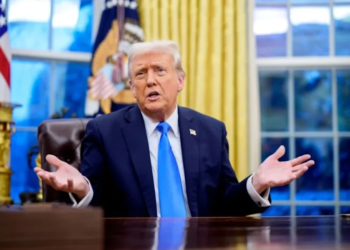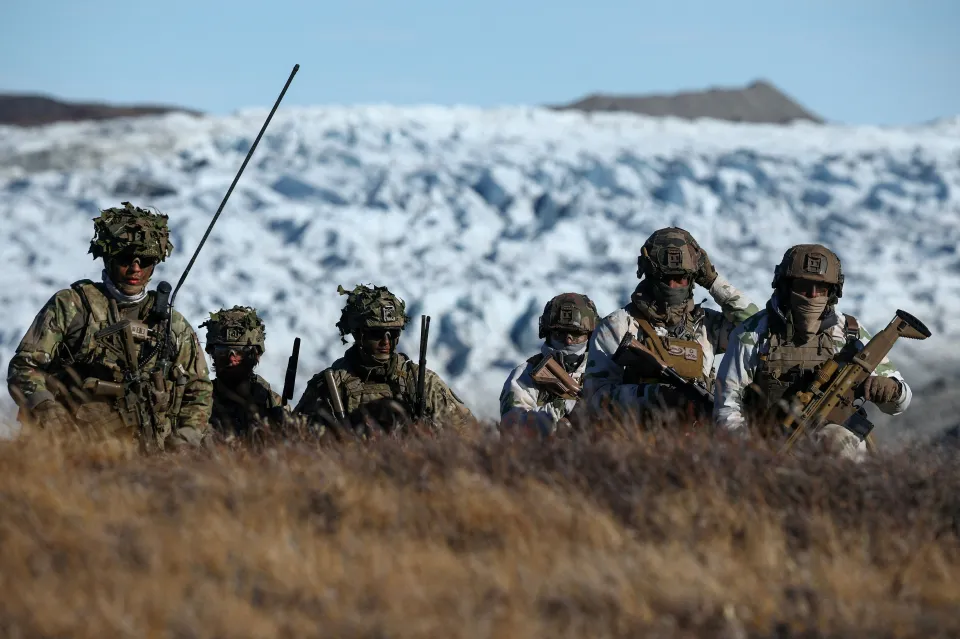
A little-known Cold War–era military rule in Denmark has resurfaced after US President Donald Trump once again floated the idea of taking control of Greenland — even suggesting force could be an option. The rule, dating back to 1952, authorizes Danish soldiers to immediately engage any invading force without waiting for political or military approval.
As Trump renews his push to acquire the Arctic territory for “national security” reasons, the revelation adds a sharp legal and military edge to what had previously been treated as an unconventional diplomatic idea.
What is the 1952 Danish military order?
At the center of the debate is a standing order issued in 1952, at the height of Cold War tensions in Europe. The directive instructs Danish forces to respond instantly to an invasion.
The rule states that if Denmark or its territories are attacked, soldiers must engage the enemy immediately, even if:
- No formal declaration of war has been made
- Commanders have not received confirmation from political leadership
- Higher authorities are unaware that hostilities have begun
In simple terms, it is a “no-wait, no-questions” defense order designed to prevent paralysis during surprise attacks.
The Danish defense ministry confirmed this week that the order remains active and legally valid.
Does the rule apply to Greenland?
Yes. Greenland, while self-governing, remains part of the Kingdom of Denmark. Danish defense responsibilities extend to the island, including its airspace, coastline, and military installations.
That means the 1952 order applies fully to Greenland. Any foreign military force attempting to seize territory there would, under Danish law, be treated as an invading army and met with immediate armed resistance.
This is significant because Greenland’s vast size, sparse population, and strategic Arctic location often lead to the false assumption that it is lightly defended or politically ambiguous. Legally, it is neither.
Why has this rule resurfaced now?
The decades-old order returned to public discussion after Donald Trump revived his long-standing interest in Greenland.
Trump has argued that the United States needs Greenland to counter growing Russian and Chinese influence in the Arctic. He has repeated claims that control of the island is essential for American national security and global stability.
While the idea of purchasing Greenland was first raised during Trump’s earlier presidency, recent statements from his administration suggest the proposal is once again under active review.
White House Press Secretary Karoline Leavitt confirmed that buying Greenland is being discussed internally, while also declining to rule out the use of force.
“All options are always on the table,” she said, while emphasizing that diplomacy remains the administration’s preferred approach.
Is a US military move even realistic?
From a legal and diplomatic standpoint, a US invasion of Greenland would be extraordinary.
Greenland is protected not only by Denmark but also by NATO’s collective defense framework. Denmark is a NATO member, meaning an armed attack on its territory could trigger broader alliance involvement.
However, Trump’s rhetoric has unsettled European leaders, particularly because it blurs the line between strategic pressure and outright threat.
Key obstacles to a military takeover include:
- NATO obligations and alliance unity
- International law prohibiting territorial acquisition by force
- The presence of Danish forces already authorized to respond immediately
Even without escalation, the mere discussion of force has pushed European governments to publicly reaffirm their position.
How has Europe responded?
European leaders moved quickly to shut down any ambiguity around Greenland’s status.
On January 6, leaders from seven European countries, the UK, France, Germany, Italy, Poland, Spain, and Denmark, issued a joint statement pledging to defend Greenland’s territorial integrity.
The statement made clear that Greenland is not open for negotiation under threat and that Europe would not step aside if its sovereignty were challenged.
This united front appeared to anger Trump, who responded on Truth Social by criticizing NATO allies and repeating long-standing grievances about defense spending.
He again claimed that the US had been unfairly subsidizing European security and credited himself with forcing allies to raise military budgets.
Why Greenland matters so much strategically
The renewed focus on Greenland is not accidental. The island sits at the center of several high-stakes geopolitical trends.
Arctic militarization
As Arctic ice melts, new shipping routes and resource access are opening. Russia has expanded its Arctic military footprint, and China has declared itself a “near-Arctic state,” investing heavily in polar research and infrastructure.
Missile defense and early warning
Greenland hosts critical US military infrastructure, including the Pituffik Space Base (formerly Thule Air Base), which plays a role in missile detection and space surveillance.
Natural resources
Greenland holds reserves of rare earth minerals, uranium, and other resources vital for modern technologies and defense systems.
These factors explain Washington’s interest, but they do not override Greenland’s political and legal status.
What does Greenland itself want?
Greenland’s leaders have consistently rejected the idea of being sold or forcibly transferred.
The island has been steadily expanding its self-rule and has a strong independence movement, but independence does not mean joining another country by coercion.
Greenlandic officials have emphasized that decisions about the island’s future must involve its people, not be imposed by external powers, even allies.
Ignoring that reality risks inflaming not just Denmark but Greenlanders themselves.
Why the 1952 rule still matters today
The Danish “shoot first” order may sound extreme, but it reflects a broader principle in modern defense planning: deterrence through clarity.
By making it clear that any invasion would meet instant resistance, Denmark reduces the risk of miscalculation. There is no gray zone, no waiting period, and no assumption that hesitation might buy time for diplomacy.
In the context of Trump’s statements, the rule serves as a reminder that military power does not exist in a vacuum. Laws, alliances, and automatic defense mechanisms still apply, even to superpowers.
What happens next?
There is no indication that the US is preparing any immediate military action. Diplomacy remains the dominant channel, and public statements often serve domestic political goals as much as foreign policy ones.
Still, the episode highlights how quickly rhetoric can revive old laws, expose alliance fault lines, and sharpen global tensions.
For now, Greenland remains Danish territory, protected by law, alliance commitments, and a rule written more than 70 years ago, one that still carries weight in 2026.
TL;DR
- Denmark has a 1952 military order requiring soldiers to immediately attack invading forces.
- The rule applies to Greenland and remains legally valid.
- It resurfaced after Donald Trump renewed talk of acquiring Greenland, including by force.
- European leaders have pledged to defend Greenland’s territorial integrity.
- The episode underscores rising Arctic tensions and the limits of military rhetoric.