

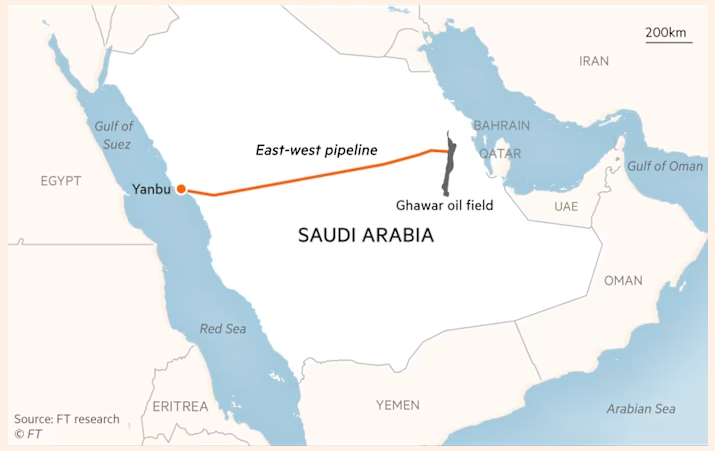
The closure of the Strait of Hormuz has pushed global energy markets into crisis mode. As tensions rise in the Gulf amid the ongoing Iran war, Saudi Arabia has turned to an alternative export route through the Red Sea.
The kingdom is rerouting crude oil via its East-West Pipeline to the port city of Yanbu, attempting to bypass the blocked maritime chokepoint.
But while the move offers a temporary workaround, energy analysts say the Red Sea route cannot replace the massive volume of oil that normally flows through the Strait of Hormuz. The result is a tightening global supply chain, rising shipping costs, and growing concern among Asian economies that depend heavily on Gulf crude.
Why the Strait of Hormuz is critical to global oil supply
The Strait of Hormuz is widely considered the most important oil transit chokepoint in the world.
The narrow waterway connects the Persian Gulf with the Gulf of Oman, allowing oil tankers from Gulf producers to reach global markets.
Before the latest escalation, millions of barrels of crude oil moved through this passage every day.
Why energy markets watch Hormuz closely
Several of the world’s largest oil producers rely on the strait for exports, including:
- Saudi Arabia
- Iraq
- Kuwait
- United Arab Emirates
Saudi Arabia alone exported about 7.2 million barrels of crude per day through its Gulf terminals before the crisis.
These shipments typically depart from large facilities such as:
- Ras Tanura Refinery
- Juaymah Oil Terminal
Both terminals are optimized for ultra-large crude carriers that transport oil directly to major Asian markets.
What is Saudi Arabia’s alternative export route?
To bypass the blockade, Saudi Arabia has activated its backup strategy: the East-West Pipeline.
This pipeline stretches roughly 1,200 kilometers across the Arabian Peninsula, linking oil fields in eastern Saudi Arabia to Yanbu on the Red Sea coast.
Instead of shipping crude through the Persian Gulf, the oil is transported overland and loaded onto tankers departing from the Red Sea.
Why the pipeline exists
The East-West Pipeline was originally designed as a contingency route in case the Strait of Hormuz became inaccessible during regional conflict.
It allows Saudi Arabia to:
- Move crude oil across the kingdom
- Avoid vulnerable maritime chokepoints
- Maintain exports during crises
However, the system was never designed to fully replace Gulf export capacity.
The biggest problem: limited capacity
The most immediate issue with the Yanbu alternative is simple arithmetic.
The East-West Pipeline has a theoretical capacity of about 5 million barrels per day.
But Saudi Arabia was exporting around 7.2 million barrels per day through Gulf terminals before the crisis.
This means even at full capacity, the pipeline cannot handle all the oil that normally passes through the Strait of Hormuz.
Why the Yanbu port creates another bottleneck
The port infrastructure at Yanbu also limits how quickly crude can be loaded onto tankers.
Challenges include:
- Lower loading capacity than Gulf terminals
- Fewer berths for large crude carriers
- Storage limitations for surge volumes
Even if the pipeline delivers oil efficiently, the port cannot process and ship it at the same scale as Saudi Arabia’s Persian Gulf terminals.
Longer shipping routes to Asia raise costs
Another major drawback of the Red Sea route is geography.
Tankers departing from the Persian Gulf have a relatively direct route to Asian markets.
Ships leaving Yanbu must travel a much longer path.
Additional distance for Asian shipments
To reach major Asian customers such as:
- China
- Japan
- South Korea
Tankers must pass through the Bab el-Mandeb Strait, enter the Indian Ocean, and travel thousands of additional nautical miles.
This longer route creates:
- Higher shipping costs
- Longer delivery times
- Increased tanker demand
All of these factors push oil prices higher.
How the supply disruption is affecting global markets
The ripple effects of the Hormuz closure are already spreading through global energy markets.
Several countries that rely heavily on Gulf oil have begun taking emergency steps.
Early signs of market disruption
Reports indicate:
- Sinopec has reduced refining activity by roughly 10 percent.
- Japan has started tapping its strategic petroleum reserves.
- European refiners are reporting reduced supply volumes.
Because global oil supply chains operate with limited spare capacity, even partial disruptions can trigger large price swings.
The geopolitical dimension: uncertainty over US policy
The crisis has also raised questions about long-term security arrangements in the Gulf.
Donald Trump has recently suggested that regional allies may need to take greater responsibility for protecting shipping routes.
In remarks about the region’s security dynamics, he emphasized that the United States has achieved energy independence and may not need to maintain the same level of military involvement in Gulf waters.
Such statements have added another layer of uncertainty to a region already dealing with rising military tensions.
Why Yanbu is only a temporary safety valve
The shift to Yanbu demonstrates that Saudi Arabia does have a backup plan for exporting oil.
But experts say the Red Sea route cannot fully compensate for the closure of the Strait of Hormuz.
The limitations are structural:
- Pipeline capacity is smaller than Gulf export volumes.
- Port infrastructure cannot handle the same scale of tanker traffic.
- Shipping routes to Asia are longer and more expensive.
As long as the Strait of Hormuz remains contested, global energy markets are likely to face continued volatility and supply shortages.
TL;DR
- The closure of the Strait of Hormuz has disrupted global oil supplies.
- Saudi Arabia is rerouting crude through the East-West Pipeline to Yanbu.
- The pipeline can move about 5 million barrels per day, less than the 7.2 million barrels normally exported through Gulf terminals.
- Longer shipping routes and limited port capacity are creating bottlenecks.
- The situation is tightening global oil supply and increasing market volatility.


