
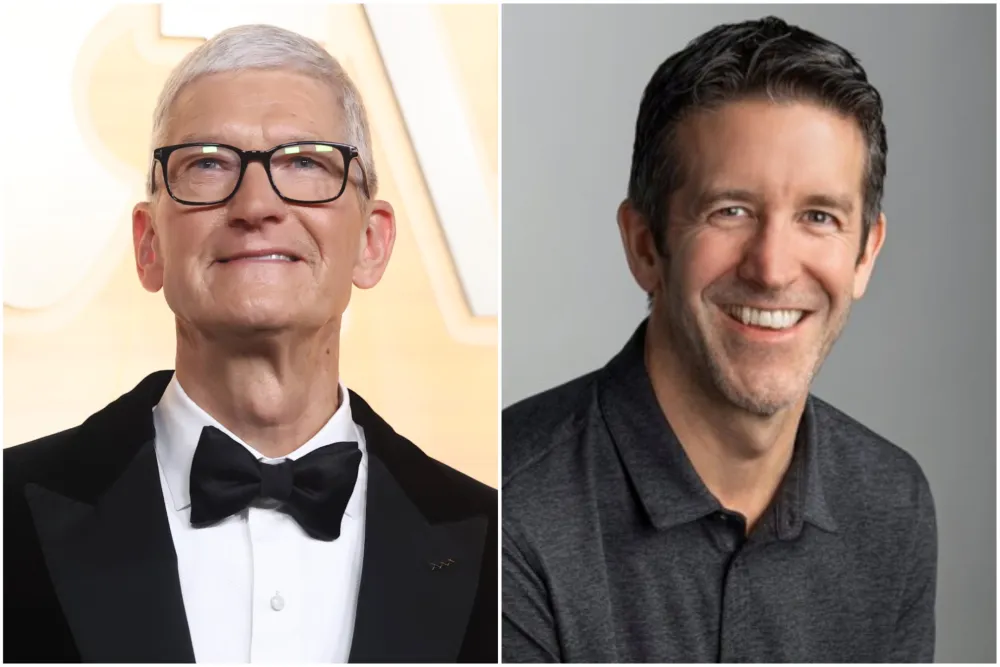
A major leadership shift is underway at Apple. John Ternus has been named CEO, succeeding Tim Cook and marking the beginning of a new chapter for one of the world’s most influential tech companies.
Ternus is not an outsider brought in to shake things up. He is a longtime insider, a product engineer who helped shape many of Apple’s most important devices. His appointment signals continuity, but also a subtle shift toward a more engineering-driven leadership style.
Who is John Ternus?
John Ternus is a senior Apple executive who has spent more than two decades inside the company, rising through the ranks of hardware engineering.
He is best known for leading teams responsible for Apple’s core product lineup, including the iPhone, iPad, and Mac. Within Apple, he built a reputation as a hands-on leader, someone who stays close to the product rather than operating purely at a strategic distance.
Education and early career
Ternus holds a degree in mechanical engineering, a foundation that shaped his technical approach to product design.
He joined Apple in the early 2000s, a period when the company was still rebuilding its identity. Over time, he worked on multiple hardware programs, gradually moving into leadership roles.
His early work focused on product engineering, laying the groundwork for his eventual rise to one of the most influential positions inside the company.
How did John Ternus rise inside Apple?
Ternus’ career at Apple reflects a pattern the company values: long-term internal growth.
Climbing through engineering leadership
Over the years, he took on increasing responsibility across product lines. His ability to manage large engineering teams and deliver flagship devices earned him recognition at the highest levels.
He eventually became senior vice president of hardware engineering, one of the most critical roles at Apple.
Key contributions
Ternus played a role in shaping several of Apple’s defining products:
• iPhone hardware evolution
• iPad design and performance improvements
• Mac transition toward Apple-designed silicon
His involvement in Apple’s custom silicon strategy is particularly notable, as it has become central to the company’s competitive advantage.
Why did Apple choose John Ternus as CEO?
Apple’s decision reflects its long-standing preference for internal succession.
Continuity over disruption
Unlike many tech companies that bring in external leaders during transitions, Apple tends to promote from within. This ensures cultural consistency and strategic alignment.
Ternus understands Apple’s design philosophy, supply chain complexity, and ecosystem strategy from the inside.
Engineering-first leadership
With Ternus, Apple appears to be leaning more heavily into its hardware roots.
His background suggests a stronger emphasis on:
• Product innovation
• Hardware-software integration
• Performance-driven design
This could shape how Apple approaches emerging technologies like AI-enabled devices and next-generation chips.
What defined Tim Cook’s era?
To understand what comes next, it helps to look at what Tim Cook leaves behind.
Expansion beyond hardware
Under Cook, Apple evolved from a product-centric company into a broader ecosystem player.
Key developments included:
• Growth of services like iCloud and Apple Music
• Expansion into wearables such as Apple Watch and AirPods
• Strengthening of global supply chains
Financial growth
Apple became one of the most valuable companies in the world during Cook’s tenure, with consistent revenue growth and market dominance.
Operational excellence
Cook, known for his operations expertise, optimized Apple’s manufacturing and logistics at a global scale.
What changes under John Ternus?
While Apple is unlikely to make abrupt shifts, subtle changes in emphasis are expected.
A stronger focus on hardware innovation
Ternus’ engineering background could accelerate advancements in:
• Custom silicon chips
• Device performance and efficiency
• New product categories
Deeper ecosystem integration
Apple’s ecosystem strategy is expected to continue, but with tighter integration between hardware and software experiences.
AI and next-generation devices
Industry watchers expect Apple to push further into AI-driven features embedded directly into devices, rather than relying heavily on cloud-based solutions.
What challenges will Ternus face?
Taking over Apple is not just about maintaining success. It is about navigating a complex and evolving tech landscape.
Market expectations
Apple is expected to deliver consistent innovation while maintaining high margins, a difficult balance.
Competition
Rivals in smartphones, AI, and computing are moving aggressively, increasing pressure on Apple to stay ahead.
Regulatory scrutiny
Global regulators are increasingly focused on big tech companies, particularly around app stores, privacy, and competition.
Innovation pressure
With mature product lines, Apple must find the next breakthrough category to sustain long-term growth.
What does this leadership change mean for Apple’s future?
The transition from Tim Cook to John Ternus represents evolution rather than disruption.
Apple is not changing direction. It is refining its trajectory.
The company appears to be doubling down on what it does best:
• Building tightly integrated hardware and software
• Controlling key technologies like chips
• Delivering premium user experiences
With Ternus at the helm, Apple’s future may look more like a laboratory of precision engineering than a services-first expansion story.
TL;DR
John Ternus is Apple’s new CEO, succeeding Tim Cook
He spent over two decades leading hardware engineering at Apple
His appointment signals continuity with a stronger engineering focus
Apple is expected to double down on hardware, silicon, and AI integration
The transition reflects evolution, not a major strategic shift