
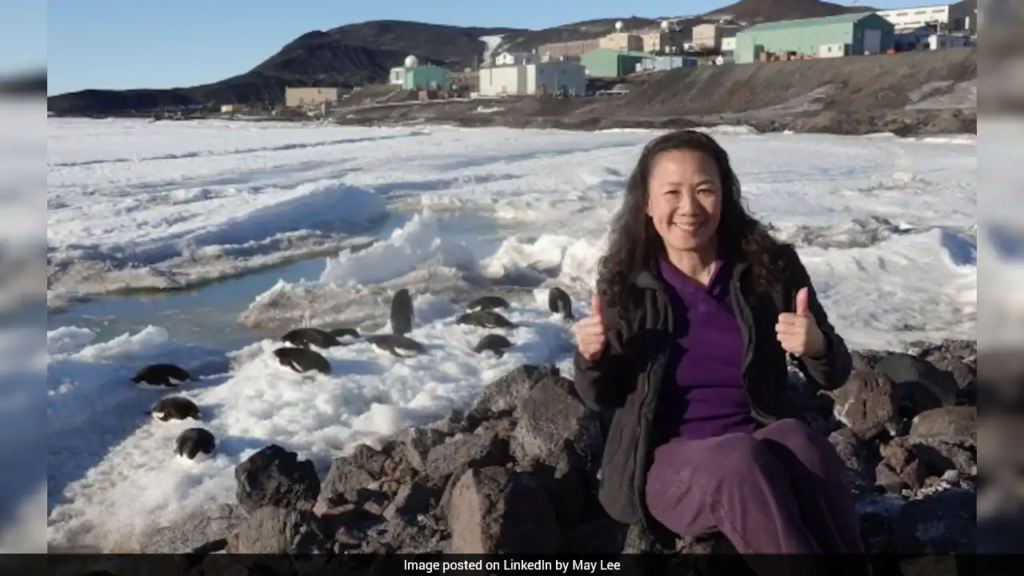
After spending more than three decades at Hewlett-Packard, May Lee thought she knew how her working life would end.
She joined HP in 1987 as a software engineering intern and had expected to stay with the company until retirement. Instead, a layoff pushed the 59-year-old into an unexpected career change, one that eventually took her thousands of miles from Silicon Valley to one of the most remote workplaces on Earth.
Today, Lee says losing her longtime job opened the door to an experience she never would have planned for herself: working in Antarctica.
Her story, told in a recent Business Insider as-told-to essay, is less about leaving corporate America than about what can happen when a career built around stability suddenly disappears.
Why did May Lee leave HP after 30 years?
Lee began her career at Hewlett-Packard in 1987 and spent more than 30 years with the company.
She had deliberately chosen stability over frequent career moves. In her account, she said she wanted to commit to a company she knew and expected that the company would remain loyal to her as well.
That plan changed when she was laid off during a round of downsizing.
There had been warning signs. Lee recalled a hiring freeze and a temporary reduction in her working hours, but she said the eventual layoff still came as a shock. She had expected to remain at HP for several more years.
The emotional impact was significant.
After devoting most of her professional life to one company, Lee suddenly had to figure out what came next.
“I felt a combination of disappointment and sadness.”
The attached source says Lee immediately began searching for another job, applying to technology companies and drawing on professional contacts and referrals, but she struggled to secure an offer.
What changed after Lee struggled to find another technology job?
About a month after the layoff, Lee was still searching.
Then a friend gave her advice that changed the direction of her job hunt.
Lee had already paid off her house and had built enough financial security that she did not necessarily need to pursue another highly paid technology position. Her friend encouraged her to consider work connected to interests she genuinely enjoyed rather than simply trying to recreate her old career.
That conversation made Lee reconsider Antarctica.
She had already visited the continent twice as a tourist and had developed a strong attachment to the place. She had never considered it as a workplace, however, until she began researching whether jobs were available there.
They were.
The opportunity required a lengthy application process, background checks and physical qualification. Lee eventually secured a seasonal position as a supply technician with Amentum.
The job came with a major financial trade-off.
It paid considerably less than her technology career, but Lee was in a position to accept the lower income because she no longer had a mortgage and had established a financial cushion.
What was Lee’s job in Antarctica?
Getting to Antarctica was an adventure before the job even began.
In 2025, Lee travelled through Auckland and Christchurch before boarding a U.S. Air Force C-17 Globemaster III military transport aircraft bound for Antarctica. Her destination was McMurdo Station, the largest research station in Antarctica.
Her work was dramatically different from the desk-based technology career she had known for decades.
Lee worked as a supply technician and was responsible for an IT and communications warehouse. Her duties included:
- Operating a forklift.
- Moving incoming cargo.
- Checking deliveries.
- Matching orders against database records.
- Handling supplies and equipment.
- Performing physical work outdoors.
The schedule was demanding. Workers at McMurdo typically worked six days a week, with shifts running roughly from 7:30 a.m. to 5:30 p.m. according to Lee’s account.
For someone who had spent much of her professional life behind a desk, the physical nature of the work represented a major change.
But the biggest surprise was not the workload.
It was the community.
Why did Lee compare McMurdo Station to a college town?
Despite the extreme environment, Lee found McMurdo surprisingly social.
Limited internet access meant people spent considerably less time on their phones. Instead, workers gathered during meals and spent time together in person.
Lee described the experience as being similar to living in a small college town.
The station also offered an unexpectedly broad range of activities.
Workers could participate in:
- Art shows.
- Line dancing.
- Marathons.
- Weekly bingo.
- Music and other social events.
Lee even volunteered as a DJ and hosted a weekly 1980s-themed music show called “Ms. Purple!!’s 80’s on the 8.”
For someone arriving after an unexpected corporate layoff, the social environment became an important part of the experience.
How did Antarctica change Lee’s plans?
Lee initially viewed the Antarctic position as an unusual opportunity.
Within about a week, however, she says she knew she wanted to return.
The experience had given her something that was difficult to find during her job search: a completely different way of working and living.
Instead of spending her days in a conventional corporate environment, she was working alongside a close-knit group of people in an isolated research community.
The attached source describes how quickly Lee became attached to the community and its atmosphere.
Her conclusion was straightforward: her life had not turned out the way she expected when she started her career, but that did not necessarily make the outcome worse.
What is Lee doing next?
Lee is not treating Antarctica as a one-time detour.
She plans to return to McMurdo Station for another seasonal position, this time working as a broadcast engineer. Business Insider reported that her next role will involve helping operate McMurdo’s television and radio services.
That means the career she once imagined ending at HP has taken a completely different direction.
Her transition also highlights an unusual feature of Antarctic employment: many positions supporting research stations are seasonal, meaning workers can spend part of the year in Antarctica rather than permanently relocating there.
For Lee, that structure has created an opportunity to continue working while pursuing an environment she had already come to love as a traveler.
What does Lee’s story say about career reinvention?
Lee’s experience does not suggest that every worker facing a layoff should abandon their industry or move to Antarctica.
Her circumstances were unusually specific. She had substantial experience, had already paid off her home and had enough savings to accept a much lower salary. The attached source specifically identifies her financial foundation as an important factor in making the transition possible.
But her story does illustrate a broader point about career transitions.
A job loss can remove a person’s expected path without removing the possibility of another one.
For Lee, the crucial change was not simply finding another employer. It was changing the question from “What technology job can I get next?” to “What kind of work would I actually like to do?”
That shift led her somewhere she had never expected to work.
From Silicon Valley to the bottom of the world
Lee began her professional life expecting decades of continuity at one company.
Instead, after more than 30 years at HP, a layoff forced her to reconsider what she wanted from work.
The answer turned out to be far removed from the corporate technology world.
In Antarctica, she found physically demanding work, limited connectivity, unusual living conditions and a community that she says made her want to return.
Her next role will take her back to the same frozen continent, this time with a different job.
Lee’s experience is ultimately a reminder that a career does not always follow the plan made at its beginning. Sometimes an unexpected ending creates an opportunity to build something that could not have been imagined at the start.
As Lee put it, “You can always reinvent yourself.”
TL;DR
- May Lee joined Hewlett-Packard in 1987 as a software engineering intern.
- She spent more than 30 years with the company before being laid off.
- At 59, she struggled to find another technology job despite her experience and professional network.
- After encouragement from a friend, she explored an interest in Antarctica.
- She secured a seasonal supply technician position with Amentum at McMurdo Station.
- Her job involved warehouse logistics, cargo handling and physical work.
- She found the station’s close-knit community particularly appealing.
- She plans to return to Antarctica as a broadcast engineer.
- Her experience has led her to embrace career reinvention rather than returning to the corporate path she originally envisioned.