
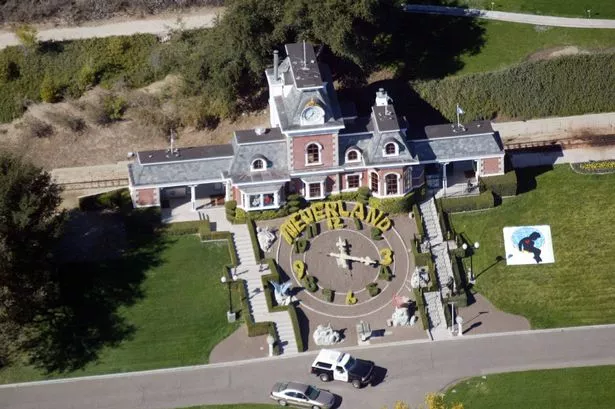
Neverland Ranch, the once-iconic home of pop legend Michael Jackson, has reopened its gates—not to visitors, but for the high-budget biopic “Michael,” chronicling the singer’s life. The filming has reignited interest in the storied estate, now known as Sycamore Valley Ranch, as well as renewed debate over Jackson’s legacy.
Neverland transformed for the big screen
Nestled in the rolling hills just 40 minutes northwest of Santa Barbara, Neverland remains a landmark deeply tied to Jackson’s memory. Visitors still leave chalk-written messages of devotion on its outer walls, one reading, “You are not alone,” while a heart-shaped balloon from Valentine’s Day flutters in the breeze—a testament to the unwavering loyalty of his global fanbase.
Once a place of childhood wonder, complete with a Ferris wheel, merry-go-round, and circus tent, the ranch was abandoned in 2005 following Jackson’s highly publicized child sex abuse trial, which accused him of molesting children there. Though he was acquitted, the allegations cast a permanent shadow over the estate.
Left to deteriorate for years, the property was eventually purchased at a steep discount—$13 million—by a billionaire close to the Jackson family. Today, it remains heavily secured, with round-the-clock surveillance and drone patrols monitoring the sprawling 2,700-acre grounds.
For the past year, Neverland has been brought back to life—at least for the cameras. The biopic’s production team restored and enhanced the estate’s amusement park elements, bringing in extras to play balloon vendors, ride operators, and food stall workers.
Jaafar Jackson, Michael’s nephew, steps into the lead role, while Colman Domingo portrays Jackson’s father, Joe, and Miles Teller plays his longtime manager, John Branca. Reflecting on the experience, Teller remarked, “We filmed at Neverland, it was wild…we dressed it up.”
Criticism and controversy surrounding the film
While fans celebrate the return of Neverland to the spotlight, critics argue that filming at the estate is an attempt to sanitize Jackson’s story. Among the most vocal is Dan Reed, director of the 2019 documentary Leaving Neverland,” which featured allegations from two men, Wade Robson and James Safechuck, who claim they were abused by Jackson as children. “It’s a return to the scene of the crime in order to whitewash and rewrite history,” Reed told The Mirror.
Reed claims to have read the script for Michael, which is produced by Branca, who also serves as a co-executor of Jackson’s estate. He describes the film as a sympathetic retelling of Jackson’s life, designed to counter the abuse allegations that have followed the singer’s legacy. “The estate has envisioned the biopic as a sort of grand rebuttal to all of their allegations of child sexual abuse,” Reed asserts.
Reportedly, the script originally included scenes depicting Jackson facing accusations from 13-year-old Jordan Chandler, the first child to publicly allege abuse. However, those scenes were later removed due to an agreement with the estate not to depict the Chandler family.
Attorney John C. Carpenter, who represents Robson and Safechuck, echoed similar concerns. “I haven’t read the script, but I’ve heard that this is a piece of propaganda,” he told The Mirror. “It’s not unexpected that the estate is trying to massage the reputation of Michael Jackson in a way that maximizes profits for the estate,” he added.
A film set for debate
As Michael moves closer to its release, the controversy surrounding the film—and the decision to shoot at Neverland—only intensifies. For some, the film is a long-overdue tribute to a musical icon. For others, it represents an attempt to reshape history. Regardless of the perspective, one thing is certain: Neverland, even years after Jackson’s death, remains as polarizing as ever.