
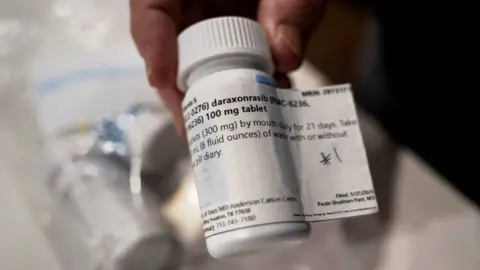
A new experimental pill is generating unprecedented optimism among cancer researchers after a major clinical trial found it nearly doubled survival time for patients with advanced pancreatic cancer, one of the deadliest forms of the disease. The drug, called daraxonrasib, targets a cancer-driving protein that has long been considered one of oncology’s most elusive targets. Researchers say the findings represent one of the most important breakthroughs in pancreatic cancer treatment in decades.
Presented at the annual meeting of the American Society of Clinical Oncology (ASCO) in Chicago, the study’s results have prompted some experts to describe the treatment as a “game-changer” and even a “grand slam” for cancer research.
Why pancreatic cancer is one of the deadliest cancers
Pancreatic cancer remains among the most difficult cancers to treat successfully.
One reason is that symptoms often do not appear until the disease has reached an advanced stage. By the time many patients receive a diagnosis, the cancer has already spread to other organs.
Challenges include:
- Late diagnosis
- Aggressive tumor growth
- Limited treatment options
- High rates of treatment resistance
- Historically low survival rates
The most common form of the disease, metastatic pancreatic ductal adenocarcinoma (mPDAC), is particularly difficult to treat and accounts for the majority of pancreatic cancer deaths.
For decades, progress has been slow, making any substantial improvement in survival a significant milestone.
What did the Daraxonrasib trial find?
The clinical trial involved approximately 500 patients with advanced pancreatic cancer that had already spread beyond the pancreas.
Researchers compared the experimental drug with standard chemotherapy treatments.
The results were striking.
According to the study:
- Patients receiving daraxonrasib survived an average of 13.2 months.
- Patients receiving chemotherapy survived approximately 6.6 to 6.7 months.
- The drug was associated with fewer side effects than traditional chemotherapy.
For patients facing a disease where treatment gains are often measured in weeks rather than months, the difference represents a major advance.
Dr. Rachna Shroff, chief of oncology at the University of Arizona Cancer Center and an ASCO gastrointestinal cancer expert who was not involved in the research, described the findings as “landscape-changing.”
She added that the results represent levels of survival rarely seen in advanced pancreatic cancer studies.
How does Daraxonrasib work?
The drug targets KRAS, one of the most important proteins involved in cancer development.
For years, KRAS was considered one of medicine’s most difficult cancer targets, earning a reputation among researchers as a nearly “undruggable” protein.
What is KRAS?
KRAS acts as a molecular switch that helps regulate cell growth.
In healthy cells, the switch turns on and off when needed.
In many cancers, mutations cause KRAS to become permanently activated, continuously sending signals that instruct cells to grow and divide.
This can lead to uncontrolled tumor growth.
In pancreatic cancer, KRAS mutations are extraordinarily common.
More than 90% of patients with metastatic pancreatic ductal adenocarcinoma carry a mutation known as a RAS G12 variant.
These mutations help fuel the growth and spread of cancer cells.
Why researchers are calling this a breakthrough
Previous drugs targeting KRAS often focused on a single mutation type.
Daraxonrasib takes a broader approach.
The treatment belongs to a new category known as RAS(On) multiselective inhibitors.
Unlike earlier therapies, it can inhibit KRAS activity across multiple mutation variants.
This broader activity could potentially make the drug useful for a larger group of pancreatic cancer patients.
The “holy grail” of pancreatic cancer research
For decades, researchers have sought effective ways to shut down KRAS signaling.
Many scientists viewed success in this area as one of oncology’s greatest challenges.
According to Dr. Shroff, targeting KRAS has long represented the “holy grail” of pancreatic cancer treatment because the mutation appears so early in disease development and is present in the overwhelming majority of patients.
The trial provides some of the strongest evidence yet that directly targeting KRAS can improve survival outcomes in pancreatic cancer.
Why experts are so excited
Cancer researchers are often cautious when discussing new treatments.
That is partly why the reaction to Daraxonrasib has attracted attention.
Dr. Julie Gralow, chief medical officer and executive vice president of ASCO, described the findings as a “game-changer.”
She reportedly went even further, saying that while some have called the study a home run, she would characterize it as a “grand slam.”
Such language is unusual in oncology, where many promising therapies fail to deliver meaningful benefits in later-stage trials.
The enthusiasm reflects both the magnitude of the survival improvement and the historical difficulty of treating pancreatic cancer.
What this means for patients
The findings offer hope for patients and families confronting one of the most challenging cancer diagnoses.
According to Paula Hanford, chief executive of Pancreatic Cancer Action in the United Kingdom, the results represent one of the most significant treatment advances the field has seen.
If future studies confirm the benefits and regulatory approvals follow, daraxonrasib could eventually become part of the standard treatment approach for advanced pancreatic cancer.
Potential benefits include the following:
- Longer survival
- Reduced treatment toxicity
- Improved quality of life
- More personalized treatment strategies
- Expanded options for patients with KRAS-driven cancers
However, experts caution that additional research and regulatory review remain necessary before the drug becomes widely available.
Could the breakthrough help other cancers?
The significance of KRAS extends beyond pancreatic cancer.
Mutations in KRAS are also found in several other major cancers, including:
- Lung cancer
- Colorectal cancer
- Ovarian cancer
- Certain gastrointestinal cancers
Because daraxonrasib targets a fundamental cancer-driving pathway, researchers will likely explore whether similar benefits can be achieved in other tumor types.
If successful, the impact of the drug could extend far beyond pancreatic cancer alone.
What happens next?
The study represents a major step forward, but it is not the final chapter.
Researchers will continue evaluating:
- Long-term survival outcomes
- Safety profiles
- Quality-of-life improvements
- Performance across different patient populations
- Potential combination therapies
Regulatory agencies will also review the evidence before determining whether the treatment should receive approval.
For now, the findings mark one of the most encouraging developments in pancreatic cancer research in years.
TL;DR
- A major clinical trial found that daraxonrasib nearly doubled survival time in patients with advanced pancreatic cancer.
- Patients receiving the drug lived an average of 13.2 months compared with about 6.6 months for those receiving chemotherapy.
- The treatment targets KRAS, a protein involved in more than 90% of pancreatic cancers.
- Researchers describe the findings as one of the most significant pancreatic cancer breakthroughs in decades.
- The drug also produced fewer side effects than standard chemotherapy.
- Additional research and regulatory review are still required before widespread use.