
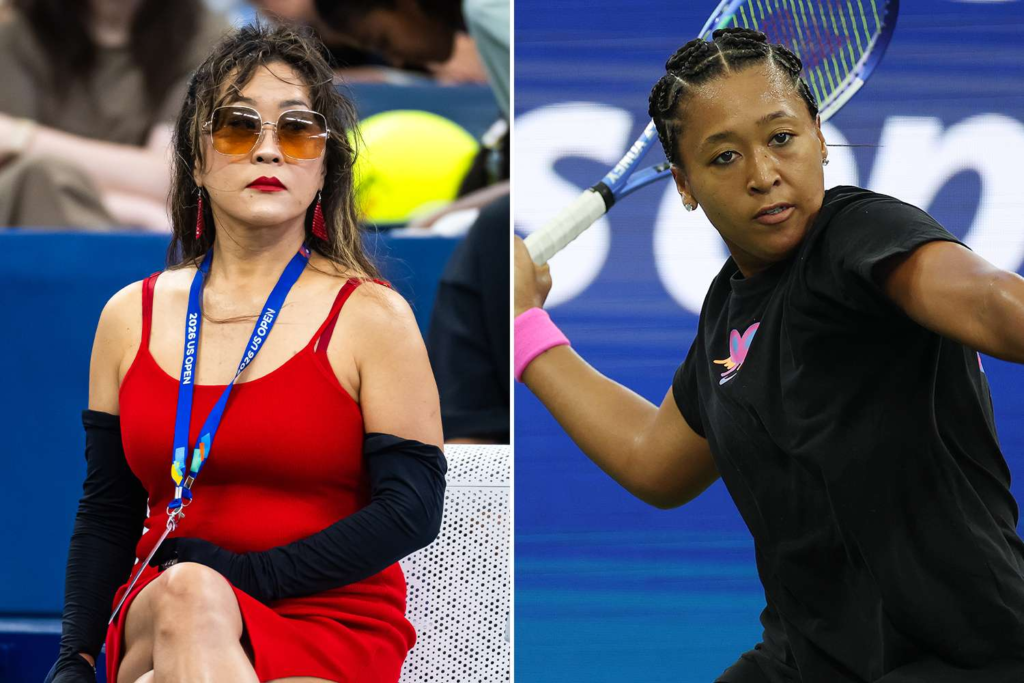
TL;DR: Naomi Osaka may be one of tennis’ biggest fashion stars, but at the 2026 U.S. Open, her mother, Tamaki Osaka, has been drawing attention of her own. From a striking red minidress and black opera gloves to a sharply tailored shirt-and-tie look, Tamaki’s courtside style has become a talking point alongside her daughter’s increasingly theatrical Grand Slam entrances.
Naomi Osaka has spent years proving that tennis fashion can be about more than what happens between the lines. At the 2026 U.S. Open, the four-time Grand Slam champion once again turned her arrival on court into a fashion event, paying tribute to NBA legend Allen Iverson in an elaborate basketball-inspired look.
But this time, Osaka was not the only member of her family making a style statement.
Her mother, Tamaki Osaka, has attracted plenty of attention from the stands at Flushing Meadows. During Naomi’s practice session before the tournament, Tamaki appeared in a fitted red minidress, long black gloves, oversized sunglasses, red earrings and a matching red lip. Days later, she switched gears completely, appearing courtside in a white dress shirt, gray jacket and silver-gray tie.
The looks have prompted an obvious question: Who is Tamaki Osaka, and how did Naomi’s mother become an unexpected fashion fixture at the U.S. Open?
Who is Tamaki Osaka?
Tamaki Osaka is Naomi Osaka’s Japanese mother and one of the central figures in the tennis star’s journey to the top of the sport.
Tamaki grew up in Nemuro, Hokkaido, Japan. She met Leonard Francois, a Haitian-American college student, while she was finishing high school in Japan. The relationship initially faced opposition from Tamaki’s family, and the couple kept it private before eventually moving to Osaka together.
Tamaki and Francois went on to have two daughters, Mari and Naomi, born in 1996 and 1997, respectively. The family later moved to the United States to provide the girls with stronger opportunities to develop their tennis careers.
That decision would ultimately shape the future of one of the most recognisable players in modern tennis.
Tamaki’s story is important because she was not simply the mother of a young athlete. She worked while the family invested heavily in the girls’ tennis development. Tamaki later recalled the financial and personal sacrifices involved in supporting two children in a sport that can be extremely expensive.
Tamaki’s role in Naomi’s tennis journey
Naomi has repeatedly credited both of her parents for helping create the circumstances that allowed her to pursue professional tennis.
Her father, Leonard, took inspiration from Richard Williams, who coached Serena and Venus Williams, after watching the sisters compete at the 1999 French Open. Leonard subsequently began developing his daughters’ tennis careers, despite having no formal background as a professional tennis coach.
Tamaki’s contribution was different but just as important.
While Leonard focused heavily on the tennis side, Tamaki worked and helped support the family financially as her daughters pursued the sport. Naomi has spoken publicly about how much her mother sacrificed during her childhood.
That foundation eventually produced a player who would win the U.S. Open twice and the Australian Open twice.
Why is Tamaki Osaka going viral at the 2026 US Open?
Tamaki has generally maintained a lower public profile than her daughter. That changed noticeably in New York this year.
On August 27, she attended Naomi’s practice session at the USTA Billie Jean King National Tennis Center wearing a fitted red minidress, long black gloves, oversized sunglasses and red earrings, finished with a bold red lip and Nike Air Max Plus sneakers embellished with Swarovski details.
It was not the sort of courtside outfit designed to disappear into the background.
The combination of opera-length gloves, dramatic eyewear and a monochromatic red palette gave the look a distinctly editorial quality. Images from the practice session quickly circulated online, with fans drawing comparisons between Tamaki’s confidence in fashion and Naomi’s own willingness to experiment with clothing.
The reaction was perhaps unsurprising. Naomi’s Grand Slam entrances have increasingly become miniature fashion productions, and Tamaki’s appearance suggested that the family’s flair for statement dressing did not begin with the younger Osaka.
What did Tamaki wear during Naomi’s U.S. Open match?
Tamaki later traded the theatrical red look for something much more tailored.
During Naomi’s second-round match against Katerina Siniakova on September 3, Tamaki appeared in a white dress shirt, gray jacket and silver-gray tie, accessorized with sunglasses and gloves. The polished ensemble had a distinctly menswear-inspired quality.
The timing was notable because Naomi was also wearing a basketball-inspired ensemble that day.
Rather than competing with her daughter visually, Tamaki’s outfit offered a different interpretation of sports style: structured, formal and understated compared with Naomi’s elaborate walk-on costumes.
The effect was almost complementary.
Naomi has made the court her fashion stage. Tamaki, from the stands, has quietly created her own.
Where does Naomi Osaka’s fashion sense come from?
It would be simplistic to say Naomi inherited her fashion sense from her mother, but the parallels are hard to miss.
Naomi has increasingly described clothing as a form of storytelling. Her Grand Slam outfits often contain references to her Japanese heritage, her family, her daughter, other athletes and aspects of popular culture.
In 2026 alone, her major-tournament looks have included:
- Australian Open: A jellyfish-inspired ensemble with a large hat, veil, parasol and ocean-inspired elements, inspired in part by a book she read with her daughter Shai.
- French Open: A dramatic black-and-gold entrance outfit created with designer Kevin Germanier, incorporating elements of Osaka’s previous tennis clothing.
- Wimbledon: An elaborate all-white kimono-inspired creation by Tokyo-based designer Hana Yagi, featuring cranes, cherry blossoms and traditional Japanese elements.
- U.S. Open: A basketball-themed look inspired by Allen Iverson, including cornrows, a headband and arm sleeves beneath a dramatic hooded garment covered with newspaper clippings about her career.
The common thread is that these outfits are rarely just about looking different.
They tell a story.
Why was Naomi Osaka’s Allen Iverson look significant?
Osaka’s U.S. Open opener provided perhaps the clearest example of how she uses fashion to connect sports cultures.
Ahead of her first-round match against Anastasia Zakharova, Osaka walked onto Arthur Ashe Stadium in a long white skirt and a gray hooded garment decorated with newspaper clippings referencing her career. Beneath it, she revealed a black basketball-inspired tennis outfit.
She also wore cornrows, a headband and arm sleeves associated with Allen Iverson’s iconic NBA-era style.
Osaka described Iverson as a trailblazer and a personal fashion influence. The choice was particularly fitting because Iverson became one of the athletes most closely associated with bringing basketball, hip-hop and streetwear aesthetics into mainstream professional sports culture.
Iverson himself acknowledged Osaka’s tribute, adding another layer to what was already a highly visible fashion moment.
Is fashion part of Naomi Osaka’s identity as an athlete?
Increasingly, yes.
Osaka’s fashion choices have become a recognizable part of her public identity, but they also serve a practical purpose for her.
At Wimbledon, for example, Osaka has spoken about how her elaborate entrances can help her deal with nerves. The ritual gives her something creative to focus on before competition.
That makes the clothes more than promotional material or celebrity styling.
They become part of her preparation.
There is also a cultural dimension. Her Wimbledon outfit incorporated Japanese ceremonial dress, while her Australian Open look referenced her daughter and her own memories of winning the tournament.
The U.S. Open Iverson tribute went in another direction: rather than looking inward, Osaka used fashion to acknowledge another athlete whose influence extended beyond his sport.
What does Tamaki Osaka’s style say about the family?
Tamaki’s recent appearances offer an interesting counterpoint to Naomi’s increasingly elaborate fashion identity.
Her style is bold without necessarily being complicated. The red minidress, black gloves and sunglasses created a strong visual silhouette. The gray suit-and-tie look relied on tailoring rather than theatricality.
Both outfits, however, share something with Naomi’s approach: confidence.
That may be the more meaningful connection between mother and daughter.
Tamaki spent years supporting Naomi away from the spotlight, helping make professional tennis possible for her daughters. Now, as Naomi has turned into one of the sport’s most recognizable fashion figures, Tamaki occasionally finds herself in front of the cameras too.
And she appears perfectly comfortable there.
What happened to Naomi Osaka at the 2026 US Open?
While the fashion conversation continued, Osaka’s tournament run ended in the fourth round.
She defeated Anastasia Zakharova in the first round and Katerina Siniakova in the second before beating Elise Mertens in the third round. Her run ended on September 7 when Elena Rybakina defeated her 6-1, 6-4. Osaka was also dealing with an Achilles issue during the match.
Despite the loss, Osaka’s tournament generated significant attention beyond her results.
Her fashion partnership with stylist Law Roach and a series of designers, including Who Decides War, Thom Browne and Monse, helped turn her tournament appearances into recurring cultural moments.
That is part of what makes Tamaki’s appearance so interesting.
For years, the spotlight has followed Naomi from the tennis court to fashion runways and magazine covers. At this U.S. Open, some of that attention briefly moved toward the woman who helped make Naomi’s tennis career possible.
Tamaki Osaka’s story is bigger than her viral outfits
The red dress and gray suit may have made Tamaki a temporary social-media sensation, but they are only a small part of her story.
She was a mother who helped support two daughters through the demanding economics of professional tennis. She and Leonard made major decisions about where the family would live and how the girls would train. Their sacrifices ultimately helped create the conditions for Naomi to become a four-time Grand Slam champion.
Today, Naomi is an established tennis star with a fashion identity of her own.
And Tamaki, once best known to tennis fans as the quiet presence in her daughter’s player box, is suddenly getting a little more attention herself.
Perhaps that is the most fitting fashion statement of all: Naomi Osaka’s style may be her own, but the confidence behind it clearly has a family history.