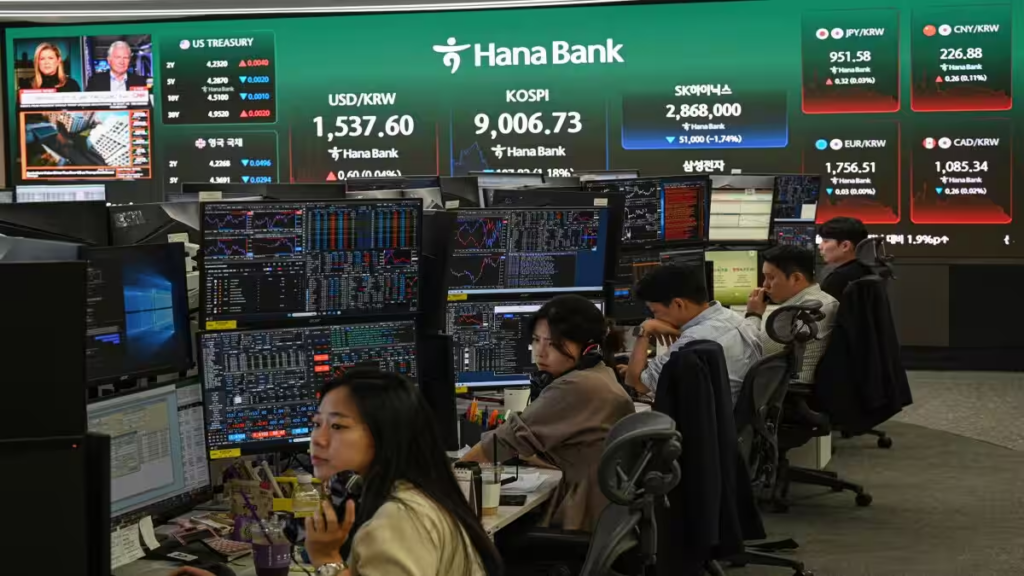
South Korea’s benchmark Kospi index suffered one of its sharpest declines in recent years on Friday, plunging more than 8% as a widening artificial intelligence (AI)-driven sell-off swept through Asian markets. The steep drop briefly triggered a 20-minute circuit breaker, underscoring growing investor anxiety over the sustainability of the AI investment boom.
The dramatic decline comes just days after the Kospi experienced another double-digit swing, highlighting how heavily AI-linked semiconductor stocks now influence one of Asia’s most important equity markets.
Why did South Korea’s Kospi fall so sharply?
The latest market rout reflects growing uncertainty surrounding AI-related investments after months of exceptional gains.
Although demand for AI technologies remains robust, investors are becoming increasingly concerned about the enormous capital required to build and maintain AI infrastructure. Rising valuations, profit-taking, and concerns that AI-related stocks had become overextended combined to trigger a wave of selling.
South Korea has become particularly vulnerable because its stock market is closely tied to the semiconductor industry, which sits at the center of the global AI supply chain.
AI stocks dominate South Korea’s market
Unlike many major stock indices, the Kospi is heavily concentrated in just two companies.
Samsung Electronics
Samsung Electronics, one of the world’s largest semiconductor manufacturers, fell more than 9% during trading before recovering slightly to close down around 6.7%.
The company plays a crucial role in producing advanced memory chips used in AI servers, data centers, and cloud computing infrastructure.
SK Hynix
SK Hynix, another global leader in high-bandwidth memory (HBM) chips essential for AI processors, also dropped as much as 9% before trimming losses.
Together, Samsung Electronics and SK Hynix account for more than half of the Kospi’s market capitalization.
That concentration means any sharp movement in semiconductor stocks has an outsized effect on the broader market.
Consider adding a pie chart here showing the weighting of Samsung Electronics and SK Hynix within the Kospi index.
Why AI enthusiasm is becoming a source of volatility
The AI revolution has fueled extraordinary gains across technology stocks worldwide.
However, investors are beginning to reassess how much companies must spend to sustain that growth.
While demand for AI chips remains healthy, markets are increasingly focused on questions such as:
- How quickly will AI investments generate profits?
- Can infrastructure spending continue at its current pace?
- Are semiconductor stocks already priced for perfection?
These concerns have led investors to lock in profits after a strong rally.
Foreign investors continue selling Korean stocks
One of the biggest drivers of Friday’s decline was continued foreign selling.
During the session, overseas investors reportedly sold approximately 2.6 trillion won (about $1.68 billion) worth of Kospi-listed shares.
According to JPMorgan, foreign investors have sold roughly $95 billion worth of South Korean equities this year, putting 2026 on pace to become one of the largest years for foreign capital outflows from a single Asian market.
Meanwhile, market breadth reflected widespread weakness:
- 792 stocks declined.
- Only 111 stocks advanced.
- Most sectors finished deep in negative territory.
Retail investors are keeping the market afloat
While foreign investors have been exiting Korean equities, domestic retail investors have largely stepped in to absorb the selling pressure.
South Korea has one of the world’s most active retail investing communities, and many individual investors remain optimistic about the long-term prospects of AI.
That optimism, however, has come with greater risk.
Rising leverage raises concerns
Margin debt has climbed to record levels as investors borrow money to increase exposure to semiconductor stocks.
At the same time, regulators have approved leveraged exchange-traded funds (ETFs) linked to Samsung Electronics and SK Hynix.
Financial regulators have warned that these products may amplify both gains and losses, contributing to larger market swings during periods of heightened volatility.
Consider adding a timeline showing the rise in margin debt alongside the performance of AI-related semiconductor stocks.
Strong AI demand isn’t enough to calm investors
Ironically, the sell-off comes despite positive industry fundamentals.
Recent earnings from Micron Technology pointed to continued strong demand for AI memory chips, suggesting that data center investment remains healthy.
Yet markets often react to expectations rather than current performance.
Many investors now appear concerned that future growth may not justify recent stock valuations, particularly after months of rapid gains fueled by AI optimism.
What does this mean for the global AI trade?
South Korea’s market is increasingly viewed as a barometer for global semiconductor demand.
Because Samsung Electronics and SK Hynix supply critical components used by companies developing AI models, cloud platforms, and advanced computing systems, weakness in Korean equities often signals broader shifts in investor sentiment toward AI.
If volatility continues, similar pressure could spread to technology-heavy markets in the United States, Taiwan, and Japan.
At the same time, analysts caution that short-term corrections do not necessarily indicate weakening demand for AI technologies.
Instead, the current sell-off may represent a recalibration after an extended period of exceptionally strong gains.
What investors will watch next?
Market participants are likely to focus on several key indicators over the coming weeks:
- AI infrastructure spending by major technology companies.
- Quarterly earnings from semiconductor manufacturers.
- Foreign investment flows into Asian markets.
- Central bank policy and interest rate expectations.
- Margin debt and leveraged ETF activity in South Korea.
These factors will help determine whether Friday’s decline proves to be a temporary correction or the beginning of a more sustained market adjustment.
The bottom line
South Korea’s sharp market decline illustrates both the opportunities and risks created by the global AI investment boom.
The country’s semiconductor giants remain central to AI development worldwide, but their dominance also leaves the Kospi especially vulnerable when investor sentiment turns.
For now, the long-term outlook for AI remains positive. The question confronting investors is no longer whether AI will reshape the global economy, but whether current stock prices accurately reflect that future.
TL;DR
- South Korea’s Kospi index dropped 8.2%, triggering a temporary trading halt.
- AI-related semiconductor stocks led the decline.
- Samsung Electronics and SK Hynix lost more than 9% at one stage.
- Foreign investors continued heavy selling while retail investors bought the dip.
- Analysts say concerns over AI infrastructure costs, leverage, and market concentration are driving volatility.