
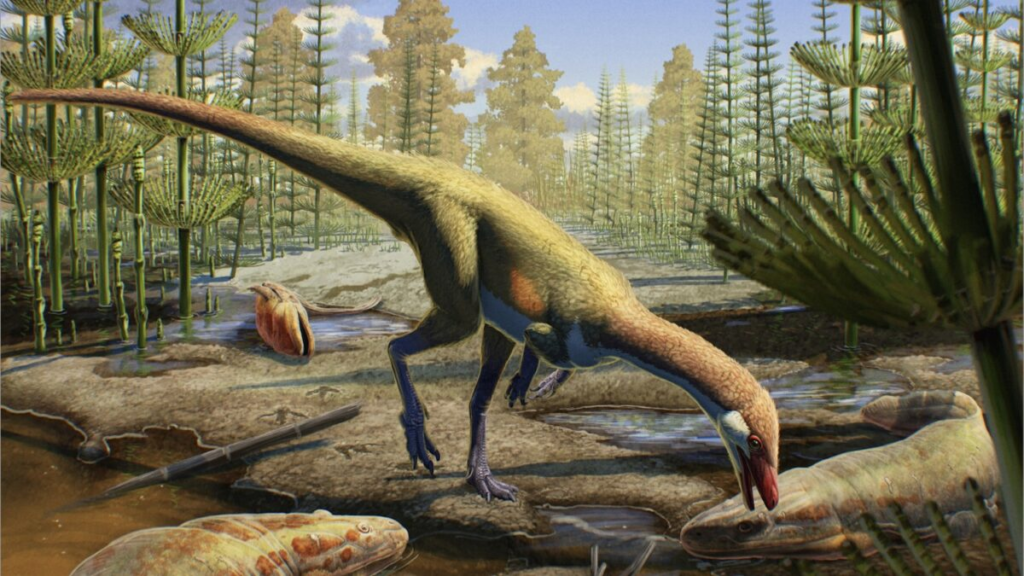
A bizarre herbivore with a beak and prominent tusks is giving scientists a new clue about when some of the earliest dinosaurs may have appeared.
Researchers led by the University of Bristol have described a previously unknown species from Tanzania that lived around 240 million years ago during the Triassic Period. Named Dinodontosaurus isiyavamanda, the animal was a dicynodont, a group of beaked and often tusked synapsids that belonged to the evolutionary lineage leading toward mammals.
The discovery is unusual not because the animal is new to the fossil record, but because much of the material had been sitting in London’s Natural History Museum for more than six decades.
More importantly, identifying the Tanzanian fossils as Dinodontosaurus could change how scientists date the rocks containing some of the earliest potential dinosaur fossils.
A strange animal with a beak and tusks
Dinodontosaurus isiyavamanda was a large herbivore with a distinctive skull, a tough beak, and large tusks.
Its appearance can make it look like a bizarre mixture of several modern animals, but the resemblance is superficial. It was neither a pig nor a reptile. It was a dicynodont, a successful group of herbivorous synapsids that lived millions of years before and during the early age of dinosaurs.
The new species has been identified from fossil material found in Tanzania’s Manda Beds. Its scientific name refers to the Wamanda people who inhabit the region where the fossils were discovered.
The researchers found that the Tanzanian animal belongs to a genus previously known only from South America.
That geographic connection is what makes the discovery particularly important.
Fossils found in the 1960s finally reveal their secret
The story of the species began during a British expedition to Tanzania in 1963.
A large collection of synapsid fossils was brought back and eventually housed at the Natural History Museum in London. Some specimens were examined over the decades, but parts of the collection remained undescribed.
One of the skeletons caught the attention of paleontologist Nigel Larkin, who studied it for his master’s thesis in 1994 and concluded that it appeared to represent a species new to science.
It took nearly three more decades for the specimen to be formally described. Modern techniques, including micro-CT scanning, helped researchers examine the material in greater detail and compare it with fossils from elsewhere.
The final analysis, published in the Journal of Vertebrate Palaeontology, confirmed that the Tanzanian material represented a new species of Dinodontosaurus.
Why a South American genus was found in Tanzania
Before this discovery, Dinodontosaurus was known only from South America.
Finding the same genus in eastern Africa provides a biological link between fossil-bearing rock sequences that were once separated by an ocean and were part of the supercontinent Pangaea during the Triassic.
The researchers argue that the Tanzanian and South American deposits containing Dinodontosaurus are therefore of approximately equivalent age.
That matters because the Manda Beds in Tanzania also contain fossils of Nyasasaurus and Asilisaurus, which have been considered among the earliest potential dinosaurs or close dinosaur relatives.
Scientists have long used those fossils when reconstructing the early history of dinosaurs. The new Dinodontosaurus evidence now complicates the age assigned to the rocks in which they were found.
The dinosaur timeline may need to move
New radiometric dates from comparable fossil-bearing sequences in South America indicate that they could be up to 10 million years younger than rocks in South Africa that had previously been used for comparison.
Because Dinodontosaurus links the Tanzanian and South American sequences, the researchers argue that the Tanzanian rocks containing the oldest potential dinosaur fossils should also be considered younger than previously thought.
That does not identify a new birthplace for dinosaurs.
Instead, it narrows the age window for some of the fossils that have been proposed as the earliest members of the dinosaur lineage.
Lead author Hady George said the discovery helps confirm that the oldest dinosaur candidates from Tanzania are probably no older than their South American counterparts, refining the timeline of dinosaur origins.
This does not mean dinosaurs originated in South America
The headline-grabbing implication needs some caution.
The new discovery does not prove that dinosaurs originated in South America, nor does it establish a precise location where the first dinosaurs evolved.
The question remains open because the early dinosaur fossil record is sparse, the identification of some very early fossils remains debated, and the exact ages of ancient rock formations are continually being refined.
What the new study does provide is a better way to compare fossil sites that once appeared to have different ages.
That can be just as important as finding a previously unknown dinosaur because the geological clock determines which fossils can actually be compared as contemporaries.
Why this animal matters despite not being a dinosaur
Dinodontosaurus itself was not a dinosaur.
Its group, the dicynodonts, belongs on the synapsid branch of the vertebrate family tree, while dinosaurs belong to the archosaur branch. But both groups shared Triassic ecosystems, making dicynodont fossils valuable for reconstructing the environments in which the earliest dinosaurs emerged.
The new species also gives scientists another window into the diversity of large herbivores living roughly 240 million years ago.
Researchers plan to examine more of the Tanzanian material, particularly bones from the rest of the body, and compare them with South American fossils. They also want to study how Dinodontosaurus and other large herbivores moved and fed and how several plant-eating species were able to coexist.
A reminder that museum collections can still rewrite prehistory
Perhaps the most surprising part of the discovery is that the key fossil was not freshly excavated.
The skeleton had been preserved in a museum collection for more than 60 years before researchers were able to establish its identity with modern methods.
For palaeontologists, that is a reminder that important discoveries do not always come from new expeditions. Old collections can contain specimens whose significance becomes visible only when scientists have better imaging techniques, improved dating methods, and more fossils for comparison.
In the case of Dinodontosaurus isiyavamanda, one long-overlooked herbivore has provided a new link between Africa and South America and may have shifted the geological goalposts for the earliest dinosaurs.