
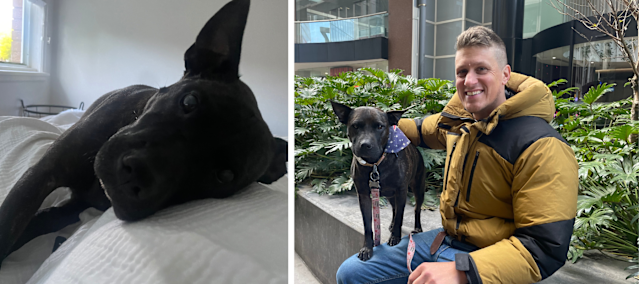
When the phrase “cancer vaccine” comes up, most people think of years of lab work, clinical trials, and teams of scientists. But an Australian tech entrepreneur has challenged that assumption by creating a personalized cancer vaccine for his dog using artificial intelligence.
The story sits at the intersection of emotion and innovation. It’s about a pet named Rose, a terminal diagnosis, and a bold experiment that may hint at the future of medicine.
Who Is Paul Conyngham, and What Did He Do?
Paul Conyngham is not a doctor, biologist, or researcher. He’s a tech entrepreneur with expertise in machine learning and data analysis. When his 8-year-old rescue dog, Rose, was diagnosed with terminal cancer, he decided to act.
Rose, a Staffordshire bull terrier, had developed large tumors on her back leg. She was diagnosed with mast cell cancer and given only a few months to live.
Instead of accepting the prognosis, Conyngham turned to the tools he understood best: AI and data.
How Did He Create a Cancer Vaccine Using AI?
Step 1: Sequencing the Tumor DNA
Conyngham began by analyzing Rose’s tumor at a genetic level. This process identified mutations unique to her cancer—essentially the “fingerprints” of the disease.
Step 2: Using AI Tools to Design a Vaccine
He then used two major AI systems:
- ChatGPT
- AlphaFold
These tools helped:
- Analyse protein structures linked to cancer
- Identify potential targets for treatment
- Generate a sequence for a personalised mRNA vaccine
The goal was to train Rose’s immune system to recognize and attack cancer cells.
Step 3: Collaboration With Scientists
The AI-generated sequence wasn’t used in isolation. It was sent to the RNA Institute at the University of New South Wales (UNSW), where researchers manufactured the vaccine.
Professor Pall Thordarson, director of the institute, confirmed that the vaccine was developed in under two months—an unusually fast timeline.
What Were the Results?
The outcome was striking, though still anecdotal.
- The vaccine reportedly reduced about 75% of the cancer
- Visible improvements appeared within a month
- Rose regained energy and mobility
Conyngham described a dramatic turnaround—from lethargy and decline to chasing rabbits again.
While some cancer remained, the improvement significantly extended her quality of life.
What Is an mRNA Cancer Vaccine?
To understand why this matters, it helps to break down the science.
How mRNA Vaccines Work
mRNA vaccines (similar in concept to some COVID-19 vaccines) work by:
- Delivering instructions to cells
- Teaching the immune system to recognize harmful targets
- Triggering an immune response
In cancer treatment, the vaccine is personalised. It targets mutations unique to a patient’s tumor.
Why Personalisation Matters
Cancer isn’t one disease—it varies from person to person (or in this case, dog to dog). Personalised vaccines:
- Increase precision
- Reduce harm to healthy cells
- Improve effectiveness
Why This Case Is So Unusual
No Medical Background
Creating a cancer vaccine typically requires:
- Advanced biomedical training
- Access to specialized labs
- Regulatory approvals
Conyngham had none of these. His contribution was in:
- Data interpretation
- AI-assisted design
- Bridging tech and biology
Speed of Development
Traditional drug development can take years. This vaccine was created in under two months, highlighting how AI can compress timelines.
What Does This Mean for the Future of Medicine?
This case is not proof that anyone can—or should—create medical treatments at home. But it does highlight several emerging trends.
1. AI as a Medical Co-Pilot
AI tools are increasingly being used to:
- Analyze genetic data
- Predict protein structures
- Suggest treatment pathways
They don’t replace experts—but they can dramatically accelerate research.
2. Rise of Personalised Medicine
The future of healthcare is moving toward treatments tailored to individuals, not mass-produced solutions.
3. Democratisation of Innovation
Access to powerful tools like AI means:
- Non-traditional contributors can participate
- Innovation can come from outside academia
That said, expert validation remains critical.
Important Caveats and Risks
While the story is inspiring, it’s important to stay grounded.
Not a Clinically Proven Treatment
- This is a single case, not a clinical trial
- Results may not be reproducible
- Long-term effects are unknown
Ethical and Safety Concerns
- Medical treatments require rigorous testing
- Improper use of AI in healthcare can be dangerous
- Regulatory oversight exists for a reason
The Bigger Picture: AI and Cancer Treatment
AI is already being explored in oncology for:
- Early detection through imaging
- Drug discovery
- Treatment optimization
TL;DR
- An Australian tech entrepreneur created a personalised cancer vaccine for his dog using AI
- Tools like ChatGPT and AlphaFold helped design the treatment
- The vaccine reportedly reduced 75% of the cancer and improved the dog’s condition
- The case highlights the potential—and risks—of AI in personalised medicine
- It’s promising, but not a substitute for clinical research