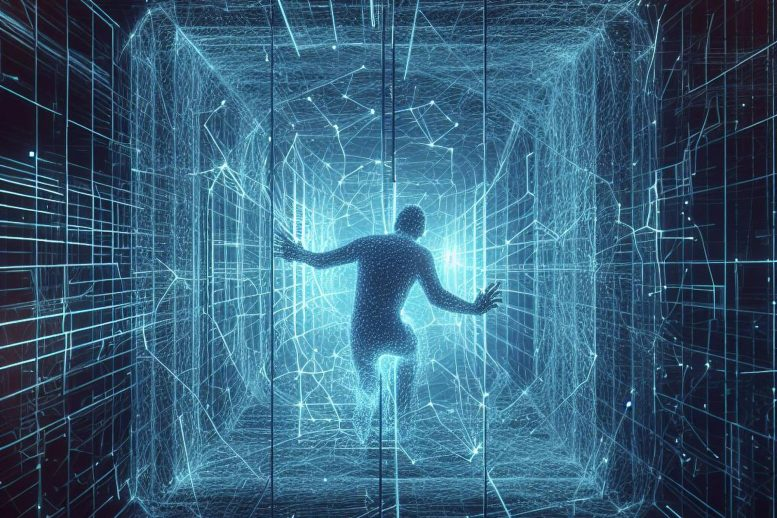
What the latest study says about the “simulation theory”
For decades, scientists, philosophers, and sci-fi enthusiasts have debated a mind-bending question, what if our universe isn’t real but a highly sophisticated simulation? Popularized by movies like The Matrix and arguments from tech figures such as Elon Musk, the idea has intrigued both physicists and philosophers.
But according to a new study led by Professor Mir Faizal of the University of British Columbia, the universe cannot be a simulation, not even in theory. The team’s findings, grounded in quantum gravity and mathematical logic, suggest that reality itself cannot be computed, no matter how powerful future computers become.
How scientists tested whether the universe could be simulated
Faizal and his colleagues approached this long-standing thought experiment using a scientific framework instead of philosophy. They examined the question through quantum gravity, a theory that seeks to unify Einstein’s general relativity (which governs large-scale phenomena like planets and galaxies) with quantum mechanics (which explains the behavior of subatomic particles).
Quantum gravity proposes that space and time are not fundamental ingredients of reality but emerge from a deeper mathematical framework based entirely on information. This concept has often been used to support simulation arguments, the idea that our universe could be the output of an immensely advanced computational system.
However, when the researchers applied logical constraints to this information-based model, they found limits that no simulation could surpass.
The role of “Gödelian truths” in proving reality isn’t simulated
Central to the study is the discovery of what the team calls “Gödelian truths,” inspired by the mathematician Kurt Gödel’s Incompleteness Theorems. These theorems state that within any consistent mathematical system, there are truths that cannot be proven using the rules of that system.
In simpler terms: some truths exist, but no algorithm or computer can define them.
Faizal’s team argues that our universe contains such truths — meaning its full nature cannot be captured by computation. Every simulation must obey fixed, algorithmic rules. But reality, according to this research, is not confined to rule-based logic.
“Every simulation operates according to fixed rules,” Faizal explained. “But the fundamental nature of reality is based on an understanding that cannot be algorithmic.”
This insight effectively shuts down the idea that any supercomputer, even one beyond human imagination, could replicate or contain the universe as we know it.
Why the simulation hypothesis appealed to scientists for so long
The simulation hypothesis gained credibility among prominent thinkers because of rapid advances in technology and physics. Philosophers like Nick Bostrom proposed that if civilizations eventually gain the power to simulate conscious beings, it’s statistically more likely that we’re in one of those simulations than in “base reality.”
Meanwhile, physicists have long observed that the universe behaves in surprisingly digital ways; for instance, energy comes in discrete packets (quanta), and reality seems to follow precise mathematical rules.
But Faizal’s findings challenge this reasoning, suggesting that mathematics may describe reality, but it does not create it.
Why the study matters for modern physics and philosophy
The implications of this research reach far beyond the simulation debate. By asserting that not all truths are algorithmic, the findings touch on deep questions about the limits of science and computation.
Theoretical physicist Lawrence M. Krauss noted that the laws of physics themselves create space and time; they aren’t confined by them. This means that even if one could code the known laws of the universe, it wouldn’t be enough to simulate the reality that gives rise to those laws in the first place.
This reshapes how scientists view the relationship between information, mathematics, and existence. If reality cannot be computed, then it must contain elements beyond logic, potentially connected to consciousness, creativity, or unknown aspects of physics.
What this means for the future of science
The study doesn’t just dismiss the simulation theory; it reframes it. If reality cannot be replicated by computation, then human understanding must expand beyond algorithmic thinking.
Future research may focus on exploring non-algorithmic patterns in nature, such as the role of randomness, quantum entanglement, or emergent phenomena that defy precise prediction.
Philosophically, this opens the door to a more profound question: if the universe isn’t a simulation, then what is it, and why does mathematics describe it so well without defining its essence?
TL;DR
- A new study from the University of British Columbia claims the universe cannot be a simulation.
- Using quantum gravity and mathematical logic, scientists found that reality includes “Gödelian truths,” concepts that no computer or algorithm can fully define.
- Every simulation runs on fixed rules, but reality, they argue, transcends those rules.
- The findings could reshape how physicists and philosophers understand the limits of computation, mathematics, and existence itself.