For decades, ultrafast lasers have been among the most powerful tools in modern science and engineering. They enable precision eye surgeries, advanced manufacturing processes, and some of the world’s most accurate timekeeping systems. But there has been one major limitation: size.
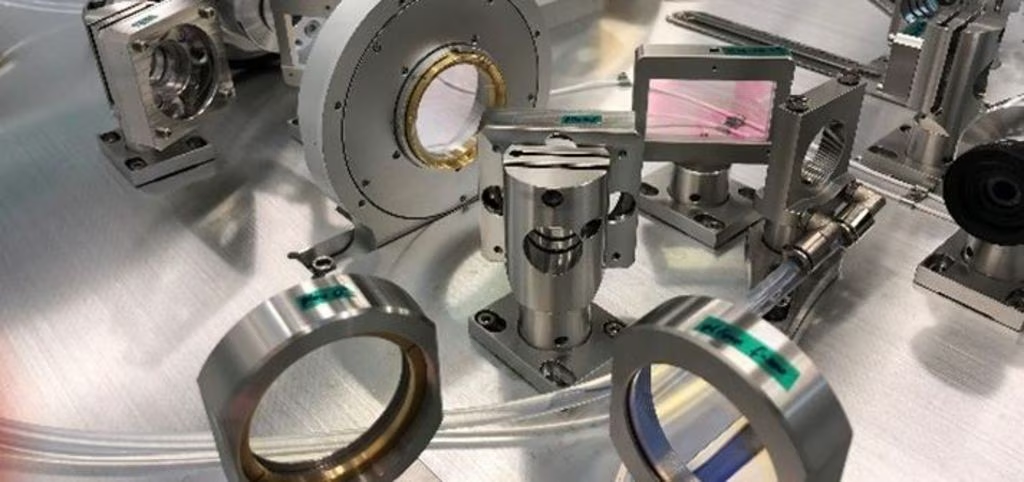
These lasers typically require large, expensive laboratory setups filled with optical components spread across entire tables. Now, researchers at EPFL have achieved what many in the photonics community considered a long-standing challenge, building a high-performance ultrafast laser directly onto a photonic chip.
The breakthrough, published in Nature, could pave the way for smaller, cheaper, and more accessible laser systems capable of powering everything from medical diagnostics to next-generation navigation technologies.
TL;DR
- Researchers at EPFL have developed the first chip-based ultrafast laser that rivals traditional laboratory systems.
- The device generates laser pulses as short as 147 femtoseconds.
- It produces pulse energies up to 1.05 nanojoules, a key benchmark for practical applications.
- The laser is based on a relatively overlooked design called a Mamyshev oscillator.
- The technology could significantly reduce the cost and size of ultrafast laser systems.
- Potential applications include environmental sensing, medical diagnostics, spectroscopy, and portable optical atomic clocks.
What Is an Ultrafast Laser?
Ultrafast lasers generate incredibly short bursts of light measured in femtoseconds.
A femtosecond is one quadrillionth of a second. To put that into perspective, a femtosecond compares to one second roughly the way one second compares to more than 30 million years.
These extraordinarily brief pulses allow scientists and engineers to perform tasks that would otherwise be impossible.
Ultrafast lasers are used in:
- Precision manufacturing and micro-machining
- LASIK and other eye surgeries
- Scientific spectroscopy
- Telecommunications research
- Optical frequency combs
- Atomic clocks and precision timing systems
Because these lasers deliver enormous peak power in an extremely short time, they can manipulate materials with remarkable precision while minimising unwanted damage.
Why Has Putting an Ultrafast Laser on a Chip Been So Difficult?
The concept sounds straightforward: if computers and telecommunications equipment can be miniaturised onto chips, why not ultrafast lasers?
The challenge lies in maintaining performance.
Traditional ultrafast laser systems rely on long optical paths and carefully controlled interactions between light waves. When engineers try to shrink these systems, unwanted optical effects can destabilise the laser pulses.
For more than 20 years, researchers have attempted to create a chip-scale ultrafast laser that could deliver the same pulse energy and performance as laboratory-based systems.
Most efforts fell short.
The missing ingredient turned out to be a laser architecture that the integrated photonics community had largely overlooked.
How Does the New Chip-Based Ultrafast Laser Work?
The EPFL team turned to a design known as a Mamyshev oscillator.
While the architecture is not new, it has rarely been explored for integrated photonic systems.
The Filtering Advantage
The laser works by combining a nonlinear waveguide with two optical filters.
As powerful light pulses travel through the waveguide, their spectrum broadens. This broadening allows the desired pulses to pass through both filters and continue circulating inside the laser cavity.
Weaker light signals fail to broaden sufficiently and are blocked.
The result is a self-selecting system that naturally favours stable, high-quality laser pulses.
This elegant filtering mechanism eliminates the need for several complex components that are often difficult to fabricate on photonic chips.
Why the Design Matters
One of the biggest challenges in chip-scale photonics is that light is confined to extremely tiny structures.
This confinement enhances nonlinear interactions between light waves. While those interactions can be useful, they often create instability in conventional laser designs.
The Mamyshev oscillator is far more tolerant of these effects.
That makes it particularly well suited for photonic integration and helps explain why the researchers were able to achieve performance levels that had previously remained out of reach.
How Powerful Is the New Laser?
Performance is where this breakthrough stands out.
The researchers demonstrated:
- Pulse durations as short as 147 femtoseconds
- Pulse energies reaching 1.05 nanojoules
- Kilowatt-level peak powers
These metrics place the chip-based system in the same performance category as many traditional tabletop femtosecond lasers.
For scientists and engineers, that distinction is critical.
Miniaturisation is valuable only if performance remains high enough for real-world applications. The EPFL device appears to clear that hurdle.
A 42-Centimetre Laser That Fits on a Tiny Chip
One of the most striking aspects of the research is the physical design.
The laser cavity itself measures approximately 42 centimeters in length.
Yet through clever engineering, that cavity is folded onto a photonic chip occupying roughly the area of a match head.
This demonstrates one of integrated photonics’ greatest advantages: the ability to compress complex optical systems into extraordinarily small footprints.
Why Photonic Chips Could Make Lasers Much Cheaper
Beyond size reduction, the breakthrough has significant manufacturing implications.
Photonic chips can be produced using wafer-scale fabrication techniques similar to those used in the semiconductor industry.
That means manufacturers could potentially fabricate more than 1,000 laser cavities simultaneously on a single wafer.
This approach offers several advantages:
- Lower production costs
- Greater manufacturing consistency
- Higher scalability
- Faster commercialization
Historically, ultrafast laser systems have been expensive because they require precise assembly of numerous optical components.
Mass-producing them on chips could dramatically expand access to the technology.
What Applications Could Benefit?
The impact of compact ultrafast lasers could extend across multiple industries.
Environmental Monitoring
Portable laser-based sensing systems could detect pollutants and hazardous chemicals more efficiently and at lower cost.
Medical Diagnostics
Smaller laser platforms could enable advanced diagnostic tools that are easier to deploy in hospitals, clinics, and field settings.
Precision Manufacturing
Manufacturers could integrate powerful ultrafast lasers directly into production equipment, reducing system complexity and cost.
Spectroscopy and Scientific Research
Researchers could gain access to high-performance optical tools without needing large laboratory installations.
Portable Atomic Clocks
Perhaps one of the most exciting possibilities involves optical atomic clocks.
These clocks represent the most precise timekeeping systems ever created. Their broader deployment could improve:
- Navigation technologies
- Communication networks
- Scientific measurements
- Future positioning systems beyond GPS
Why This Breakthrough Matters for Photonics
The achievement represents more than just a smaller laser.
It demonstrates that integrated photonics can now support one of the most demanding categories of laser technology while maintaining performance levels previously reserved for laboratory-scale systems.
For years, the field has focused on shrinking optical components without sacrificing functionality.
This work suggests that some of the most advanced optical tools may soon become compact, scalable, and commercially viable.
In many ways, the development mirrors the transformation that occurred in electronics decades ago, when room-sized computers evolved into powerful chips that fit in a pocket.
Photonics may now be entering a similar phase.
The Bottom Line
Researchers at EPFL have achieved a milestone that many scientists viewed as one of integrated photonics’ toughest challenges: creating a high-pulse-energy ultrafast laser on a chip.
By using a Mamyshev oscillator architecture, the team produced femtosecond laser pulses with performance comparable to traditional laboratory systems while reducing the device footprint to the size of a match head.
If the technology scales as expected, it could make ultrafast lasers smaller, cheaper, and more widely available—unlocking new possibilities in medicine, environmental monitoring, manufacturing, communications, and precision timing.
For a technology that once required an entire laboratory bench, fitting it onto a chip could mark the beginning of a new era in photonics.