
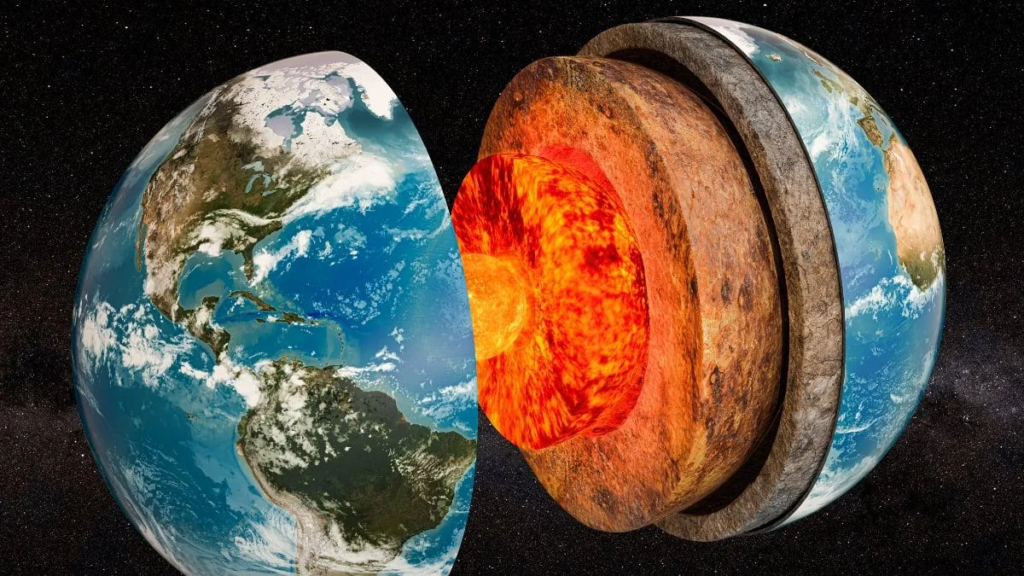
Earth’s surface is dominated by oceans, rivers and ice, but some of the planet’s water may be stored in a far less accessible place: nearly 2,900 kilometers beneath our feet. A new study published in Nature Geoscience has identified two previously unknown iron oxyhydroxide phases that can form under the extreme temperatures and pressures found in Earth’s lowermost mantle. The researchers say the minerals could act as dense reservoirs capable of storing and transporting hydrogen and water deep inside the planet.
The finding could help scientists explain how water has been transported into Earth’s deepest interior and potentially shed light on mysterious structures known as ultralow-velocity zones at the core-mantle boundary.
Two new minerals found under extreme conditions
The researchers synthesized two hexagonal iron oxyhydroxides, Fe₅O₁₂Hₓ and Fe₇O₁₂Hₓ, in laboratory experiments designed to recreate conditions near the bottom of Earth’s mantle.
The experiments used laser-heated diamond-anvil cells, which can squeeze tiny samples under enormous pressures while simultaneously raising their temperatures to levels comparable to those deep inside Earth.
Both newly identified phases are unusually dense and can incorporate hydrogen. According to the study, their properties allow them to remain stable under lowermost-mantle conditions, making them plausible hosts for water-derived material.
That is significant because the major minerals that dominate much of the lower mantle, including bridgmanite and ferropericlase, are generally poor candidates for storing large amounts of water under the most extreme conditions.
Where could this hidden water be?
The minerals could exist near the core-mantle boundary, roughly 2,900 kilometers below Earth’s surface.
This boundary separates the solid rocky mantle from the liquid outer core. Scientists already know that this region contains unusual structures called ultralow-velocity zones, or ULVZs, where seismic waves travel significantly more slowly than through the surrounding material.
Their exact composition remains uncertain.
The new study proposes that dense iron oxyhydroxides could be one contributor to at least some of these anomalies. Because the minerals are dense enough to sink through the mantle, they could accumulate near the bottom of the planet and potentially store water that entered Earth’s interior through different processes.
It is not an underground ocean
The phrase “water hidden inside Earth” can be misleading.
Scientists are not suggesting that a giant liquid ocean is sitting near the core. Under the enormous pressure and temperature found in the deep mantle, water would primarily be incorporated into minerals and their crystal structures rather than existing as a conventional underground sea.
Estimates that compare possible deep-Earth water inventories with one or more oceans are therefore a way of communicating the potential quantity of water involved, not evidence that literal oceans are trapped underground.
The new study establishes that the minerals can host hydrogen-bearing material under laboratory conditions. It does not establish how much of these minerals actually exists inside Earth today.
How Earth could have stored water so deep
The researchers suggest that the newly identified minerals may have formed during the early history of Earth, when a hot, molten basal magma ocean was crystallizing.
As the young planet cooled, dense iron oxyhydroxides could have formed and migrated downward toward the core-mantle boundary. Their high density would have helped them settle into the deepest parts of the mantle.
The study also suggests that these phases could accommodate both primordial water retained from Earth’s early formation and water recycled into the interior through geological processes such as subduction.
That gives scientists a possible mechanism connecting Earth’s ancient formation with its modern deep-water cycle.
What are ultralow-velocity zones?
ULVZs are among the most enigmatic structures inside Earth.
They are detected indirectly through seismic waves, which slow substantially when passing through these localized regions near the core-mantle boundary. Researchers have proposed several explanations for them, including unusually iron-rich material, partial melts and other chemically distinct phases.
The new research adds iron oxyhydroxides to that list.
The authors say the density and seismic properties of the newly identified minerals make them plausible candidates for contributing to some ULVZs. That does not mean every ULVZ has been explained by these minerals. Other recent research continues to support multiple possible origins for the structures.
Why the discovery matters for Earth’s water cycle
Water deep inside Earth is not simply an isolated geological curiosity.
The movement of hydrogen and other volatile elements between Earth’s surface, mantle and core can influence chemical reactions, mantle dynamics and the long-term evolution of the planet.
The new study suggests that iron oxyhydroxides could help carry water-derived material toward the core or release it later through mantle plumes. That opens another possible pathway for volatile cycling over geological timescales.
It also helps explain how some water may have survived and moved through parts of Earth’s interior despite the extreme conditions there.
Scientists still do not know how much water is actually there
The most important caveat is that the discovery was made in the laboratory, not through direct sampling of the deep mantle.
No drilling project has reached anywhere near the core-mantle boundary. Researchers therefore rely on high-pressure experiments, seismic observations, mineral physics and geochemical evidence to reconstruct what exists at those depths.
The study provides a plausible mineral host for deep water, but determining how abundant these phases are in the real Earth remains an open question.
In other words, scientists may have found a missing piece of the deep-water puzzle, but they have not yet measured an underground reservoir equivalent to two Pacific Oceans.