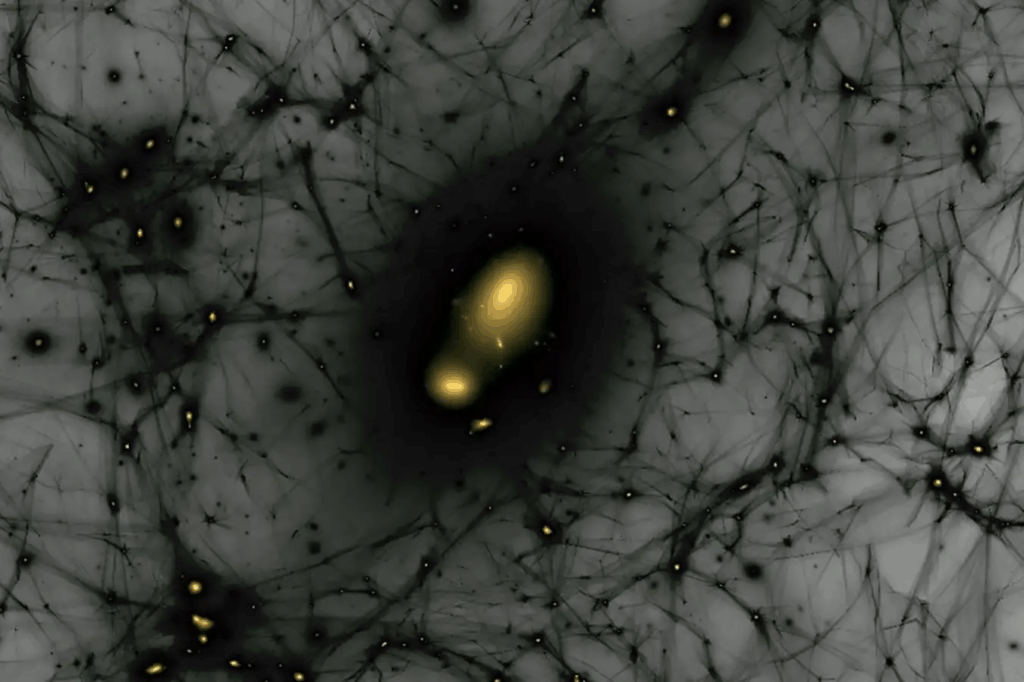
A Rare Cosmic Formation
Astronomers have identified a never-before-seen cosmic phenomenon: an Einstein Cross with a visible fifth image. Typically, this gravitational lensing effect produces four bright images arranged at right angles around a galaxy. But in this case, scientists found an extra image at the center—a discovery that has left researchers stunned.
Einstein Crosses are already among the rarest objects in the universe, with only about a dozen known to exist. The addition of a fifth image makes this one truly exceptional.
What Is an Einstein Cross?
An Einstein Cross occurs when light from a distant galaxy is warped by the gravity of massive galaxies in front of it. This gravitational lensing bends space-time and creates four separate images of the same background galaxy.
Normally, a faint central image also exists but is hidden—too close to the lensing object to detect. This time, however, the central fifth image appeared clearly.
“You can’t get a fifth image in the centre unless something unusual is going on with the mass that’s bending the light,” said Charles Keeton, a theoretical astrophysicist at Rutgers University.
The Discovery
French astronomer Pierre Cox, Research Director at the French National Centre for Scientific Research, first spotted the anomaly while studying a distant, dusty galaxy known as HerS-3.
Using the Northern Extended Millimeter Array (NOEMA) in the French Alps and the Atacama Large Millimeter/submillimeter Array (ALMA) in Chile, Cox observed light from HerS-3 splitting into five distinct images.
At first, he thought it was a glitch. “I tried to make the fifth image go away, but it wouldn’t,” Cox said.
He shared the data with Rutgers physicist Andrew Baker, who showed it to Keeton. The team quickly realized they were looking at something unprecedented.
Could Dark Matter Be the Key?
When scientists attempted to model the gravitational lens using only the four visible foreground galaxies, the configuration failed. The five-image pattern simply couldn’t be explained.
The breakthrough came when they factored in a dark matter halo.
“That’s the power of modelling—it helps reveal what you can’t see,” Keeton said.
Dark matter is believed to make up about 85 percent of the universe’s mass, but it has never been directly observed. Its presence is inferred through effects like this one—by how it bends and distorts light.
Baker added: “This discovery gives us a rare chance to study that invisible structure in detail.”
Why It Matters
This unusual Einstein Cross is more than a cosmic curiosity. It could help scientists:
- Map dark matter halos with greater precision.
- Test theories of gravity and space-time under extreme conditions.
- Understand galaxy formation in the early universe.
The finding will be detailed in an upcoming paper in The Astrophysical Journal, authored by Cox, Baker, Keeton, and Rutgers graduate student Lana Eid.
TL;DR
Astronomers have spotted the first-ever Einstein Cross with a visible fifth image, caused by a distant galaxy called HerS-3. The anomaly couldn’t be explained by visible galaxies alone but made sense once researchers added dark matter into their models. This rare event offers a unique window into the hidden structure of the universe.