

False vacuum decay is a real question in particle physics, and it has a published answer. The best complete calculation puts the lifetime of our vacuum at about 10^139 years. That is a 1 followed by 139 zeros. The universe has been running for 13.8 billion years, so the central estimate is roughly 10^129 times the age of everything that has ever happened.
The idea is sound. The measurements behind it are real. The arithmetic is the part that rarely survives the retelling.
Empty space has a value, and it might not be the lowest one
In quantum field theory, empty space is not nothing. Fields fill it, and those fields sit at some energy. The state we live in is a minimum of that energy. The question is whether it is the lowest minimum or merely a local one.
A local minimum is a false vacuum. A field can sit in it indefinitely, the way a ball sits in a dip partway down a hill. Quantum mechanics allows the field to tunnel through the ridge into the deeper valley below. Where that happens, a bubble of true vacuum forms and grows.
Inside such a bubble, the constants that govern particles would take different values. Atoms as we know them would not hold together. That is the reason the scenario gets described as the end of everything rather than an explosion.
The Higgs mass put the question on the table
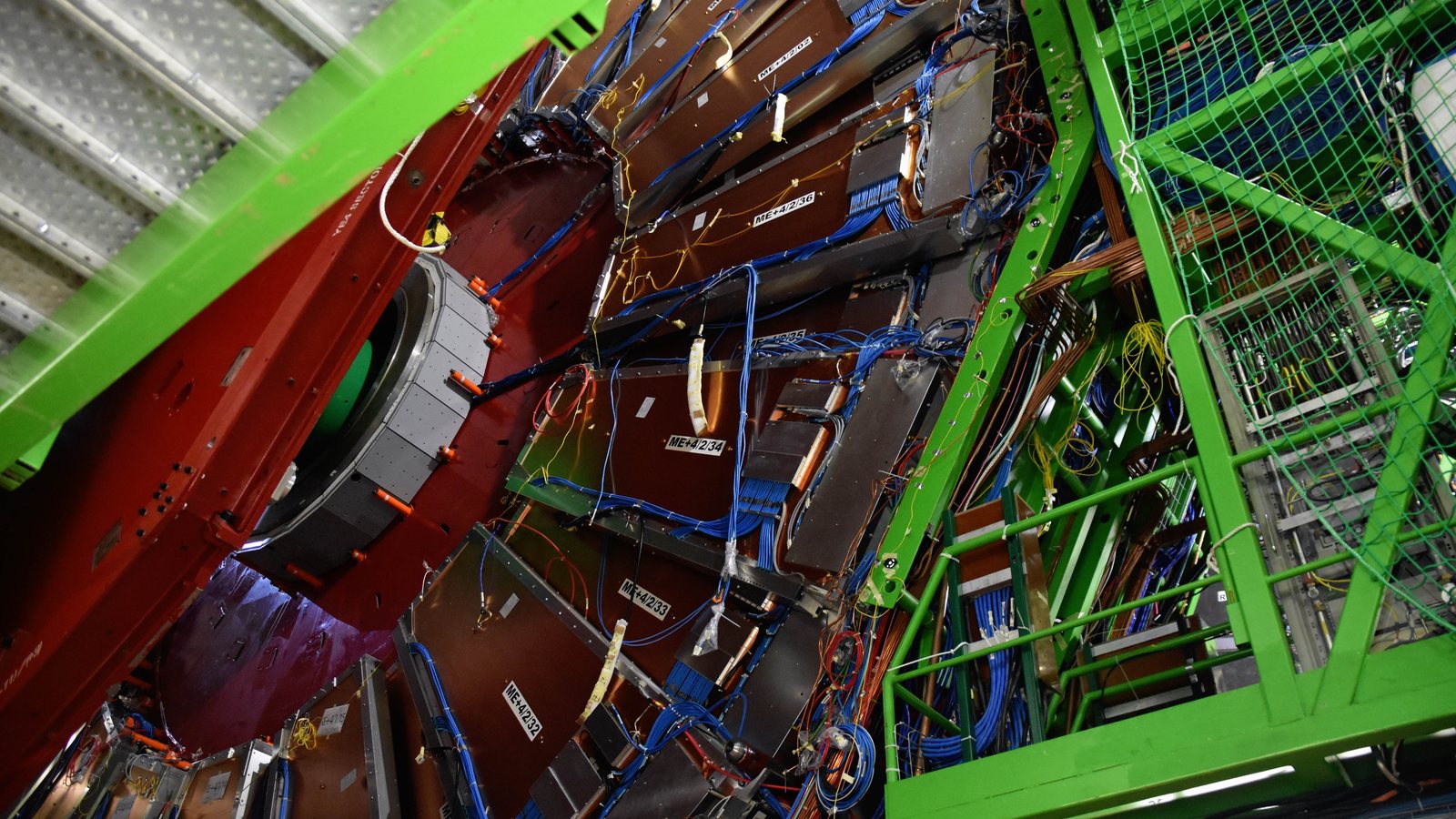
This stopped being abstract when CERN measured the Higgs boson in 2012. The shape of the Higgs potential at very high energies depends on the Higgs mass and, more sharply, on the mass of the top quark. Feed in the measured values and the Standard Model lands close to a boundary.
A team led by Dario Buttazzo worked this out at two-loop precision and ran the parameters up to high energies. Their conclusion was precise and strange: the measured Higgs mass sits near the smallest Higgs quartic coupling and top Yukawa coupling consistent with a metastable vacuum, they wrote in 2013. The universe appears to be balanced on the edge of the stability region rather than comfortably inside it.
Nobody knows why. That near-criticality is one of the open puzzles in the field. Several proposed answers reach beyond the Standard Model.
The lifetime is 10^139 years, and the error bars still leave you safe
In 2018, Anders Andreassen, William Frost and Matthew Schwartz published what they called the first complete calculation of the lifetime of our universe in Physical Review D. Their central value is 10^139 years. At 95% confidence, the vacuum lasts more than 10^58 years.
That lower bound is the number worth holding onto. It is the pessimistic end of the published range. It is still about 10^48 times the current age of the universe. The Sun will leave the main sequence in roughly 5 billion years. Every star that will ever form will have burned out long before the optimistic case and the pessimistic case begin to differ in any way a person could notice.
The uncertainty comes mostly from one place: the top quark mass, along with the strong coupling constant. The authors are blunt about what it would take to settle the stability question properly. Ruling out absolute stability at three sigma would need the top quark pole mass pinned to better than 250 MeV, or the strong coupling to better than 0.00025. Neither measurement is there yet.
So the honest statement is not that the universe is doomed. It is that current measurements cannot establish our vacuum is the lowest one. The calculated decay time is long enough that the distinction has no practical content.
A lab in Trento watched bubbles form
In January 2024, a group at the University of Trento, the Italian National Institute of Optics and TIFPA reported the first experimental evidence of this kind of bubble formation, with theory support from Newcastle University. The paper ran in Nature Physics.
They cooled a sodium gas to under a millionth of a degree above absolute zero and prepared it in a state that behaves like a false vacuum. Bubbles of the more stable state appeared and grew. The measured rates matched a formula derived from instanton theory, which is the same mathematical machinery used for the cosmic version.
Two caveats matter. The bubbles in Trento were thermally activated rather than driven by quantum tunnelling. The team says the next goal is to see the process at absolute zero, where tunnelling alone does the work. And the system is an analogue. Nobody changed the Higgs field or made a universe.
“Vacuum decay is thought to play a central role in the creation of space, time and matter in the Big Bang,” Ian Moss, professor of theoretical cosmology at Newcastle, said when the work was published. That is what the experiment is for. It is early-universe physics with a test bench, not a weather forecast.
The “no warning” line is true and almost useless
One detail does all the work in the scary version of this story. A bubble wall would expand at close to the speed of light, so the light announcing its arrival would reach you at roughly the same moment it did. There would be no advance notice.
That is a correct reading of the model. It also carries no information about whether a bubble exists, where it is, or when one might form. A claim that cannot be checked before the fact is not a prediction.
It is a pattern worth recognising in science coverage generally. We wrote about a 1960 paper that assigned doomsday a date, and about what China’s FAST telescope actually found at K2-155. In both cases the real result was narrower and more interesting than the headline version.
What would change the answer
Three things could move these numbers. A sharper top quark mass from the LHC would tighten the lifetime calculation directly. New particles above the Standard Model would reshape the potential at high energies. Some well-motivated extensions tighten the metastability bound considerably. A tunnelling-driven bubble seen at absolute zero would test the instanton calculation in the regime that matters.
The Cambridge experiment aiming at that last one is running under the QSimFP collaboration, with Newcastle involved. Its result is the next real development in this story.