
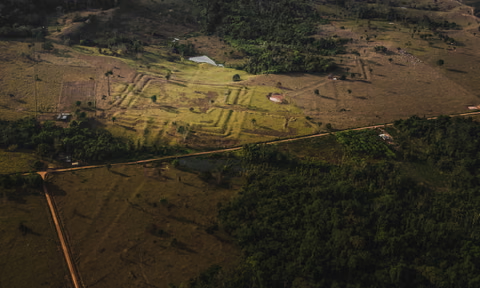
For centuries, the Amazon rainforest has been portrayed as an untouched wilderness with only scattered human settlements before European contact. A new archaeological study is challenging that long-held assumption.
Using advanced laser mapping technology, researchers have uncovered hundreds of previously hidden earthworks beneath the dense Brazilian rainforest, providing fresh evidence that a large, interconnected society flourished there more than 2,000 years ago. The findings, published in Nature, suggest that millions of people may once have lived in parts of the Amazon, reshaping historians’ understanding of the region’s past.
TL;DR
- Scientists discovered 432 ancient earthworks beneath the Brazilian Amazon using lidar technology.
- 396 of the sites were previously unknown.
- Researchers estimate 20,000 to 30,000 earthworks could still be hidden across the rainforest.
- The study suggests an interconnected society, called the Aquiry, lived in the region between 600 BCE and 850 CE.
- The findings challenge the long-standing belief that the Amazon was largely untouched before European colonization.
- Researchers estimate 1.5 million to 3 million people may have lived in the region.
Scientists uncover evidence of a lost Amazon civilization
A multinational team of researchers has identified hundreds of ancient monuments concealed beneath the Amazon rainforest, offering one of the strongest pieces of evidence yet that complex societies once thrived deep within the world’s largest tropical forest.
The research, published in Nature, documented 432 well-preserved archaeological sites, including ceremonial earthworks, geometric enclosures, and ancient road networks. Nearly all of these—396 sites—were discovered for the first time.
Based on their survey, researchers estimate that 20,000 to 30,000 similar earthworks may still lie hidden beneath the forest canopy, waiting to be discovered.
The findings add to a growing body of evidence that the Amazon was not an isolated wilderness but a landscape extensively shaped by Indigenous communities over thousands of years.
Who were the Aquiry?
The researchers use the name Aquiry, derived from the Indigenous Iñapari name for the Acre River, to describe the ancient society associated with these earthworks.
A multicultural network rather than a single empire
Instead of a centralized kingdom, archaeologists believe the Aquiry consisted of multiple communities connected by shared traditions, trade routes, and ceremonial practices.
Although the civilization left no written language, its engineering achievements remain visible through:
- Monumental earthworks
- Large ceremonial plazas
- Geometric enclosures
- Straight roads linking settlements
- Defensive ditches and embankments
According to the study, these communities occupied southwestern Amazonia between 600 BCE and 850 CE, surviving for roughly 1,500 years.
Researchers estimate the population ranged from 1.5 million to 3 million people, making it one of the largest known pre-Columbian population centers in tropical South America.
How lidar helped scientists see beneath the rainforest
The breakthrough was made possible by lidar (Light Detection and Ranging), a remote sensing technology that has transformed modern archaeology.
How lidar works
Instead of relying on traditional excavation, scientists mounted laser scanners on aircraft flying above the rainforest.
Millions of laser pulses were fired toward the ground.
While many reflected off the forest canopy, enough reached the surface below and bounced back, allowing researchers to digitally remove vegetation and create detailed three-dimensional maps of the landscape.
For this project, the team surveyed approximately 4,497 square kilometers (about 1,736 square miles) of rainforest.
Researchers’ survey method included:
- Long aerial transects stretching roughly 450 kilometers (280 miles)
- Mapping strips about 1 kilometer wide
- Survey lines spaced approximately 10 kilometers apart
This approach enabled scientists to examine large continuous sections of rainforest efficiently without disturbing the environment.
What did archaeologists discover?
The lidar scans revealed an impressive range of ancient structures.
Massive geometric earthworks
Among the most striking discoveries were enormous geoglyphs—large geometric designs constructed by excavating ditches and building earthen embankments.
Researchers identified:
- Perfect circles
- Squares
- Octagons
- Pentagonal designs
- Complex geometric combinations
- Straight roads connecting ceremonial sites
Some earthworks were enclosed by deep ditches measuring several meters in depth, suggesting they may have served ceremonial, social, or defensive purposes.
Radiocarbon dating indicates many of these structures were built approximately 2,500 years ago.
Why this discovery changes Amazon history
For decades, many scholars believed the Amazon’s nutrient-poor soils prevented the development of large, permanent civilizations.
This study adds to mounting evidence that Indigenous societies engineered the rainforest in sophisticated ways.
How many archaeological sites may still be undiscovered?
The 432 documented earthworks likely represent only a fraction of what remains hidden.
Using statistical modeling, researchers estimate there may be 20,000 to 30,000 undiscovered earthworks scattered throughout the Amazon Basin.
Because much of the rainforest remains inaccessible by ground, lidar is expected to play an increasingly important role in identifying ancient settlements without disturbing fragile ecosystems.
The findings also highlight the importance of preserving archaeological landscapes threatened by deforestation and development.
Questions researchers still cannot answer
Despite the remarkable discovery, many mysteries remain.
Scientists are still investigating:
- How the Aquiry supported such large populations.
- What crops they cultivated.
- How their political systems functioned.
- Why the civilization eventually disappeared.
- Whether disease, climate shifts, migration, or social changes contributed to its decline.
- How many additional settlements remain hidden beneath the forest.
Future lidar surveys and archaeological excavations may provide answers in the coming years.
Why the discovery matters today
The study does more than reveal an ancient civilization—it reshapes how historians view one of Earth’s most important ecosystems.
Rather than an untouched wilderness, the Amazon increasingly appears to be a landscape profoundly influenced by Indigenous societies over thousands of years. Their engineering, agriculture, and environmental management may hold valuable lessons for balancing human activity with ecological preservation today.
As researchers continue scanning the rainforest with advanced technology, the Amazon may prove to contain one of the richest archaeological records yet to be fully explored.