
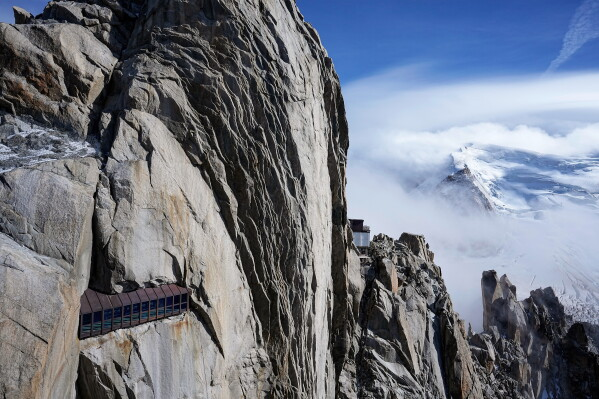
The effects of a warming planet are becoming increasingly visible in the world’s high mountains. After a glacier-related disaster in Nepal raised fresh concerns about communities living below unstable ice and rock, attention is turning to the Alps, where Mont Blanc is also showing signs of rapid change.
Known as the “White Mountain,” Mont Blanc is covered by glaciers, snow and permanently frozen ground. But rising temperatures are changing that landscape. Glaciers are retreating, snow is disappearing and thawing permafrost is weakening the frozen material that helps hold mountain slopes together.
The consequences are not limited to shrinking glaciers. As the ground beneath high-altitude rock formations warms, slopes can become unstable, increasing the risk of rockfalls and making some climbing routes increasingly difficult or dangerous.
Why is Mont Blanc becoming more dangerous?
One of the biggest concerns is the loss of permafrost, permanently frozen ground that can contain soil, rock and sediment bound together by ice.
When temperatures remain high for extended periods, that ice can thaw. In steep mountain terrain, the process can weaken the natural structure holding rocks and cliffs together.
On Mont Blanc, local authorities have reported an increase in rockfalls during periods of intense summer heat.
Stéphane Bozon, a deputy mayor in Chamonix-Mont-Blanc, said areas of the mountain have become harder to access because of glacier retreat, snowmelt, opening crevasses and collapsing rock.
Rockfalls are becoming a growing concern
The combination of melting ice and unstable rock can transform familiar mountain routes.
A gully at an altitude of around 4,805 metres has reportedly become temporarily impassable. Local officials have also warned that authorities need to prepare for potentially serious scenarios involving the collapse of parts of glaciers or mountains.
This matters beyond mountaineering.
Mont Blanc attracts climbers, hikers, guides and tourists throughout the year. Changes to high-altitude routes can create direct safety risks while also affecting communities and businesses that depend on mountain tourism.
How much have temperatures risen on Mont Blanc?
Data cited by French weather service Meteo-France show a significant increase in temperatures at high elevations.
At the Aiguille du Midi, which sits at approximately 3,842 metres, average July temperatures reportedly increased from 1.6°C in 1994 to 3.3°C in recent years.
Even a seemingly modest increase can have major consequences at elevations where temperatures often hover around the freezing point.
When temperatures cross that threshold more frequently, snow can melt sooner, glaciers can lose mass and ice that previously remained frozen year-round can begin to thaw.
What happens when mountain permafrost melts?
Permafrost is often described as frozen ground, but in mountainous regions it can serve another important function: it helps stabilize steep slopes.
Ice within cracks and rock formations can act like a natural cement. When that ice melts, the bonds holding rocks together can weaken.
The sequence can look like this:
- Air temperatures rise.
- Snow and ice melt earlier and for longer periods.
- Heat penetrates deeper into mountain slopes.
- Permafrost begins to thaw.
- Ice binding rocks and sediment weakens.
- Rockfalls, landslides and other slope failures become more likely.
That does not mean every thawing area will immediately collapse. Mountain hazards are influenced by geology, rainfall, slope angle, snow cover and other factors. But the loss of permafrost can remove an important stabilizing mechanism.
Is climate change causing glaciers to retreat across the Alps?
Yes, Alpine glaciers have experienced substantial long-term losses.
In Italy, Alpine glaciers have reportedly lost more than 40% of their surface area since 1991, according to regional glacier monitoring data cited in the supplied information.
The changes are visible in more than measurements.
Snow that historically persisted at high elevations is becoming less reliable, while exposed rock and ice are appearing in areas that were previously covered for longer periods.
For Mont Blanc, glacier retreat also changes the physical geography of climbing routes. Crevasses can open, ice bridges can disappear and previously snow-covered terrain can become exposed rock.
Why is the Nepal disaster raising concerns elsewhere?
The situation in the Himalayas illustrates why communities around the world are watching changes in mountain environments closely.
Glacial lakes can form as glaciers retreat. In some cases, ice, rock and debris create natural barriers around these bodies of water. If such a barrier fails, enormous quantities of water can be released suddenly in a glacial lake outburst flood, or GLOF.
These floods can carry rocks, mud and ice downstream, potentially destroying infrastructure and threatening settlements.
The reported disaster in Nepal has therefore renewed concerns about other communities located beneath glaciers and glacial lakes.
The risks are different from those at Mont Blanc, but the underlying climate signal is similar: warming is altering frozen mountain environments that communities have historically treated as relatively stable.
Are the Himalayas warming faster?
Scientists have warned that warming in the high Himalayas is creating increasing risks for glaciers and glacial lakes.
The region contains thousands of glaciers that feed major river systems across Asia. Their condition matters not only for mountain communities but also for populations downstream that depend on meltwater.
Researchers have also warned that some glacial lakes could become increasingly hazardous as glaciers retreat and new water bodies form.
This makes glacier monitoring especially important. Satellite observations, ground measurements and early-warning systems can help authorities identify changes before they become disasters.
What is happening to mountain permafrost elsewhere?
The problem extends well beyond the Alps and Himalayas.
The Arctic has also experienced dramatic changes linked to thawing permafrost. A 2025 study, cited in the supplied material, linked a major rockslide on an Arctic island to permafrost degradation.
That is important because it shows that permafrost loss is not simply a problem affecting isolated mountain routes.
It can alter entire landscapes.
As frozen ground thaws, slopes can become unstable, infrastructure can be damaged and previously rare landslides or rockfalls can become more frequent.
Can anything be done to stop Mont Blanc from melting?
Local authorities cannot stop global warming at a single mountain.
They can, however, reduce exposure to hazards by monitoring unstable areas, closing dangerous routes, improving warnings and preparing emergency plans.
Scientists can also track glacier thickness, snow cover and permafrost temperatures to identify areas where conditions are changing rapidly.
The longer-term solution remains reducing greenhouse-gas emissions. Local safety measures can reduce immediate risks, but they cannot reverse the global warming driving glacier retreat and permafrost thaw.
Why Mont Blanc matters beyond the Alps
Mont Blanc is more than Europe’s highest mountain. It is also a visible indicator of how a warming climate is changing high-altitude environments.
Its retreating glaciers and thawing permafrost demonstrate that climate change can create risks that go beyond rising temperatures and melting ice.
The biggest concern is instability.
As frozen ground disappears, landscapes that have remained structurally stable for generations can become more unpredictable. For communities beneath mountains, climbers navigating high-altitude routes, and scientists monitoring glaciers, that shift makes preparation increasingly urgent.
The warning from Mont Blanc is therefore similar to the one emerging from the Himalayas and the Arctic: when Earth’s frozen landscapes warm, the consequences can reach far beyond the ice itself.