
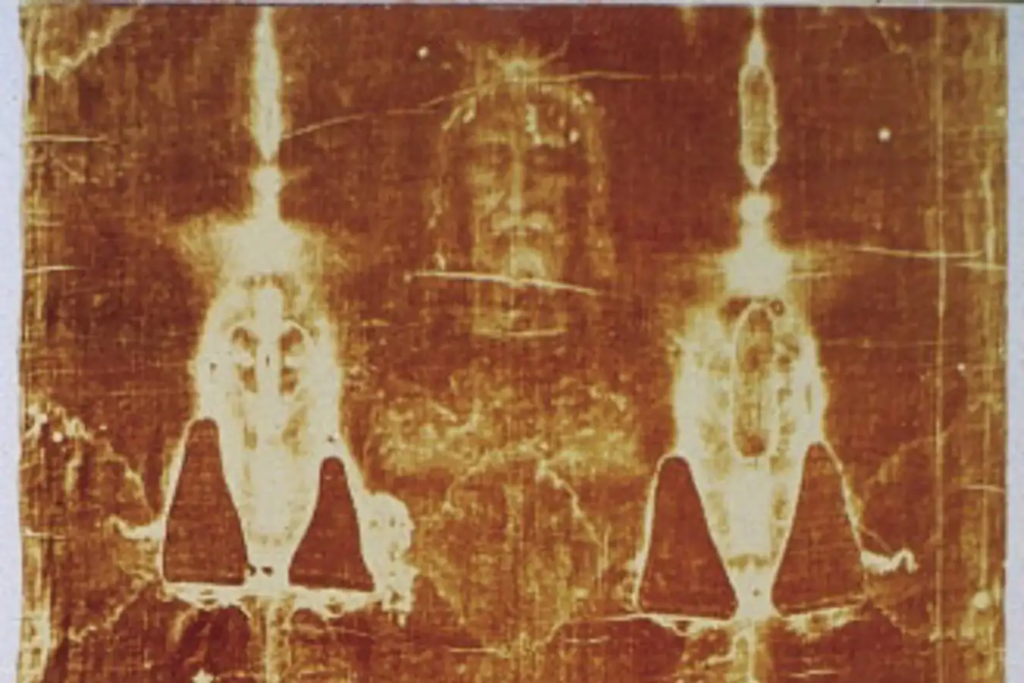
The Shroud of Turin’s India origin claim is stirring fresh debate around one of the world’s most examined religious relics. A new scientific analysis suggests that a significant portion of the human DNA found on the cloth may trace back to India, adding another layer to an already tangled historical puzzle.
For centuries, the Shroud has sat at the intersection of faith, science, and skepticism. This latest finding does not settle the debate. Instead, it deepens it.
What is the Shroud of Turin?
The Shroud of Turin is a 4.4-meter-long linen cloth believed by some to have wrapped the body of Jesus Christ after his crucifixion.
It bears the faint image of a man whose features resemble traditional depictions of Christ. For believers, it is a sacred object. For scientists, it is a forensic puzzle.
Why has it always been controversial?
The Shroud has sparked debate for three main reasons:
- The image formation remains unexplained
- Its historical record is incomplete before the Middle Ages
- Scientific tests have produced conflicting conclusions
Radiocarbon dating conducted in 1988 placed the cloth in the 13th to 14th century, suggesting a medieval origin rather than a first-century relic.
What does the new DNA study claim?
A study led by Gianni Barcaccia from the University of Padova revisits samples collected from the Shroud in 1978.
The key claim: Nearly 40 percent of the human DNA found on the cloth belongs to Indian lineages.
What else did researchers find?
The Shroud appears to be a biological time capsule. Researchers identified DNA traces from:
- Multiple human populations across regions and eras
- Domestic animals such as cats, dogs, and cattle
- Wild animals, including deer and rabbits
- Plant species like wheat, potatoes, and peppers
- Even traces linked to fish
This diversity suggests the cloth has been handled, exposed, and possibly transported across continents over centuries.
Why is the DNA so mixed?
Researchers point to heavy contamination over time:
- Pilgrims and handlers touching the cloth
- Environmental exposure across different regions
- Movement through trade routes
In simple terms, the Shroud is less a pristine artifact and more a crowded guestbook of history.
Could the Shroud of Turin have originated in India?
The study outlines two main theories behind the Indian DNA presence:
1. Historical contact and contamination
The cloth may have come into contact with individuals of Indian origin over centuries through the following:
- Trade routes linking Asia and Europe
- Religious pilgrimages
- Colonial-era exchanges
This would explain the DNA without requiring the cloth itself to be Indian.
2. Indian origin of the fabric
A more provocative idea is that
- The linen or yarn used to make the Shroud originated in India
- It was later transported to the Mediterranean
This aligns with known ancient trade networks, including those connected to the Indus Valley and Silk Road systems.
Why are many scientists skeptical?
Not everyone is convinced by the India-origin theory.
Anders Götherström from Stockholm University argues there is still no strong reason to abandon the medieval European origin theory.
Key counterpoints include the following:
- Radiocarbon dating places the cloth in the Middle Ages
- DNA contamination makes it nearly impossible to identify the original material
- Historical records link the Shroud to France in the 13th–14th century
Earlier critics, including medieval scholar Nicole Oresme, even dismissed the Shroud as a fabrication centuries ago.
What does this mean for the Shroud’s authenticity?
The new findings do not prove the Shroud is from India. They also do not confirm it is the burial cloth of Jesus Christ.
Instead, they highlight a key challenge: the Shroud has been handled too extensively to preserve a clean scientific record.
What scientists can and cannot conclude
What we know:
- The cloth contains DNA from multiple regions
- It has been exposed to diverse environments
- Its current biological profile is heavily contaminated
Also, what remains uncertain:
- Where the cloth was originally made
- When exactly was it created
- Whether it has any direct link to Jesus Christ
Why the Shroud of Turin still captivates the world
The Shroud endures because it sits at a rare crossroads:
- Religion and science
- Faith and evidence
- History and mystery
Each new study, including this one, adds data but rarely closure. The result is a relic that continues to invite both devotion and doubt.
TL;DR
- A new study claims that about 40 percent of the DNA on the Shroud of Turin is linked to Indian lineages
- Researchers suggest contamination or the possible Indian origin of the fabric
- Critics argue the evidence is inconclusive due to heavy DNA mixing
- Radiocarbon dating still points to a medieval European origin
- The Shroud remains one of history’s most debated relics