
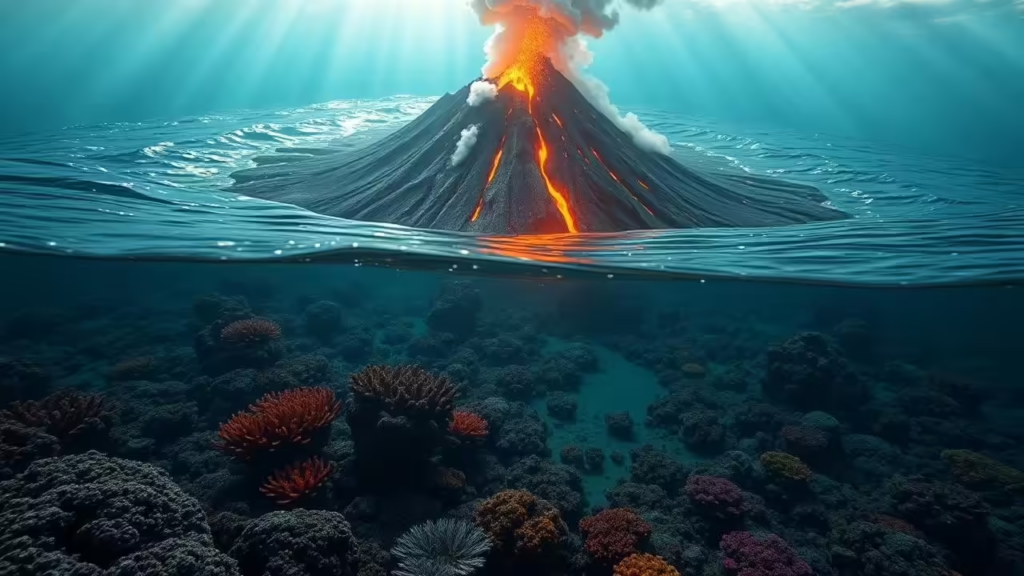
Scientists have identified 73 previously unknown underwater volcanoes, a discovery that could improve understanding of one of Earth’s least-studied geological hazards. The findings, published in Nature Communications Earth & Environment, reveal dozens of potential volcanic systems hidden beneath the ocean floor, some of which may still be capable of future eruptions.
While the discovery has prompted headlines warning of catastrophic underwater explosions, researchers emphasize that the newly identified calderas are not an indication that an eruption is imminent. Instead, the study highlights the need for further monitoring to determine which sites, if any, remain volcanically active.
What did scientists discover?
An international team of researchers used image-recognition technology originally developed to identify impact craters on Mars to analyze detailed maps of the ocean floor.
The automated system initially identified 87,435 possible circular structures. After several rounds of verification and manual analysis, researchers narrowed the list to:
- 78 likely volcanic calderas.
- Five had already been documented.
- 73 previously unknown underwater volcanic calderas remained.
The newly identified structures are distributed across different geological settings:
- Eight along underwater mountain ranges.
- Nine in volcanic arcs near tectonic plate boundaries.
- Sixty-one within the interiors of tectonic plates.
The findings significantly expand the known catalog of submarine volcanic calderas.
What is a volcanic caldera?
A caldera is a large depression that forms after a volcano erupts and empties much of its underground magma chamber.
As the magma reservoir drains, the ground above can collapse, leaving behind a broad crater-like basin.
Finding a caldera indicates that a volcano experienced at least one major eruption in the past. However, it does not necessarily mean the volcano is permanently extinct.
Many volcanic systems can remain dormant for centuries or even thousands of years before becoming active again.
Why are underwater volcanoes important?
Most of Earth’s volcanic activity occurs beneath the oceans.
Submarine volcanoes form as tectonic plates spread apart, collide, or move over mantle hotspots, allowing magma to rise toward the seafloor.
Although many eruptions occur unnoticed in deep water, some can have significant global consequences if they are particularly powerful or occur in shallow seas.
Because much of the ocean floor remains poorly mapped, scientists know far less about underwater volcanoes than those on land.
Before this latest study, only about 30 submarine calderas had been thoroughly documented.
The newly identified features could help researchers better understand how underwater volcanic systems evolve and where future hazards may exist.
Could these volcanoes erupt again?
Possibly, but researchers cannot yet determine which ones remain active.
The study concludes that some of the calderas may belong to volcanic systems capable of future eruptions. However, there is currently no evidence that any specific volcano is preparing to erupt.
Scientists identified seven calderas as having relatively higher potential for future activity based on their geological characteristics. These sites have been prioritized for additional investigation.
Determining whether a submarine volcano poses a real hazard requires years of further research, including:
- Seismic monitoring.
- Mapping of magma movement.
- Temperature measurements.
- Gas emissions.
- High-resolution seafloor surveys.
What happened during the Tonga eruption?
Researchers point to the 2022 eruption of Hunga Tonga-Hunga Ha’apai as an example of why submarine volcanoes deserve closer attention.
After years of relative quiet, the volcano produced one of the most powerful eruptions in modern history.
The eruption:
- Generated an enormous atmospheric plume that reached into the mesosphere.
- Produced shock waves detected around the world.
- Created a tsunami that affected coastlines across the Pacific.
- Sent waves to countries including Peru and Fiji.
- Caused widespread damage in Tonga.
The event demonstrated that underwater volcanoes can produce global impacts despite being hidden beneath the ocean’s surface.
Why this discovery matters
The discovery is less about predicting an impending disaster than improving scientific understanding.
Identifying previously unknown volcanic systems allows researchers to:
- Build more accurate maps of Earth’s geology.
- Improve tsunami hazard assessments.
- Better understand tectonic activity beneath the oceans.
- Prioritize monitoring of potentially active volcanoes.
- Strengthen early-warning capabilities for coastal communities.
As ocean mapping technology continues to improve, scientists expect additional submarine volcanoes to be identified in the coming years.
Should people be worried?
At this stage, there is no immediate reason for public concern.
The research does not indicate that any of the newly identified volcanoes are about to erupt. Instead, it expands scientists’ understanding of where potentially active volcanic systems exist beneath the seafloor.
Geologists caution that predicting volcanic eruptions, especially underwater ones, remains extremely difficult. The newly discovered calderas represent locations for future study rather than confirmed future disasters.
TL;DR
- Scientists discovered 73 previously unknown underwater volcanic calderas using technology adapted from Mars crater detection.
- The findings were published in Nature Communications Earth & Environment.
- A caldera forms when a volcano collapses after a major eruption.
- Some of the newly identified volcanic systems could potentially erupt again, but there is no evidence that any eruption is imminent.
- Researchers identified seven calderas for further monitoring because they may present relatively higher volcanic potential.
- The discovery could improve future tsunami risk assessments, volcanic monitoring, and understanding of Earth’s underwater geology.