
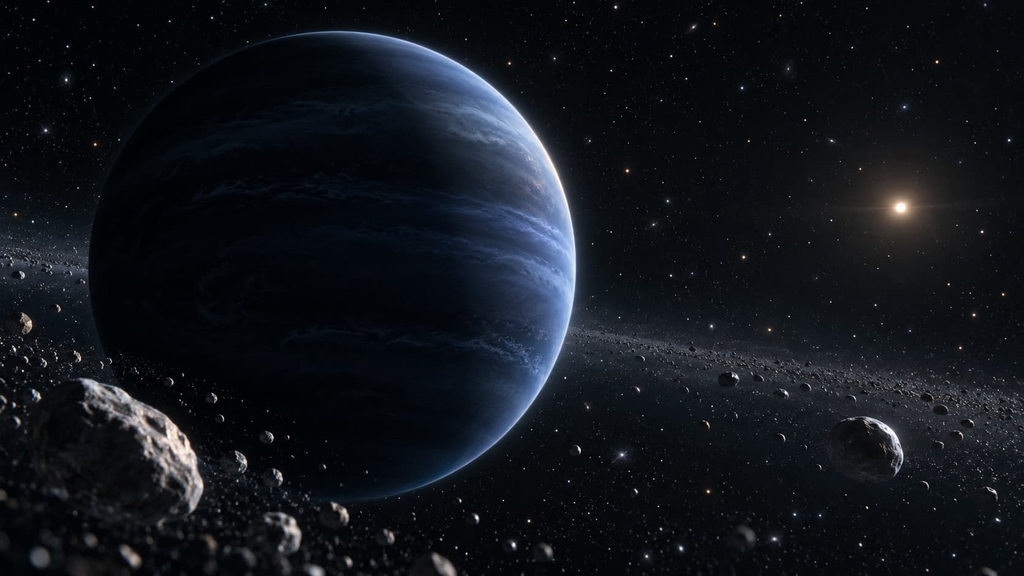
Astronomers searching for the Solar System’s hypothetical ninth planet may finally have a specific object worth chasing. Researchers from National Tsing Hua University in Taiwan identified a faint infrared source that appears to have shifted across the sky in a way broadly consistent with a distant, slowly moving body. The candidate emerged after scientists compared observations from two space-based infrared surveys taken 23 years apart.
The finding is intriguing, but it is not a discovery of Planet Nine.
The study’s authors explicitly say that the available observations are insufficient to establish the object’s full orbit, determine its nature with confidence or prove that it is the planet astronomers have been searching for. Follow-up observations are needed.
The research, led by Terry Long Phan and colleagues in Taiwan, Japan and Australia, was published in the journal Publications of the Astronomical Society of Australia in May 2025. It has received renewed attention in October 2026 after new coverage highlighted the surviving candidate.
What did astronomers actually find?
The researchers searched archival infrared data for an object that could fit theoretical expectations for Planet Nine.
Their approach relied on a simple but powerful idea: a planet hundreds of astronomical units from the Sun would move incredibly slowly across the sky. It might therefore look stationary during an individual observing campaign but shift enough over decades for astronomers to detect the difference.
To exploit that effect, the team compared data from the Infrared Astronomical Satellite, or IRAS, which surveyed the sky in 1983, with observations from Japan’s AKARI spacecraft collected in 2006 and 2007.
The 23-year gap gave the researchers a long enough baseline to search for the apparent movement expected from an extremely distant planet.
After applying filters for position, brightness and infrared characteristics, the researchers produced 13 candidate pairs.
They then manually inspected the corresponding images.
Only one candidate pair survived that process.
Why use infrared light to search for Planet Nine?
Finding a planet this far from the Sun is extraordinarily difficult using ordinary visible-light observations.
Planet Nine, if it exists, would be far beyond Neptune. At such distances, sunlight reaching the planet would be extremely weak, and only a tiny fraction of the reflected light would make the journey back toward Earth.
A distant planet can still emit its own thermal radiation, however.
That makes infrared astronomy particularly useful. Rather than trying to detect sunlight reflected from an almost invisible world, researchers can look for the faint heat signature expected from a cold planetary body.
The Taiwanese team therefore focused on far-infrared observations from IRAS and AKARI.
The surveys were never designed specifically to find Planet Nine. Instead, researchers are mining their historical data for objects that were moving too slowly to attract attention at the time.
The mysterious object moved nearly 48 arcminutes
The surviving candidate appears to have shifted by about 47.5 arcminutes between the IRAS and AKARI observations.
That is a substantial angular movement over 23 years, but it is still consistent with the kind of slow motion researchers would expect from an extremely distant Solar System object.
For perspective, the full Moon appears about half a degree wide, or roughly 30 arcminutes, in Earth’s sky. The candidate’s apparent displacement was therefore around one and a half times the Moon’s apparent diameter.
The movement is one of the reasons the source attracted attention.
A background star or distant galaxy would effectively remain fixed relative to the sky over that period. A nearby Solar System object, by contrast, changes position.
The challenge is determining whether the two observations really represent the same physical object.
How did millions of sources become one candidate?
The process was considerably more selective than simply looking at two pictures and noticing something had moved.
The team began with very large infrared source catalogs and used assumptions about Planet Nine’s expected temperature, brightness, mass and distance to establish what a plausible candidate should look like.
The researchers targeted objects between 500 and 700 astronomical units from the Sun and considered a mass range of roughly seven to 17 times Earth’s mass.
After the initial filtering, candidate infrared sources from the two surveys were paired according to the angular separation expected from a slowly moving planet.
That produced 13 possible pairs.
The researchers then inspected the images manually, checking that the sources were real, that the relevant background was not contaminating the observations and that the positions behaved in a manner consistent with a moving Solar System body.
Only one pair remained.
Does this mean Planet Nine has been found?
No.
This is the most important distinction in the story.
The candidate has not been confirmed as a planet, and the researchers do not claim that they have discovered Planet Nine.
Two positions measured more than two decades apart are not enough to calculate a reliable Keplerian orbit.
Astronomers need additional observations to determine whether the object follows a gravitationally bound orbit around the Sun and, if so, what that orbit looks like.
The candidate also has a significant data problem. The team’s paper says its AKARI flux measurement at 65 micrometers may be unreliable.
That means even the infrared brightness that helped identify the source requires further verification.
Why does the orbit matter so much?
Planet Nine was originally proposed to explain unusual patterns in the outer Solar System.
Some distant trans-Neptunian objects have highly eccentric or tilted orbits that appear clustered in ways that could potentially be explained by the gravitational influence of a large unseen planet.
But finding any distant object is not enough.
For the new candidate to become Planet Nine, astronomers would need to show that its orbit is compatible with the gravitational effects attributed to the hypothetical planet.
The researchers themselves acknowledge an additional complication: depending on where the candidate is located on the sky, it may not reproduce the particular orbital clustering used in some Planet Nine models.
So even a genuine planet-like object in the right general distance range would not automatically be the long-sought Planet Nine.
What happens next?
Follow-up observations are the crucial next step.
The researchers have proposed using the Dark Energy Camera, or DECam, mounted on the 4-meter Víctor M. Blanco Telescope in Chile.
The instrument’s wide field of view and sensitivity could allow astronomers to locate the candidate again and determine whether it continues to move in the expected direction.
More observations would provide additional positions from which scientists could begin calculating an orbit.
That would dramatically strengthen or weaken the Planet Nine case.
If the object follows a consistent trajectory over multiple observations, researchers could begin testing whether it is bound to the Sun and whether its estimated physical properties match those expected of Planet Nine.
If it disappears or fails to move as predicted, the candidate could simply be another false lead.
Why has Planet Nine remained so elusive?
The hypothetical planet was proposed because of gravitational clues rather than direct observation.
Its possible distance is one of the biggest problems.
Some models place it hundreds of astronomical units from the Sun. One astronomical unit is the average distance between Earth and the Sun, meaning that an object 500 AU away would be 500 times farther from the Sun than Earth is.
That extreme distance leaves Planet Nine cold, faint and difficult to distinguish from the enormous population of background sources.
There is also uncertainty over its exact location, mass and orbit.
Researchers cannot simply point a telescope at one known coordinate and expect to find it.
Instead, astronomers must search wide regions of sky while accounting for different theoretical possibilities.
Why do astronomers think Planet Nine could exist?
The Planet Nine hypothesis grew out of observations of distant objects beyond Neptune.
Several extreme trans-Neptunian objects exhibit orbital arrangements that some researchers argue are unlikely to be purely random. In the Planet Nine model, the gravity of an unseen massive planet could gradually shape those orbits over long periods.
The idea was formally presented by Caltech astronomers Konstantin Batygin and Mike Brown in 2016 and has remained controversial ever since.
Other researchers have questioned whether the apparent clustering could be caused by observational biases or whether alternative explanations can reproduce the same orbital patterns.
That means Planet Nine remains a hypothesis, not an established member of the Solar System.
Could the candidate turn out to be something else?
Yes.
That possibility is precisely why the scientific team is calling it a candidate rather than a discovery.
Infrared surveys contain sources generated by stars, galaxies, dust and other astronomical objects. Instrumental effects and measurement uncertainties can also complicate the identification of extremely faint targets.
The researchers specifically noted concerns about the candidate’s AKARI flux measurement.
More importantly, the object has not yet been observed enough times to establish its orbit.
The candidate could ultimately prove to be an unrelated astronomical source or an artifact of the data.
A tantalizing lead, not a ninth planet yet
The significance of the research lies in giving astronomers something concrete to investigate.
For years, Planet Nine searches have relied largely on indirect evidence, theoretical calculations and the unusual orbital behavior of distant icy bodies.
The IRAS-AKARI study offers a different kind of clue: a faint source that appears to have moved over decades in a way compatible with an extremely distant Solar System object.
That is an exciting development, but science still has another hurdle to clear.
The candidate must be seen again.
Its motion must be measured.
Its orbit must be reconstructed.
And only then can astronomers determine whether this faint infrared source is actually the elusive world that has occupied a strange corner of planetary science for nearly a decade.
For now, Planet Nine remains hypothetical.
But researchers may finally have a very specific piece of sky to watch.