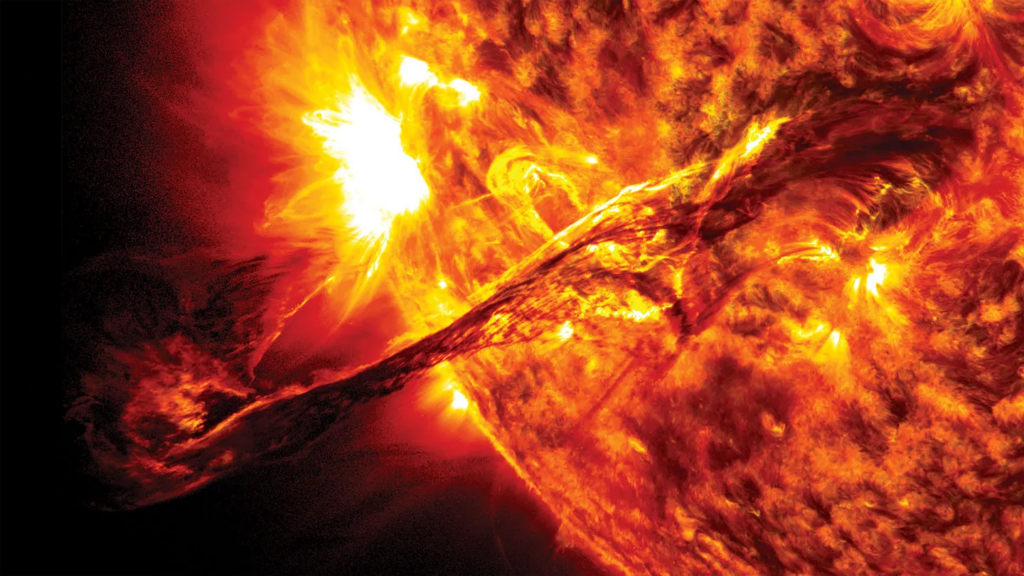
A powerful solar storm could push Earth into a space crisis faster than most people realize. According to new research, if operators lose control of satellites during such an event, a catastrophic collision in low-Earth orbit could happen in as little as 2.8 days, setting off a chain reaction that may cripple modern life on the ground.
This isn’t science fiction or distant speculation. It’s a scenario scientists say is becoming more likely as Earth’s orbital neighborhood grows dangerously crowded.
What is the space catastrophe scientists are warning about?
Researchers are sounding the alarm about a fragile system most people never see: the vast network of satellites circling Earth in low-Earth orbit.
LEO is now packed with thousands of satellites that power everyday services such as GPS navigation, internet connectivity, weather forecasting, banking timestamps, and military and emergency communications.
Under normal conditions, satellite operators constantly monitor and maneuver these objects to avoid crashes. But the new study asks a troubling question: what happens if that control suddenly disappears?
The short answer is chaos, very quickly.
A severe solar storm could disrupt communication and navigation systems on Earth, precisely the tools needed to keep satellites from colliding.
Why does a solar storm pose such a serious risk?
Solar storms occur when the Sun releases bursts of charged particles that slam into Earth’s magnetic field. Most storms are manageable. The danger comes from extreme events.
How solar storms affect satellites
During a powerful storm, Earth’s upper atmosphere heats up and expands. Satellites experience increased atmospheric drag, their orbits decay faster than expected, and they drift into unpredictable paths.
At the same time, solar activity can interfere with ground-based communication systems, GPS and navigation signals, and real-time command-and-control links.
This creates a worst-case scenario: satellites need urgent course corrections, but operators may be unable to send them.
How crowded is low-Earth orbit right now?
The scale of the problem is staggering.
According to existing data, satellites pass within one kilometer of each other every 22 seconds. Thousands of new satellites have been launched in the past few years, and mega-constellations now dominate LEO, multiplying collision risks.
Operators already conduct constant avoidance maneuvers. Even a brief loss of control dramatically raises the odds of disaster.
What is the CRASH Clock, and why does 2.8 days matter?
To quantify the danger, researchers introduced a new metric called the Collision Realization and Significant Harm, or CRASH, Clock.
What the CRASH Clock measures
The clock estimates how long it would take for a catastrophic satellite collision to occur if operators cannot intervene.
In 2018, the time window was about 121 days. By June 2025, that window had shrunk to 2.8 days. A 24-hour loss of control carries a 30 percent chance of a collision.
That speed reflects just how tightly packed low-Earth orbit has become.
What happens after the first collision?
The real danger isn’t one crash. It’s what comes next.
Understanding the Kessler Syndrome
A single satellite collision can create thousands of debris fragments traveling at speeds exceeding 17,000 miles per hour. Those fragments can strike other satellites, triggering additional collisions.
This cascading effect is known as the Kessler Syndrome, a scenario where the orbit becomes choked with debris.
Once it starts, the process can become self-sustaining.
Could this really wipe out satellite infrastructure?
Yes, especially if the solar storm rivals past extremes.
Researchers point to the Carrington Event of 1859, the most intense solar storm ever recorded. If a storm of similar strength struck today, satellite operators could lose control for more than three days. Avoidance maneuvers would fail, and mega-constellations could collapse like a pack of cards.
Three days is far longer than the 2.8-day threshold flagged by the CRASH Clock.
Why does this matter for people on Earth?
Satellite failure wouldn’t just affect space agencies. The impact would ripple across daily life.
Potential consequences include GPS outages affecting aviation and shipping, internet disruptions, especially in remote regions, weather forecasting blind spots, financial system timing errors, and military and emergency communication gaps.
Modern society quietly depends on satellites. Losing them would be felt almost immediately.
Are we prepared for this risk?
Not enough, according to the researchers.
Current gaps in preparedness
These include heavy reliance on real-time human intervention, limited autonomous collision-avoidance systems, no global traffic authority for space, and inadequate integration of space-weather forecasting into satellite operations.
The study suggests response windows are shrinking faster than safeguards are improving.
What could reduce the risk?
Scientists stress that this outcome is not inevitable, but action must come quickly.
Possible mitigation steps include stronger space-weather monitoring and early warning systems, autonomous satellite maneuvering capabilities, stricter debris-mitigation and end-of-life disposal rules, and international coordination on space traffic management.
Each of these requires cooperation across governments, militaries, and private companies.
TL;DR
A severe solar storm could disrupt satellite control systems. Without intervention, a catastrophic collision could occur in 2.8 days. One collision could trigger the Kessler Syndrome, filling the orbit with debris. A Carrington-level storm could cripple satellite infrastructure within days. Modern life depends heavily on satellites, making this a global risk.