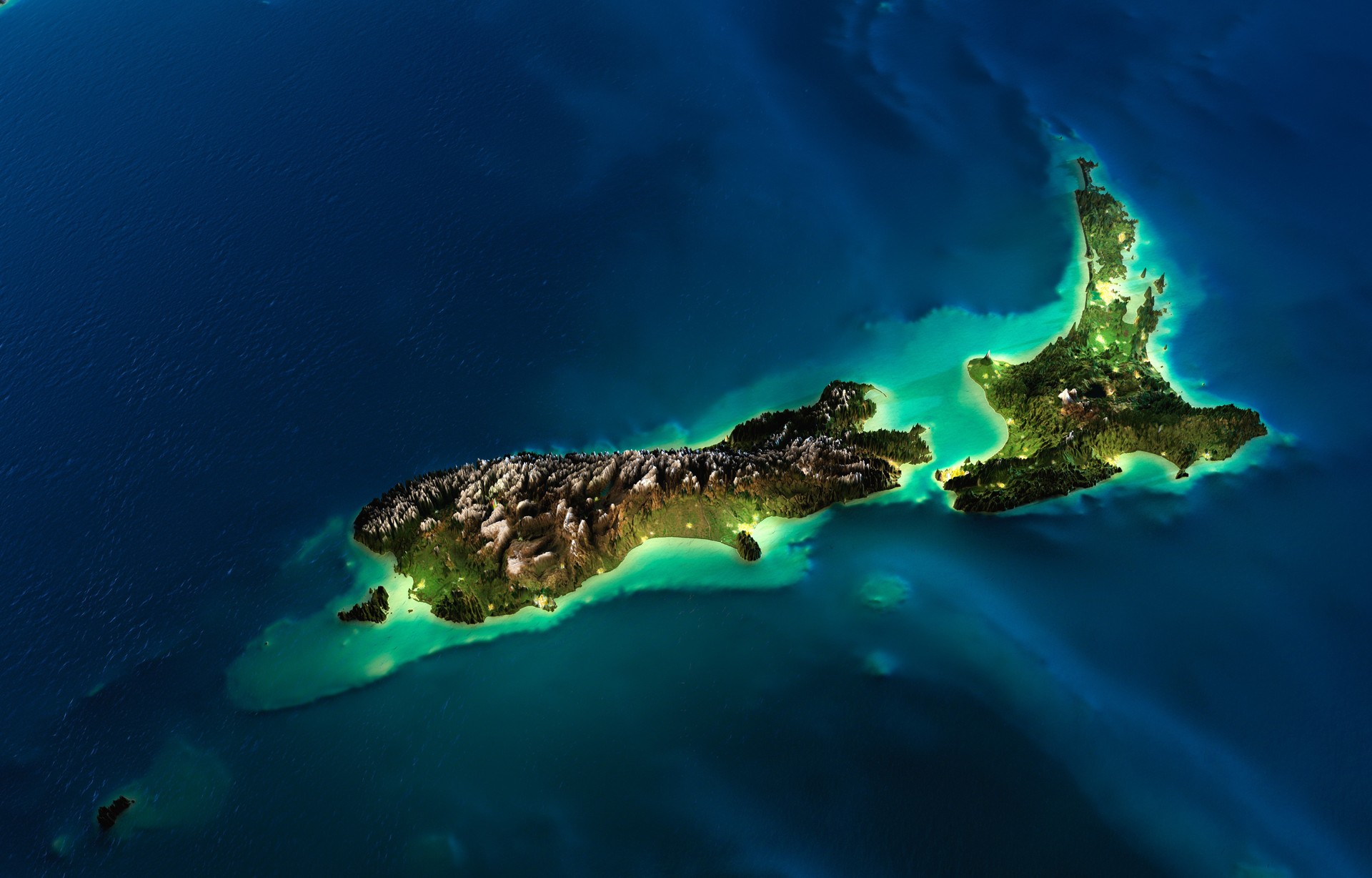
We all know the geography of the earth by now. We are well aware that there are 7 continents on our planet earth. Of course, you are correct but the scientists may not agree with you. Scientists have made a discovery that may give us the world’s eighth continent. They’ve found a piece of land called Zealandia.
94 percent of it is underwater

In 2017, a group of geologists made headlines when they published the finding of Zealandia. It is roughly six times the size of Madagascar and encircles 1.89 million square miles. Though the world’s encyclopedias, maps, and search engines had been arguing for some time that there are only seven continents. The team confidently acquainted the world that this was false. After all, there are eight of them and the most recent proliferation is the world’s smallest, thinnest, and youngest. The catch is that 94 percent of it is underwater, with only a few islands, such as New Zealand, jutting out from its depths. It had been lurking in plain sight the entire time.
The first real evidence of Zealandia’s presence was collected by the Scottish naturalist Sir James Hector
“This is an example of how something very obvious can take a while to uncover,” says Andy Tulloch. Andy is a geologist at the New Zealand Crown Research Institute GNS Science, who was part of the team that discovered Zealandia. However, this is only the beginning. Four years later, the landmass remains mysterious, its puzzles jealously guarded beneath 6,560 feet of water. How did it come to be? Who or what used to live there? How long has it been submerged? The first real evidence of Zealandia’s presence was collected by the Scottish naturalist Sir James Hector. He joined an expedition to study a group of islands of New Zealand’s southern coast in 1895.
Despite this is an early breakthrough, the existence of a feasible Zealandia lingered in a dilemma until the 1960s. Then, in the 1960s, geologists eventually agreed on an explanation of a continent: a geological area with a high elevation, a distinct range of rocks, and a thick crust. It must also be large. “Things happen pretty slowly in this field,” says Nick Mortimer, a geologist at GNS Science who led the 2017 study. “You just can’t be a tiny piece,” says Mortimer.
A mysterious elongation
The final ornament came from satellite data, which can be utilized to study and map the seafloor by tracing tiny deviations in the Earth’s gravity across several parts of the crust. Zealandia is noticeable with this technology as a shapeless mass nearly the size of Australia. “If you think about it, every continent on the planet has different countries on it, [but] there are only three territories on Zealandia,” said Mortimer. Zealandia was once a part of Gondwana, a historical supercontinent that formed around 550 million years ago and almost incorporated all of the lands in the southern hemisphere. It inhabited a corner on the eastern side, where it shared borders with several other countries, including half of West Antarctica and the entirety of eastern Australia.
Continental crust is typically 40km thick, significantly thicker than oceanic crust, which is typically 10km thick. Zealandia was stretched so much as a result of the strain that its crust now only extends 20km (12.4 miles) down. The water-thin continent eventually sank though not quite to the level of normal oceanic crust and vanished beneath the sea. The shape of Zealandia is another mystery. “If you look at a geological map of New Zealand, there are two things that stand out,” says Sutherland. One of these is the Alpine Fault, a plate boundary that runs along the South Island and is so significant, it can be seen from space. The second is that the geology of New Zealand, as well as that of the wider continent, is oddly bent. Both are split in two by a horizontal line, which is where the Pacific and Australian tectonic plates meet.