
For the first time in more than half a century, humans are preparing to leave Earth’s neighborhood and head back toward the Moon. NASA has officially set February 6 as the target launch date for Artemis II, marking humanity’s first crewed deep-space mission since the Apollo era ended in 1972.
This is not a symbolic joyride. Artemis II is designed to answer a fundamental question that has hovered over human spaceflight for decades: Are we truly ready to live, work, and travel beyond low Earth orbit again, safely and sustainably?
The mission is a crucial step in NASA’s long-term plan to return astronauts to the Moon and, eventually, push onward to Mars.
What is Artemis II, and why is it such a big deal?
Artemis II is the first crewed mission of NASA’s Artemis program, a multi-phase effort to establish a lasting human presence on and around the Moon.
Unlike the Apollo missions, which were short and politically driven, Artemis is structured as a long-term exploration campaign. Artemis II sits at the heart of that strategy.
A historic first since Apollo
Artemis II will be the first time since Apollo 17 that humans:
- Leave low Earth orbit
- Travel hundreds of thousands of kilometers into deep space
- Experience prolonged exposure beyond Earth’s protective magnetic field
In practical terms, this mission reopens a door that has been closed for 53 years.
When will Artemis II launch?
NASA has set February 6 as the primary launch date, with a broader launch window running from January 31 to February 14.
Backup launch opportunities are scheduled for:
- February 7
- February 8
- February 10
- February 11
Additional contingency dates are also under evaluation.
As with all space launches, the final decision will depend on factors such as:
- Weather conditions
- Technical readiness of the rocket and spacecraft
- Crew safety assessments
Who is going to the Moon?
Artemis II will carry four astronauts, representing both the United States and Canada:
- Reid Wiseman (NASA) – Mission commander
- Victor Glover (NASA) – Pilot
- Christina Koch (NASA) – Mission specialist
- Jeremy Hansen (Canadian Space Agency) – Mission specialist
Hansen’s participation makes him the first Canadian astronaut to fly on a lunar mission, underscoring Artemis’ international character.
How will the Artemis II mission work?
Launch and spacecraft
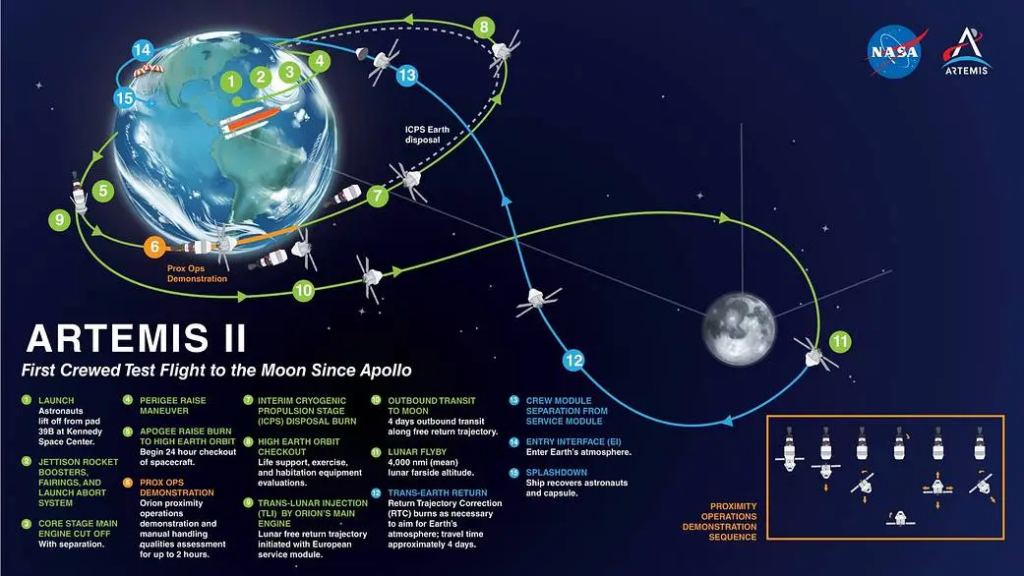
The mission will lift off from Cape Canaveral, with astronauts riding inside the Orion spacecraft, launched atop NASA’s Space Launch System (SLS)—the most powerful rocket currently in operation.
- Orion spacecraft
- Space Launch System
After launch, Orion will:
- Orbit Earth several times to verify onboard systems
- Begin its trajectory toward the Moon
- Conduct a close lunar flyby
- Use the Moon’s gravity to slingshot back toward Earth
No landing, by design
Artemis II will not orbit or land on the Moon. That’s intentional.
This mission focuses on:
- Testing life-support systems
- Evaluating navigation and communication in deep space
- Assessing human performance far from Earth
- Verifying safe reentry at lunar-return speeds
If something goes wrong, Orion’s trajectory allows it to return to Earth using lunar gravity alone—an important safety feature.
Why does Artemis II matter beyond symbolism?
1. It validates human deep-space travel again
Robotic missions have thrived, but humans haven’t left Earth orbit since the early 1970s. Artemis II tests whether today’s technology—and today’s astronauts—can safely handle that challenge.
2. It reduces risk for future Moon landings
Artemis II functions as a stress test. Any flaw discovered here prevents far more dangerous failures during Artemis III, which is expected to land astronauts on the lunar surface.
3. It supports long-term lunar infrastructure
NASA isn’t just going back to plant a flag. Artemis aims to:
- Build the Lunar Gateway space station
- Enable sustained surface missions
- Test technologies needed for Mars
Artemis II is the bridge between ambition and execution.
How Artemis II differs from Apollo
| Apollo Era | Artemis Program |
|---|---|
| Short-term missions | Long-term exploration |
| Cold War-driven | Science and sustainability-driven |
| US-only crews | International partnerships |
| Minimal infrastructure | Lunar bases, gateways, supply chains |
What happens before launch?
The countdown begins well before liftoff.
Key pre-launch milestones
- January 17: The fully stacked SLS rocket and Orion spacecraft roll out from NASA’s Vehicle Assembly Building
- Pad 39B: Systems checks and simulated countdowns
- Wet dress rehearsals: Fueling tests with cryogenic propellants
- Final launch day: Full fueling and crew boarding
Each step is designed to surface potential issues early—before astronauts are aboard.
How does Artemis II lead to Artemis III?
Artemis II answers the “can we?” question. Artemis III tackles the “can we land?” challenge.
Artemis III is expected to:
- Carry astronauts to lunar orbit
- Use a human landing system to reach the surface
- Return humans to the Moon for the first time since 1972
Success on Artemis II is a non-negotiable prerequisite.
Why this mission matters right now
Space is no longer a two-player game. China, Europe, India, and private companies are all accelerating their lunar ambitions.
Artemis II sends a clear signal:
- The US intends to lead, not follow
- Human exploration is back on the table
- The Moon is a stepping stone, not a destination
For a generation that has only known robotic exploration, Artemis II restores a sense of human presence in deep space.
TL;DR
- Launch date: February 6, with backups through mid-February
- Mission: First crewed lunar mission since 1972
- Crew: Four astronauts from NASA and Canada
- Goal: Test deep-space systems before a Moon landing
- Why it matters: Lays the groundwork for sustained lunar exploration and future Mars missions