
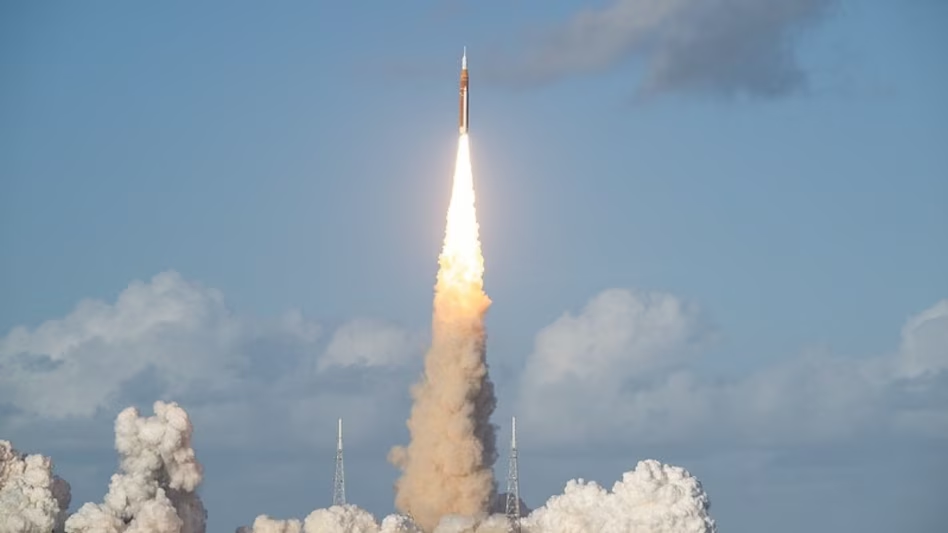
For the first time in over half a century, humans are heading back toward the Moon. NASA has successfully launched its Artemis II mission, sending a four-member crew on a historic journey that marks a turning point in modern space exploration.
The launch took place at Kennedy Space Center, reviving ambitions last seen during the Apollo program era. But unlike those missions, Artemis II is not about planting flags—it’s about proving that humanity is ready to go deeper into space, sustainably.
What Is Artemis II and Why Does It Matter?
Artemis II is NASA’s first crewed mission in its Artemis program, designed to return humans to the Moon and eventually pave the way for missions to Mars.
Key mission facts:
- Duration: 10 days
- Objective: Test systems with astronauts onboard
- Destination: Around the Moon (no landing)
- Distance: Roughly 400,000 km from Earth
This mission builds directly on Artemis I, which validated critical systems without a crew.
Why it matters: Artemis II is the bridge between testing and execution. If successful, it clears the path for future missions that will land astronauts on the lunar surface for the first time since 1972.
Who Are the Astronauts on Artemis II?
The crew represents both experience and historic milestones in spaceflight.
Meet the team:
- Reid Wiseman – Mission Commander
- Victor Glover – Pilot
- Christina Koch – Mission Specialist
- Jeremy Hansen – Mission Specialist
Historic firsts:
- Victor Glover becomes the first person of color to travel beyond low-Earth orbit
- Christina Koch becomes the first woman to do so
- Jeremy Hansen becomes the first non-American astronaut on a lunar mission
Koch also holds the record for the longest single spaceflight by a woman—328 days—bringing deep experience to the mission.
How Will the Artemis II Mission Unfold?
The journey is carefully choreographed to test every critical system needed for future deep-space travel.
Phase 1: Earth Orbit Testing
After launch, the crew will spend about 25 hours orbiting Earth.
During this phase, they will:
- Check life-support systems
- Test navigation and communication
- Ensure spacecraft stability with a human crew onboard
Phase 2: Journey to the Moon
Once systems are verified, the spacecraft will fire its engines and begin its journey toward the Moon.
- Travel time: ~3 days
- Distance: ~400,000 km
The mission uses NASA’s powerful Space Launch System (SLS), paired with the Orion spacecraft.
Phase 3: Lunar Flyby (Free-Return Trajectory)
Rather than entering lunar orbit or landing, Orion will perform a free-return trajectory.
This means:
- The spacecraft loops around the Moon
- Gravity naturally redirects it back to Earth
- Minimal fuel is required for return
This approach is a safety-first design—if systems fail, the spacecraft will still head back home.
Phase 4: Return to Earth
After circling the Moon, the crew will begin their return journey, culminating in a high-speed re-entry into Earth’s atmosphere.
This phase will test:
- Heat shield performance
- Re-entry navigation
- Crew safety systems
Why Artemis II Won’t Land on the Moon
A common question: Why not land if we’re going all that way?
The answer lies in spacecraft design.
The Orion spacecraft is built for:
- Transporting astronauts
- Supporting life in deep space
- Surviving re-entry
But it is not designed for lunar landing.
So what will handle future landings?
NASA is partnering with private companies, including:
- SpaceX
- Blue Origin
These companies are developing specialized lunar landers for upcoming missions like Artemis III.
How Artemis II Compares to Apollo Missions
Key differences:
| Feature | Apollo Program | Artemis Program |
|---|---|---|
| Goal | Beat Soviet Union | Sustainable exploration |
| Duration | Short missions | Long-term presence |
| Crew diversity | Limited | More inclusive |
| Technology | 1960s-era | Modern systems + AI support |
While the Apollo program proved humans could reach the Moon, Artemis aims to make lunar exploration routine—and eventually extend it to Mars.
What Comes Next After Artemis II?
If Artemis II succeeds, the next major milestone is:
Artemis III
- Planned lunar landing mission
- Will include the first woman and person of color on the Moon
- Will rely on private-sector landers
Beyond that, NASA envisions:
- A permanent lunar base
- Use of the Moon as a staging ground for Mars missions
Why This Mission Is a Big Deal
This isn’t just a nostalgic return to the Moon—it’s a test of humanity’s future in space.
Artemis II demonstrates:
- Confidence in new-generation spacecraft
- International collaboration (with Canada onboard)
- A shift toward public-private partnerships
Most importantly, it signals that deep space exploration is no longer a distant goal—it’s actively underway.
TL;DR
- NASA launched Artemis II, the first crewed Moon mission in 50+ years.
- The mission lasts 10 days and will orbit the Moon without landing.
- The crew includes historic firsts in diversity and international participation.
- Orion spacecraft will test systems for future deep-space missions.
- Lunar landings will come in later missions with help from SpaceX and Blue Origin.