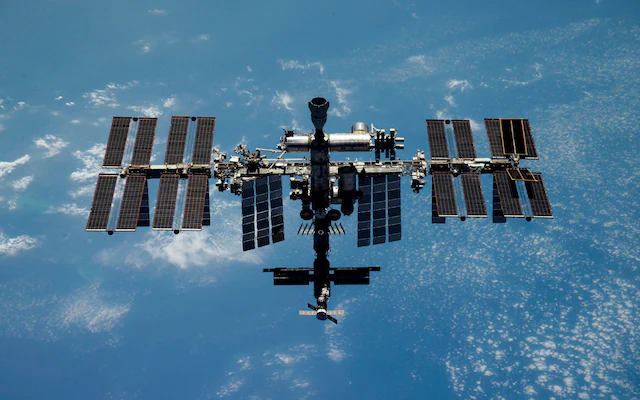
A long-running air leak aboard the International Space Station (ISS) has entered a critical new phase, prompting precautionary safety measures for astronauts and renewed scrutiny of one of the orbiting laboratory’s most persistent engineering challenges. While Russia’s space agency says progress has been made in sealing part of the leak, NASA has temporarily paused repair activities as engineers continue assessing the situation.
The latest developments come after concerns intensified over structural cracks in a Russian section of the station that have been monitored for years.
What is happening on the International Space Station?
The issue centers on the PrK transfer tunnel, a small pressurized compartment attached to the Russian segment of the ISS.
The module connects the station’s main Russian service module, known as Zvezda, to docking ports used by cargo spacecraft.
For more than five years, engineers have been tracking a slow air leak originating from this area.
According to NASA and Roscosmos, the leak is associated with microscopic cracks found in structural components and welded joints inside the module.
Although the leak has remained manageable through operational procedures and periodic repairs, recent measurements appear to have triggered additional concern.
What has Roscosmos said?
According to Russian media reports citing Roscosmos officials, engineers have successfully sealed one identified leak location and have moved on to addressing a second suspected source.
The development suggests that repair teams are making progress in narrowing down the exact pathways through which air has been escaping.
However, neither agency has yet declared the issue permanently resolved.
Engineers will likely need to verify whether air pressure remains stable over an extended monitoring period before concluding that repairs have fully succeeded.
Why did NASA ask astronauts to prepare for evacuation?
NASA emphasized that the precautionary measures were not evidence of an immediate emergency.
Instead, the agency adopted what it described as an elevated safety posture while repairs were underway.
As a precaution:
- Crew members were directed to remain close to the emergency spacecraft.
- NASA astronauts took positions inside a docked SpaceX Dragon capsule.
- Astronauts wore protective equipment during portions of the repair operation.
- Emergency procedures were reviewed in case conditions deteriorated unexpectedly.
NASA later confirmed that repair operations had been paused and that crew members were allowed to exit their temporary shelter positions.
The agency has not indicated that evacuation is currently imminent.
Where exactly is the leak?
The PrK transfer tunnel
The leak is located within the Russian-built transfer compartment attached to the Zvezda service module.
The tunnel plays an important role by connecting various spacecraft and station systems.
Because the ISS maintains a carefully controlled atmosphere similar to Earth’s, even small leaks require continuous monitoring.
A tiny loss of air pressure may not pose an immediate danger, but gradual structural deterioration can become a significant concern over time.
Why do NASA and Roscosmos disagree about the cause?
One of the more unusual aspects of the issue is that the two agencies have not fully agreed on what caused the cracks.
Roscosmos’ view
Russian engineers reportedly believe the damage is primarily linked to:
- Structural fatigue
- Repeated docking operations
- Vibrations from spacecraft arrivals and departures
- Stress generated by thruster firings
NASA’s assessment
NASA has suggested a broader combination of factors may be involved, including
- Material aging
- Environmental exposure in space
- Mechanical stresses
- Original manufacturing characteristics
The differing explanations reflect the complexity of diagnosing problems in spacecraft that have been operating continuously for decades.
How serious is the leak?
The ISS is not currently in danger of catastrophic depressurization.
However, the issue remains significant because it involves a critical structural component that has required repeated attention over several years.
Why are engineers concerned
The primary concerns include the following:
- Whether existing cracks are expanding.
- Whether additional cracks remain undiscovered.
- How the structure will behave as the station continues aging.
- Whether future repairs can provide a permanent solution.
The International Space Station first began operations in 1998, and several of its modules have now spent more than a quarter-century in orbit.
As hardware ages, maintenance challenges naturally increase.
What happens if a leak worsens?
The ISS was designed with multiple layers of redundancy.
If pressure loss accelerates, crews can:
- Seal off affected sections.
- Relocate to other modules.
- Shelter inside a docked spacecraft.
- Return to Earth if necessary.
Modern crew vehicles, including SpaceX Dragon capsules and Russian Soyuz spacecraft, remain attached to the station specifically to provide emergency evacuation capability.
That safety architecture is one reason officials were able to take precautionary measures without creating panic.
A reminder of the ISS’s aging infrastructure
The latest leak incident highlights a broader reality facing international space agencies.
The ISS remains one of humanity’s greatest engineering achievements, but it is also aging.
NASA, Roscosmos, and their international partners are increasingly balancing two priorities:
- Maintaining safe operations aboard the current station.
- Preparing for the next generation of commercial and government space stations expected to replace it during the 2030s.
Every new maintenance challenge offers engineers valuable lessons for designing future orbital habitats.
Why this matters
The current leak is not just a maintenance issue. It is a test of how space agencies manage risk aboard a structure that has been continuously inhabited for more than two decades.
While Roscosmos says one leak location has been sealed and NASA has paused repairs pending further assessment, engineers will continue closely monitoring pressure readings in the coming days and weeks.
For now, astronauts remain safe aboard the station, but the incident serves as another reminder that even the most sophisticated machines in orbit require constant vigilance.
TL;DR
NASA temporarily paused repair efforts on a long-running air leak aboard the International Space Station after precautionary safety measures were implemented for astronauts. Roscosmos says one leak location in the Russian PrK transfer tunnel has been sealed, and work has begun on a second suspected leak source. The issue has persisted for more than five years and remains under investigation, with NASA and Roscosmos differing on its exact cause.