NASA has spotted something whimsical in one of the coldest, most isolated corners of the planet. From hundreds of miles above Earth, a satellite image appears to show a giant snowman etched into the Arctic landscape of Russia. The figure is striking, almost playful, and entirely natural.
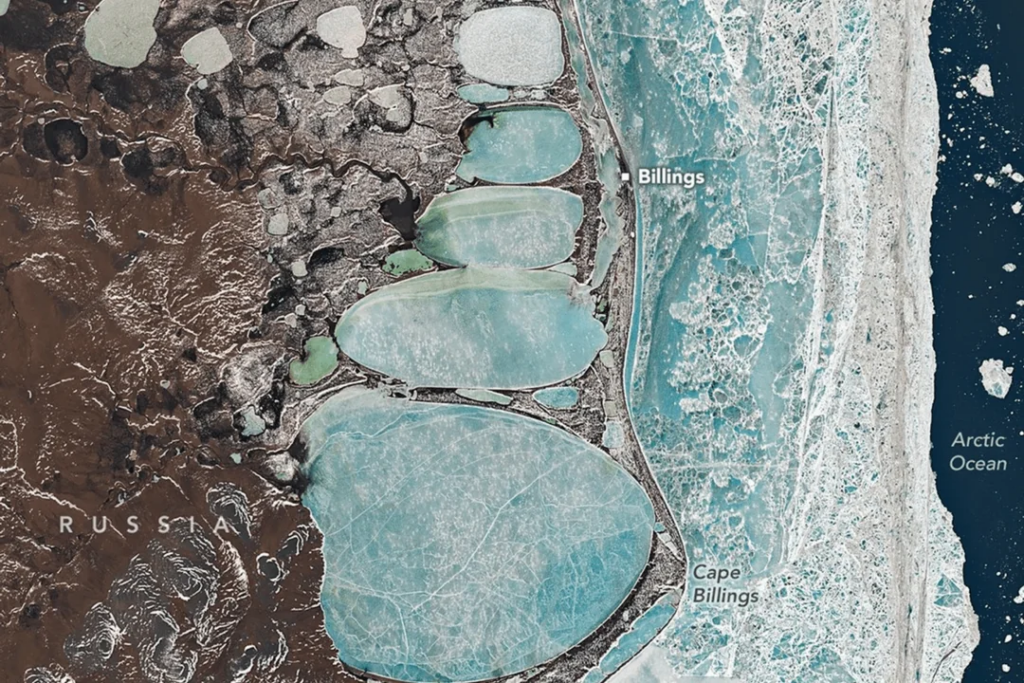
Captured by NASA’s Landsat 8 satellite in June 2025, the so-called “Siberian snowman” is not a trick of Photoshop or a seasonal joke. It is a chain of frozen lagoons near the tiny settlement of Billings on Russia’s Chukchi Peninsula, shaped by ice, wind, and time. The image offers a rare look at how extreme cold quietly sculpts the land and why Arctic regions matter far beyond their frozen horizons.
What did NASA actually capture from space?
The image was taken on June 16, 2025, by the Operational Land Imager aboard Landsat 8, with data provided by the US Geological Survey. At first glance, the formation looks unmistakable: a round “head,” a larger “body,” and stacked shapes that resemble a snowman lying on its side.
In reality, the scene spans about 22 kilometers and consists of five frozen lagoon basins aligned in sequence near Billings and Cape Billings along the East Siberian Sea coast. Their size, spacing, and oval forms happen to line up in a way that tricks the human eye.
This kind of visual coincidence is common in satellite imagery, where patterns on Earth echo familiar shapes. NASA scientists often point out that the brain is wired to recognize faces and figures, even where none were intended.
Primary keyword placement note: This section reinforces the context behind the phrase “NASA captures a Siberian snowman,” which also appears naturally in the opening paragraphs.
Why does this “snowman” exist in the first place?
The role of thermokarst activity
The frozen lagoons are the result of a process called thermokarst. This occurs in regions underlain by permafrost, where large wedges of ground ice sit just below the surface.
When those ice wedges begin to melt, the soil above them collapses, forming shallow depressions. Over time, these depressions fill with meltwater, creating ponds or lagoons. In Billings, several of these basins formed close together.
Key elements behind the formation include:
- Buried ice wedges melting unevenly
- Soil collapse creating shallow basins
- Meltwater collecting in depressions
- Persistent freezing that locks the shapes in place
Wind and wave action then stretch these water bodies into elongated, oval forms. The thin ridges visible between them in the satellite image mark the boundaries of underground ice wedges.
Why the shapes look so precise
The precision is not design but repetition. Similar geological conditions acted on nearby areas in the same way, producing basins of comparable size and shape. When aligned, they resemble something intentional.
NASA has documented similar optical illusions before, from heart-shaped islands to faces in desert rock. The “Siberian snowman” stands out because of its clarity and scale.
How cold is Billings, even in summer?
Billings sits in one of the harshest inhabited environments on Earth. Cold defines the landscape year-round.
Even in June, typically one of the warmest months, average daily minimum temperatures hover around minus 0.6 degrees Celsius, or about 30.9 degrees Fahrenheit. Ice cover is routine, not an exception.
This persistent cold explains why the lagoons remain frozen long enough to be captured so clearly from space. In warmer climates, similar formations would thaw, shift, and lose their definition.
Why this region stays frozen most of the year
The Chukchi Peninsula lies well within the Arctic Circle and is influenced by cold air masses from Siberia and the Arctic Ocean. Several factors keep temperatures low:
- Limited sunlight for much of the year
- Sea ice in the East Siberian Sea
- Strong polar winds
- Continuous permafrost beneath the surface
These conditions lock the landscape into a slow-motion cycle where change happens over decades, not seasons.
Why NASA watches places like Billings so closely
At first glance, a frozen lagoon shaped like a snowman might seem like a curiosity. But for scientists, it is a data point.
Thermokarst features are sensitive indicators of climate change. As global temperatures rise, permafrost becomes less stable. That can lead to:
- Increased ground collapse
- Expansion of thermokarst lakes
- Release of greenhouse gases like methane
- Damage to ecosystems and infrastructure
By tracking these features over time, NASA can measure how quickly permafrost regions are changing. Landsat’s long-running mission allows scientists to compare images across decades, spotting subtle shifts that are invisible on the ground.
How remote is Billings, really?
Billings is home to roughly 200 people, making it one of the few inhabited settlements along this stretch of the Russian Arctic coast. Reaching it is a challenge in any season.
In winter, frozen rivers and lakes become temporary roads, allowing travel by snow vehicles. In summer, the ground thaws and turns waterlogged, cutting off overland routes entirely. At that point, helicopters are often the only way in or out.
This isolation adds to the scientific value of satellite imagery. In places where ground surveys are difficult or dangerous, space-based observation becomes essential.
Why images like this capture public attention
There is a reason NASA shared the “Siberian snowman” image beyond scientific circles. Visuals like this create a bridge between complex Earth science and everyday curiosity.
They invite people to look closer and ask questions such as
- How does frozen ground behave over time?
- What is permafrost, and why does it matter?
- How do satellites see details from space?
That curiosity can lead readers toward deeper understanding of climate systems and the fragile balance of polar regions.
What this tells us about seeing Earth from space
Satellite imagery often reveals patterns that are impossible to notice from the ground. From orbit, landscapes become abstract, shaped by physics rather than human borders.
The “Siberian snowman” is a reminder that Earth’s surface is dynamic, even in places that seem frozen in time. Ice moves, ground shifts, and water finds new paths, all under conditions that challenge life but tell powerful scientific stories.
TL;DR
NASA’s “Siberian snowman” is not a sculpture of ice but a chain of frozen lagoons near Billings, Russia, captured by Landsat 8 in June 2025. Formed through thermokarst activity in extreme cold, the image highlights how permafrost landscapes evolve and why satellite monitoring of the Arctic is crucial for understanding climate change.