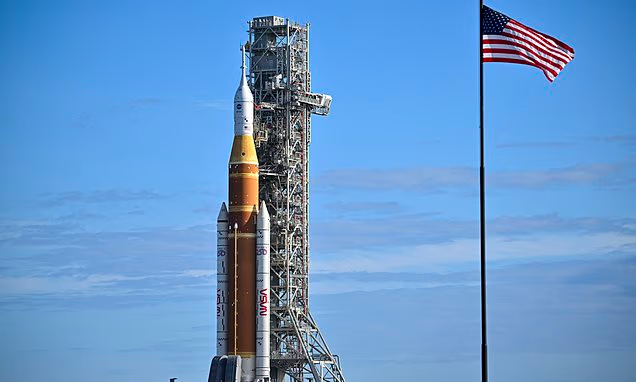
When NASA announced that its long-awaited Artemis 2 mission would launch on April 1, the internet reacted with equal parts excitement and skepticism.
The reason is simple. April 1 happens to be April Fools’ Day, a date traditionally associated with pranks and hoaxes.
But there is nothing playful about the mission itself. Artemis 2 is expected to send astronauts around the Moon for the first time in more than half a century, marking a major milestone in humanity’s return to deep space exploration.
Still, the choice of launch date has sparked widespread jokes and memes across social media.
What is Artemis 2, and why does the mission matter?
Artemis 2 is the first crewed mission of NASA’s Artemis program, which aims to return humans to the Moon and eventually establish a sustainable presence there.
The mission will use the powerful Orion spacecraft launched atop the Space Launch System.
Unlike the previous mission, Artemis 1, which flew without astronauts, Artemis 2 will carry four crew members on a roughly 10-day journey around the Moon before returning to Earth.
The astronauts selected for the historic mission include:
- Reid Wiseman (NASA)
- Victor Glover (NASA)
- Christina Koch (NASA)
- Jeremy Hansen (Canadian Space Agency)
If successful, Artemis 2 will mark the first time humans travel beyond low Earth orbit since the final Apollo mission in 1972.
Why NASA chose April 1 as the launch date
The April 1 launch window is primarily based on technical and orbital considerations rather than symbolism.
Space missions must align with precise launch windows determined by factors such as
- orbital mechanics
- spacecraft trajectory requirements
- lunar positioning
- weather conditions
NASA officials say the agency is comfortable targeting April 1 after completing repairs and inspections following earlier test issues.
Lori Glaze, acting associate administrator for NASA’s Exploration Systems Development Mission Directorate, said the agency expects the next fueling of the rocket to occur during the actual launch attempt.
If the April 1 launch opportunity is missed, NASA has also identified April 30 as another potential window.
Technical issues that delayed the launch
The Artemis 2 mission has already faced multiple delays during testing.
During earlier preparations, engineers encountered problems while fueling the rocket.
Key issues included:
- hydrogen leaks during fueling tests
- cold weather affecting launch preparations
- helium flow issues in the rocket’s upper stage
During a wet dress rehearsal, the rocket was filled with roughly 2.65 million liters of cryogenic liquid hydrogen and liquid oxygen, the propellants needed to power the heavy-lift rocket.
Following the tests, engineers detected a helium flow problem in the Interim Cryogenic Propulsion Stage (ICPS), which required further inspection.
To resolve the issue, the rocket was rolled back to the Vehicle Assembly Building at Kennedy Space Center in Florida.
After repairs and additional checks, NASA selected April 1 as the next available launch opportunity.
Why the internet thinks the date is ironic
Despite NASA’s technical reasoning, the timing has become a viral talking point.
Many people online have joked that launching on April Fools’ Day could make historic news sound like a prank.
Some users suggested that if the mission were delayed again, people might assume the announcement itself was a joke.
Others pointed out the irony that one of the most serious space missions in decades might launch on a day traditionally associated with humor.
But in reality, space agencies rarely consider cultural dates when choosing launch windows. Orbital mechanics and safety requirements almost always determine the schedule.
The bigger goal of NASA’s Artemis program
The Artemis program represents NASA’s long-term strategy for returning humans to the Moon and eventually preparing for missions to Mars.
The program’s roadmap currently includes several missions.
Artemis 2
A crewed lunar flyby that tests spacecraft systems with astronauts on board.
Artemis 3
Originally planned as the first lunar landing of the program, Artemis 3 is now expected to focus on testing communications systems, propulsion technologies, and next-generation spacesuits known as xEVA.
Artemis 4
NASA now expects the first Artemis lunar landing to occur during this mission, currently targeted for 2028.
These missions aim to establish a sustainable human presence on and around the Moon, including the planned Lunar Gateway space station.
Why Artemis 2 will be historically significant
If Artemis 2 launches successfully, it will mark several historic milestones.
The mission will:
- send humans beyond Earth orbit for the first time in more than 50 years
- test deep-space systems designed for long-duration missions
- pave the way for future lunar landings
- include the first woman and first person of color to travel toward the Moon
The mission will also serve as a crucial test of the Orion spacecraft’s life-support systems, navigation technology, and heat shield performance before astronauts attempt a lunar landing.
TL;DR
- NASA plans to launch the Artemis 2 mission on April 1.
- The date sparked jokes because it coincides with April Fools’ Day.
- Artemis 2 will send astronauts around the Moon for the first time in over 50 years.
- The mission faced delays due to hydrogen leaks and helium flow issues during testing.
- If the April 1 window is missed, NASA may attempt another launch on April 30.