• About BreezyScroll
  • Privacy & Policy
  • Contact Us
Wednesday, June 10, 2026
BreezyScroll
  • Home
  • Breezy Stories
  • Technology
  • Gaming
  • Entertainment
  • Lifestyle
  • World
  • Money
  • Sports
  • Breezy Explainer
No Result
View All Result
  • Home
  • Breezy Stories
  • Technology
  • Gaming
  • Entertainment
  • Lifestyle
  • World
  • Money
  • Sports
  • Breezy Explainer
No Result
View All Result
BreezyScroll
No Result
View All Result

Home  /  Space  /  ‘Sunspot archipelago’ 15 times wider than Earth could soon bombard us with solar storms

‘Sunspot archipelago’ 15 times wider than Earth could soon bombard us with solar storms

by Siddhi Vinayak Misra
November 23, 2023
in Space
Reading Time: 2 mins read
Solar Dynamics

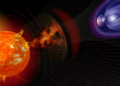
A new image from NASA’s Solar Dynamics Observatory reveals seven Earth-sized black areas on the Sun that could soon be bombarded with solar flares. Scientists refer to the collection of these dark spots as a “solar archipelago.”

According to Spaceweather.com, the cluster spans 200,000 kilometers and is more than 15 times broader than Earth, influencing how the entire Sun vibrates. Sunspots seem dark because they are cooler than other portions of the sun (but they are still incredibly hot at over 6,500 F).

Regardless of whether we can see the dark patches, sunspots can produce powerful coronal mass ejections (CMEs) that can collide with Earth and cause potentially dangerous geomagnetic storms. This implies that we can be caught off guard by extreme space weather events.

The massive clouds of electrified gas travel at hundreds of miles per second and have the potential to disrupt power systems, communications, GPS navigation, air transport, and satellites. The sole bright spot is the spectacular auroras that occur at Earth’s poles.

Since first detecting the sunspot group AR3490 and associated cracking flares, Earth-orbiting satellites have already recorded three M-class flares and roughly a dozen C-class flares.

How do solar flares and sunspots form according to Solar Dynamics?

Solar activity follows a predictable pattern, with peaks and valleys every 11 years. The magnetic field of the Sun drives these cycles, known as solar maximum and solar minimum.

We are now in Solar Cycle 25, which is anticipated to end in July 2025. However, this cycle has produced more activity than NASA and NOAA predicted, with the official projection of roughly 115 sunspots at the peak.

Scientists aren’t clear why the Sun has been more active than expected, and additional observations are needed to enhance future predictions and gain a better knowledge of the Sun’s fundamental processes.

Aside from the Solar Dynamics Observatory, NASA’s Perseverance Mars rover takes daily photographs of the Sun with its Mastcam-Z camera system. While the primary goal is to measure the amount of dust in the Martian atmosphere, the camera can also photograph sunspots. The rover detects these sunspots early because Mars orbits the Sun’s far side, giving it a week’s head start over Earth.

Tags: NASASunspot-archipelago
ShareTweetShareSend

Recent Articles

FIFA World Cup

FIFA World Cup 2026 Is Turning Into a Global Music Festival — Here’s What’s Changing

June 10, 2026
Scientists Want To ‘spray’ a Giant Shield to Protect Earth from Solar Storms. Here’s how StormWall could protect Earth

Scientists Want To ‘spray’ a Giant Shield to Protect Earth from Solar Storms. Here’s how StormWall could protect Earth

June 10, 2026
Ex-Taliban commander sentenced to 42 years for kidnapping journalist and killing US troops

Ex-Taliban commander sentenced to 42 years for kidnapping journalist and killing US troops

June 10, 2026
FIFA World Cup Ticket Controversy: Why 180,000 Tickets Are Flooding The Resale Market Before Kick-Off

FIFA World Cup Ticket Controversy: Why 180,000 Tickets Are Flooding The Resale Market Before Kick-Off

June 10, 2026
BreezyScroll Logo

BreezyScroll is a global content platform that provides a unique experience of enhancing the knowledge quotient for its audience by providing the latest news and updates from various categories such as politics, sports, entertainment, technology, and more.
The platform aims to provide a concise and easy-to-read format for its users. BreezyScroll covers news stories from around the world, majorly the United States. The platform was launched in 2021 and has become one of the fastest-growing content companies in the US.

Follow Us

Browse by Category

  • Africa
  • Alaska
  • Animals
  • Asia
  • Athletics
  • Australia
  • Auto
  • Basketball
  • Bollywood
  • Brand
  • Breezy Explainer
  • Breezy Feature
  • Breezy Soul
  • Business
  • Canada
  • Chess
  • China
  • Coronavirus
  • Cricket
  • DIY
  • Education
  • Entertainment
  • Environment
  • EPL
  • Europe
  • Exclusive Interview
  • Exclusive Review
  • Football
  • Gaming
  • Health
  • Hollywood
  • India
  • International
  • K Pop
  • Law
  • Lifestyle
  • Middle East
  • Money
  • NFL
  • North America
  • OTT
  • Paris Olympics
  • Pets
  • Press Releases
  • Russia
  • Science
  • South America
  • Space
  • Sports
  • Startup
  • Technology
  • Tennis
  • Tennis
  • The Achievers
  • The US
  • Travel
  • UK
  • UK
  • Uncategorized
  • World
  • WWE

Trending Topics

AI Apple Australia Biden California Canada ChatGPT China Climate Change Coronavirus COVID-19 Donald Trump Elon Musk Featured Florida Google IPL Iran Japan Joe Biden Mars Meta Moon NASA NBA Netflix New York North Korea Ohio OpenAI Putin Russia Russia-Ukraine crisis South Korea Taliban Tesla Texas TikTok Trump Twitter UFO UK Ukraine USA Virat Kohli

No Result
View All Result
  • About BreezyScroll
  • Privacy & Policy
  • Contact Us

© 2024 · BreezyScroll.com

No Result
View All Result
  • Home
  • Breezy Stories
  • Technology
  • Gaming
  • Entertainment
  • Lifestyle
  • World
  • Money
  • Sports
  • Breezy Explainer

© 2024 · BreezyScroll.com

Go to mobile version