
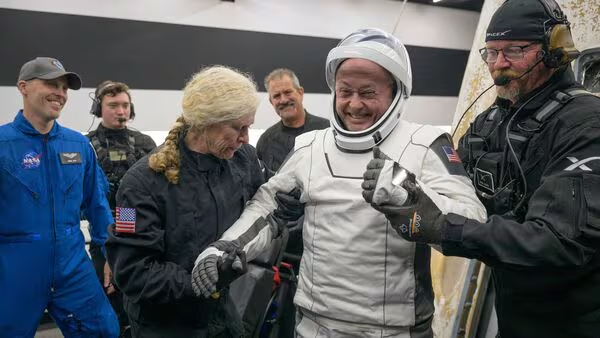
For a few tense minutes aboard NASA’s orbiting laboratory, something unusual happened. Veteran astronaut Mike Fincke, a four-time space traveler, suddenly lost the ability to speak. No pain. No warning. No clear explanation. Just silence.
The episode, which lasted about 20 minutes on the International Space Station (ISS), has now become a rare and puzzling case in space medicine. It also triggered the first-ever medical evacuation from the ISS, raising fresh questions about how the human body behaves after months in microgravity.
What happened during the NASA astronaut medical emergency?
Fincke’s account is straightforward, almost unsettling in its simplicity. On January 7, after preparing for a scheduled spacewalk, he sat down for dinner with his crewmates. Mid-meal, he realized he couldn’t speak.
There was no choking, no chest pain, no dizziness. Just an abrupt inability to form words.
His crewmates noticed immediately. Communication is lifeblood in space, and even a brief disruption sets off alarms. The crew contacted flight surgeons on Earth while monitoring him closely.
Within about 20 minutes, his speech returned as suddenly as it had disappeared.
Key details from the incident
- Duration: Approximately 20 minutes
- Symptoms: Temporary loss of speech, no pain or distress signals like choking
- Recovery: Spontaneous and complete
- Timing: One day before a planned spacewalk
- Outcome: Cancellation of the spacewalk and eventual crew evacuation
Fincke later described the moment as a “lightning bolt” event. Fast, unpredictable, and gone before anyone could fully understand it.
Why is this case so unusual?
Space medicine has documented a wide range of physiological changes, from bone density loss to vision impairment. But a sudden, isolated speech disruption without other neurological symptoms is rare.
Doctors have ruled out some of the most immediate concerns:
- No evidence of a heart attack
- No signs of choking or airway obstruction
- No lingering neurological deficits
That leaves a wide field of possibilities, none confirmed.
Possible explanations experts may consider
While NASA has not provided a diagnosis, several hypotheses are likely under review:
- Transient ischemic attack (TIA): Often called a “mini-stroke,” though typically accompanied by other symptoms
- Microgravity-induced fluid shifts: Fluids move toward the head in space, potentially affecting brain function
- Neurological signaling disruption: Changes in how the brain communicates with speech muscles
- Fatigue or stress-related anomalies: Though Fincke reported feeling fine before and after
How does long-duration spaceflight affect the human body?
Fincke had spent over five months in orbit during this mission and a total of 549 days in space across his career. That kind of exposure changes the body in subtle and sometimes unpredictable ways.
Known effects of microgravity
- Fluid redistribution toward the head
- Changes in intracranial pressure
- Muscle atrophy and bone density loss
- Altered cardiovascular function
- Vision issues linked to Spaceflight-Associated Neuro-ocular Syndrome (SANS)
What makes Fincke’s case compelling is that it doesn’t neatly fit into any of these known categories.
This is where space medicine still has gaps. The body adapts to orbit, but not always in ways that are fully mapped.
Why did NASA evacuate the crew?
The incident led to a major operational decision. NASA opted for a full crew return aboard a SpaceX vehicle, marking the first medical evacuation in ISS history.
Crew members aboard the mission
- Zena Cardman (NASA astronaut)
- Mike Fincke (NASA astronaut)
- Oleg Platonov (Russian cosmonaut)
- Kimiya Yui (Japanese astronaut)
The planned spacewalk was canceled, and the mission timeline shifted immediately.
From a risk management perspective, the decision reflects a simple truth: in space, uncertainty is the real threat. Even a resolved symptom can carry unknown risks.
What is NASA doing now to investigate?
NASA is now combing through decades of astronaut medical data to identify whether similar incidents may have occurred but gone unnoticed or unreported.
According to agency officials, the focus is on pattern recognition.
Areas under investigation
- Historical astronaut health records
- Real-time telemetry from the ISS
- Neurological response data in microgravity
- Comparisons with Earth-based medical cases
NASA Administrator Jared Isaacman reportedly reassured Fincke that the incident was not a personal failure but a reminder of space’s unpredictability.
That distinction matters. Spaceflight is a controlled environment, but it is never a completely understood one.
Why this NASA astronaut’s medical emergency matters for future missions
This incident arrives at a critical moment. NASA is preparing for deeper space missions, including lunar flybys and eventual Mars expeditions.
Long-duration missions will push astronauts far beyond the safety net of immediate return.
Key implications
- Medical autonomy: Crews may need to diagnose and manage conditions without immediate Earth support
- Screening protocols: Astronaut selection may evolve to account for rare neurological risks
- Onboard diagnostics: More advanced tools may be required in spacecraft
- Mission planning: Greater flexibility for medical contingencies
Could this happen again?
That’s the question NASA is now trying to answer.
Right now, there is no clear cause, which makes prediction difficult. But the absence of evidence is not evidence of absence. It simply means the investigation is still in its early stages.
For astronauts, the takeaway is pragmatic. Space remains an environment where the body can behave in unfamiliar ways. Training prepares them for known risks. Cases like this expand the list of unknowns.
The quiet reminder from space
Fincke has since recovered fully and reports no ongoing issues. Yet his brief silence echoes beyond that 20-minute window.
It underscores a reality that often gets lost behind launch footage and mission milestones. Space exploration is not just about engineering challenges. It is about human limits, and sometimes, the body writes its own script.
TL;DR
- NASA astronaut Mike Fincke experienced a sudden 20-minute loss of speech on the ISS
- No clear medical cause has been identified
- The incident led to the first medical evacuation from the space station
- NASA is reviewing historical data to find similar cases
- The event highlights gaps in understanding long-term human health in space