
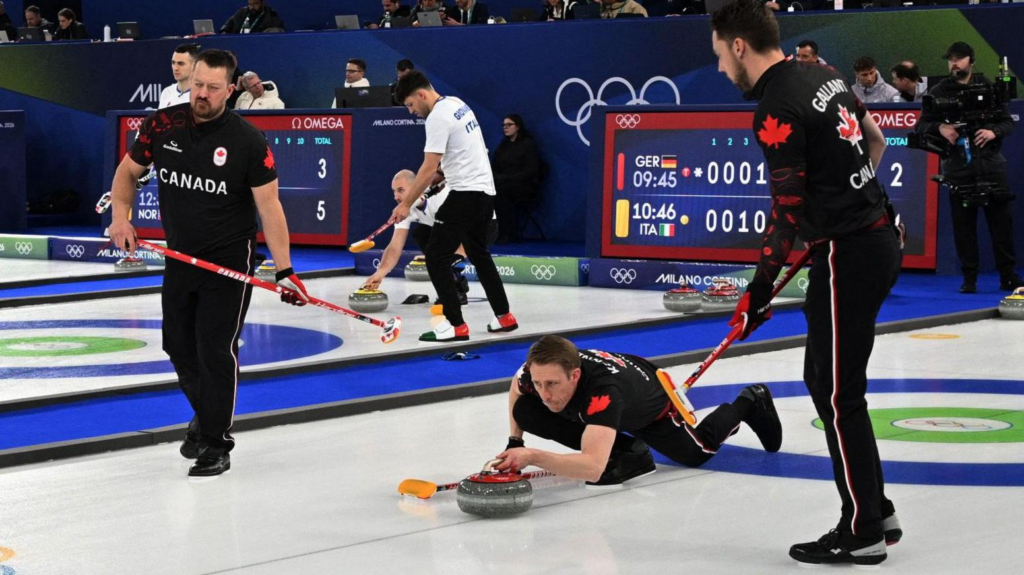
Canada vs. Sweden Curling Cheating: A routine round-robin curling match turned into one of the most heated moments of the Winter Games after Sweden accused Canada of cheating mid-game. The confrontation, complete with profanity, on-ice tension, and social media backlash, has sparked debate about sportsmanship, technology, and how far competitive fire should go at the Olympics.
At the center of the controversy: alleged illegal contact with the curling stone.
What sparked the Canada vs. Sweden curling cheating clash?
The incident unfolded during a men’s Olympic curling match between Canada and Sweden. Sweden alleged that Canadian players were touching the stone after release, an infraction under curling rules.
Specifically, Swedish players claimed that Canadian third Marc Kennedy was double-touching the stone beyond the hog line. That accusation escalated into a heated exchange between Kennedy and Sweden’s third, Oskar Eriksson.
According to reports, Eriksson told Kennedy he could show him video evidence of the alleged contact. Kennedy fired back bluntly:
“I haven’t done it once. You can f*** off.”
After the match, Kennedy defended his reaction.
“It’s sport. It’s the Olympics. Both teams are trying to win. Oskar was accusing us of cheating. I didn’t like it. I’ve been curling professionally for 25 years.”
The confrontation quickly became one of the most talked-about moments of the Games.
What are the rules about touching the stone?
To understand the dispute, it helps to know the basics.
In curling:
- A player must release the stone before the hog line
- Any contact with the stone after release is prohibited
- Infractions can result in the removal of the stone or other penalties
At these Games, World Curling introduced electronic hog line devices. The handles of the stones are fitted with sensors that flash red if the player maintains contact beyond the hog line.
The technical dispute
Eriksson argued that Kennedy may have been touching the stone itself, not the handle containing the sensor, meaning the red light would not trigger.
Kennedy rejected that outright:
“There are hog-line devices on there. And he’s still accusing us of cheating. I didn’t like it. So I told him where to stick it.”
This wasn’t just a disagreement over judgment. It was a disagreement over whether the technology could miss an infraction.
How did officials respond?
After Sweden raised the issue, umpires were stationed at the hog line to observe deliveries for three ends.
In a formal statement, World Curling said:
“There were no hog line violations or retouches of the stone during the observation.”
In other words, no evidence of cheating was found.
From an officiating standpoint, the matter was closed.
Did the tension affect the match result?
On the scoreboard, Canada prevailed with an 8–6 victory.
Kennedy suggested frustration may have played a role in Sweden’s complaints.
“He might have been upset that he was losing… They’re 0-2, grasping for straws.”
Eriksson, however, maintained that Sweden believed a rule was being broken, even if technology didn’t catch it.
“It was obviously not a red light, but some players are touching the rock according to us. And that’s not allowed.”
The clash wasn’t about points alone, it was about principle.
Why did this moment explode online?
Curling is not typically associated with profanity-laced Olympic drama. That’s part of why this incident resonated.
Social media reactions ranged from patriotic disappointment to ironic obsession:
- One Canadian viewer criticized Kennedy’s tone, calling it “not Canadian.”
- Another joked about being unexpectedly consumed by a curling cheating scandal.
The episode tapped into larger themes:
- Fair play at the Olympics
- The limits of technology in officiating
- Whether emotional reactions cross a line
Is this a bigger issue for Olympic curling?
The controversy raises broader questions about tech-assisted officiating.
Electronic hog line handles were introduced to eliminate human error. But if players believe infractions can occur outside sensor detection, it exposes a grey area.
Key considerations:
- Should additional sensors be added to the entire stone?
- Should overhead camera review be mandatory in disputes?
- How much reliance should officials place on athlete accusations?
For World Curling, the technology worked—at least by its standards. But the perception of a loophole may prompt further review.
The competitive edge: Is heated exchange part of Olympic sport?
Kennedy framed the moment as a byproduct of elite competition.
“It’s good. It’s sport. It’s the Olympics.”
At this level, accusations of cheating strike at a player’s reputation, not just a single delivery. Kennedy’s 25-year professional career adds context: defending integrity is personal.
Still, critics argue that composure under pressure is part of the Olympic ethos.
The line between competitive fire and unsportsmanlike conduct is subjective—and often judged more harshly when microphones pick it up.
What happens next?
There are no formal sanctions announced, and officials have declared no rule violations occurred.
The story may fade on the standings table—but not necessarily in public memory. Olympic controversies often linger longer online than in record books.
For now:
- Canada keeps its win.
- Sweden keeps its skepticism.
- World Curling stands by its technology.
And the rest of us are reminded that even in a sport defined by precision and etiquette, emotions can sweep harder than a brush.
TL;DR
- Sweden accused Canada of illegally touching the stone during an Olympic curling match.
- A heated exchange erupted between Marc Kennedy and Oskar Eriksson.
- Electronic hog line sensors showed no violations.
- Officials monitored deliveries and found no infractions.
- Canada won 8–6, but the controversy sparked widespread debate online.