
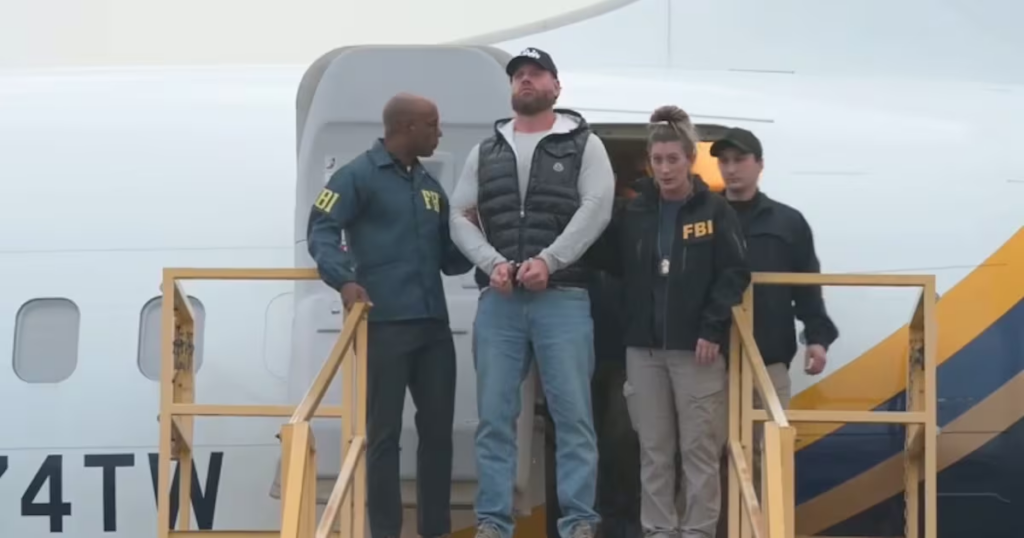
For the first time since his arrest, disgraced former Olympian Ryan Wedding has been seen back on US soil—this time in handcuffs, flanked by federal agents, and facing some of the most serious criminal charges imaginable. Wedding, once a member of Canada’s Olympic snowboarding team, landed Friday at Ontario International Airport in Southern California after being captured in Mexico. Dramatic video released by authorities shows the 44-year-old being escorted off a plane by FBI agents, head down, as he was transferred into US custody.
The moment marked the end of a decade-long manhunt and the collapse of what federal officials describe as a sprawling international narcotics empire tied to multiple murders.
Who is Ryan Wedding?
Wedding represented Canada at the 2002 Winter Olympics in Salt Lake City, competing in the parallel giant slalom and finishing 24th. After retiring from professional snowboarding, authorities say his life took a sharp and violent turn.
According to US law enforcement, Wedding reinvented himself as a major drug trafficker with deep ties to Southern California, eventually becoming one of the most-wanted fugitives in the United States.
He is accused of overseeing an operation that funneled massive quantities of cocaine through Los Angeles and across North America.
How was Wedding captured?
The Federal Bureau of Investigation confirmed Friday that Wedding was captured in Mexico after years on the run. According to the Associated Press, he turned himself in at the US embassy.
The arrest was announced during a joint press conference involving the FBI, the Los Angeles Police Department, the Drug Enforcement Administration, and Canada’s Royal Canadian Mounted Police—a signal of how international the case had become.
“When you go after a guy like Ryan Wedding, it takes a united front,” said FBI Director Kash Patel, calling the arrest a major blow to a global criminal network.
Why was Wedding one of America’s most-wanted fugitives?
Wedding was placed on the FBI’s Top 10 Most Wanted Fugitives list in March 2025, after authorities linked him to multiple homicides connected to his alleged drug operation.
Investigators say Wedding used numerous aliases, including:
- El Jefe
- Giant
- Public Enemy
- James Conrad King
- Jesse King
Federal officials allege that his organization moved hundreds of kilograms of cocaine through Southern California, with shipments traveling onward to Canada and other parts of the US.
The FBI initially offered a $10 million reward for information leading to his capture. That figure was later raised to $15 million—the largest bounty ever offered for a fugitive on the bureau’s most-wanted list.
What charges does Wedding face now?
Wedding is expected to appear in court early next week. Prosecutors say he faces a sweeping list of charges, including:
- Running a criminal enterprise
- Murder
- Conspiracy to distribute cocaine
- Multiple drug- and weapons-related offenses
Authorities say at least 36 other suspects connected to Wedding’s alleged drug empire have already been arrested.
According to Akil Davis, agents have seized large quantities of drugs, firearms, and cash, along with millions of dollars’ worth of luxury vehicles, artwork, jewelry, and motorcycles.
Rewards of up to $2 million are still being offered for tips that lead to additional arrests.
Why Southern California mattered to the case
Law enforcement officials say Los Angeles was the primary US hub for Wedding’s alleged narcotics operation. From there, drugs were distributed across the region and transported north into Canada.
That long-standing connection explains why Wedding was flown directly to Southern California after his arrest and why multiple local and federal agencies are involved in the prosecution.
From Olympic slopes to “Operation Giant Slalom”
The FBI codenamed the investigation “Operation Giant Slalom,” a pointed reference to the Olympic event in which Wedding once competed.
Officials say the name reflects the dramatic contrast between Wedding’s former life as an elite athlete and the criminal enterprise he is now accused of leading.
“To tell you how bad of a guy Ryan Wedding is,” Patel said, “he went from an Olympic snowboarder to one of the largest narco traffickers in modern times.”
A criminal history that didn’t end the first time
This was not Wedding’s first run-in with US authorities.
He was previously arrested in San Diego in 2008, convicted in federal court in 2009, and released from prison in 2011. Prosecutors now argue that instead of leaving crime behind, Wedding escalated his activities on a global scale.
Why this case matters
The arrest of Ryan Wedding underscores how former athletes and public figures can sometimes leverage fame, money, and international mobility to build criminal networks that are difficult to dismantle.
For law enforcement, the case is being framed as a rare success story—one where years of international cooperation finally paid off.
For Wedding, it marks a stunning and public fall from Olympic competition to a federal courtroom, where the consequences could include life behind bars.
TL;DR
- Former Olympian Ryan Wedding has been returned to the US after his arrest in Mexico
- He faces murder, drug trafficking, and racketeering charges
- Wedding was on the FBI’s Top 10 Most Wanted list with a $15 million bounty
- Authorities allege he ran a major cocaine operation centered in Los Angeles
- The case highlights the reach of modern international crime—and the scale of effort required to stop it