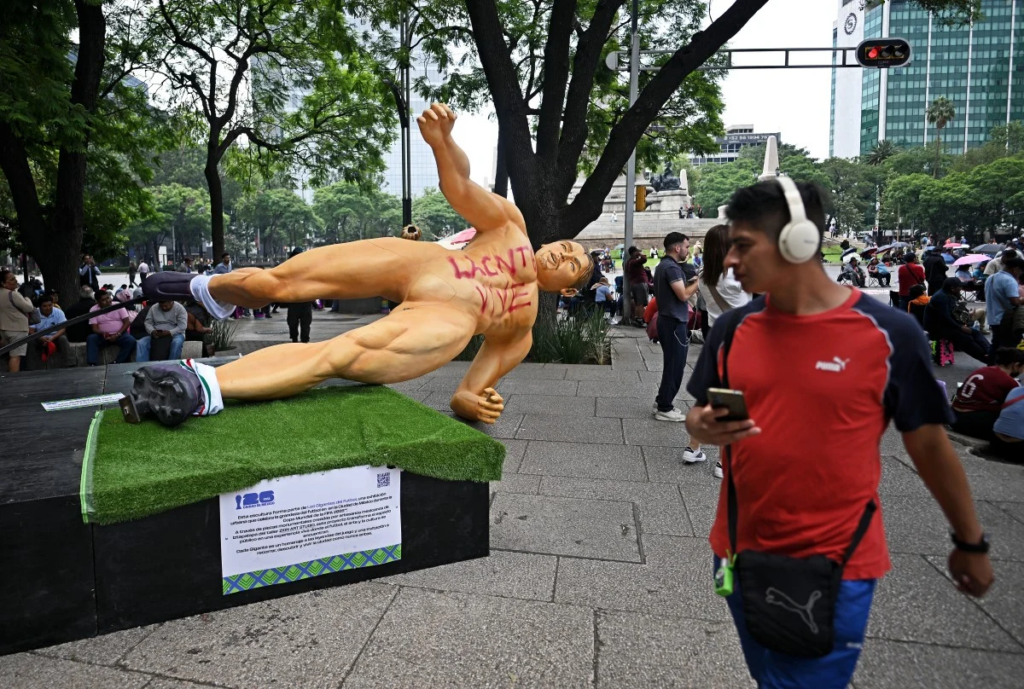
As the world’s attention turns to Mexico for the opening match of the FIFA World Cup 2026, a different spectacle has unfolded on the streets of the capital. Thousands of teachers have staged demonstrations, blocked major roads, and set up sprawling protest camps across Mexico City, creating a political challenge for President Claudia Sheinbaum’s administration just days before the tournament begins.
The protests are not about football. They are about pensions, wages, and what educators say is a years-long failure by successive governments to address the concerns of public-sector workers.
With Mexico preparing to host the World Cup opener on June 11 at the iconic Azteca Stadium, the demonstrations have become one of the country’s most significant labor movements in recent years.
Why are Mexican teachers protesting?
The protests are being led by a dissident faction of the National Coordination of Education Workers (CNTE), one of Mexico’s most influential teachers’ organizations.
Teachers say the government has failed to honor campaign promises made by former President Andres Manuel Lopez Obrador and current President Claudia Sheinbaum. They argue that public education workers have been left behind while authorities focus on international events, tourism, and economic development projects.
The movement has established semi-permanent encampments throughout Mexico City, with union leaders claiming that around 12,000 teachers are participating in the demonstrations.
Their demands center on two key issues:
- Repeal of the 2007 ISSSTE pension reform law
- A 100 percent increase in base salaries
Protesters say these measures are necessary to restore financial security for educators and other public-sector employees.
What is the ISSSTE law, and why is it controversial?
At the heart of the dispute is Mexico’s 2007 reform of the ISSSTE pension system, which covers federal government employees.
Before the reform, workers were covered by a state-backed defined-benefit pension system. Retirement payments were based largely on years of service, providing workers with a predictable income after retirement.
The reform significantly changed that model.
Shift to individual retirement accounts
The 2007 law moved many public-sector workers into individual retirement accounts managed by private pension fund administrators known as Afores.
Under this system:
- Retirement savings are invested in financial markets
- Pension payouts depend partly on investment performance
- Workers bear greater exposure to market fluctuations
- Benefits are no longer guaranteed at previous levels
Teachers argue that this change transferred risk from the government to workers and weakened retirement security.
Changes to retirement calculations
Another major source of frustration involves the use of UMA (Measurement and Update Units), an inflation-linked benchmark that replaced calculations tied to Mexico’s minimum wage.
Teachers contend that the shift reduced the long-term value of retirement benefits and effectively limited the purchasing power of pension payments.
Union leaders say the current system leaves many educators uncertain about their financial future and does not adequately reflect decades of public service.
What do teachers want to change?
The CNTE is calling for a complete reversal of the pension reforms rather than incremental adjustments.
Their demands include:
- Restoring the pre-2007 pension system
- Eliminating what they consider unfair retirement restrictions
- Reducing reliance on private pension fund administrators
- Guaranteeing state-backed pensions
- Increasing teacher salaries by 100 percent
The union also wants retirement eligibility to be based more heavily on years of service rather than age requirements.
Supporters of the movement argue that educators should not have to work until age 65 to secure a stable retirement after spending decades in classrooms.
How have the protests affected Mexico City?
The demonstrations have disrupted transportation and daily life across large parts of the capital.
Protesters have:
- Blocked major avenues and highways
- Established tent camps in central locations
- Occupied public spaces
- Organized marches through key districts
Some demonstrations have also included symbolic acts targeting World Cup-related imagery, reflecting frustration over what protesters view as misplaced government priorities.
The timing has amplified international attention because the protests coincide with preparations for one of the world’s largest sporting events.
For authorities, maintaining order while avoiding confrontation has become a delicate balancing act.
How has President Claudia Sheinbaum responded?
President Claudia Sheinbaum has sought to project openness while maintaining that some of the protesters’ demands are financially unrealistic.
Her administration says it understands the concerns raised by teachers and remains committed to dialogue.
The government has already proposed:
- A 9 percent salary increase
- Lower retirement ages for certain categories of educators
- Additional labor-related concessions
However, union leaders rejected the proposal, describing it as insufficient and far below what workers need.
Negotiations have repeatedly stalled, deepening the political impasse.
Why the government says a full repeal is difficult
Officials argue that restoring the old pension system would place enormous pressure on public finances.
Mexico, like many countries, faces demographic challenges associated with an aging population and rising pension costs.
Government economists contend that returning to a fully state-funded defined-benefit model could create long-term fiscal risks and strain future budgets.
This financial reality has become one of the biggest obstacles to reaching an agreement.
Why does the timing matter ahead of the FIFA World Cup 2026?
The protests come at a highly visible moment for Mexico.
The country is preparing to welcome international visitors, media organizations, and football fans from around the world for the opening stages of the FIFA World Cup 2026.
While authorities insist the tournament will proceed as planned, the demonstrations have highlighted broader debates about inequality, labor rights, and public spending priorities.
For teachers, the World Cup presents an opportunity to draw global attention to their demands.
For the government, it creates additional pressure to find a solution without escalating tensions.
What happens next?
The standoff shows no immediate signs of ending.
Teachers remain committed to pushing for pension reform and higher wages, while the government continues to argue that a full return to the pre-2007 system is financially unworkable.
Whether negotiations resume successfully could determine not only the future of the protests but also how Mexico balances labor demands with fiscal constraints in the years ahead.
As football fans prepare for kickoff, the dispute serves as a reminder that some of the country’s most important battles are taking place far from the stadium pitch.
TL;DR
- Thousands of Mexican teachers are protesting in Mexico City before the FIFA World Cup 2026 opener.
- The demonstrations are led by the CNTE teachers’ union.
- Protesters want the repeal of Mexico’s 2007 ISSSTE pension reform.
- Teachers are also demanding a 100 percent increase in base wages.
- President Claudia Sheinbaum has offered concessions, including a 9 percent wage hike.
- The government says returning to the old pension system would be financially unsustainable.
- The protests have become a major political issue ahead of one of the world’s biggest sporting events.