
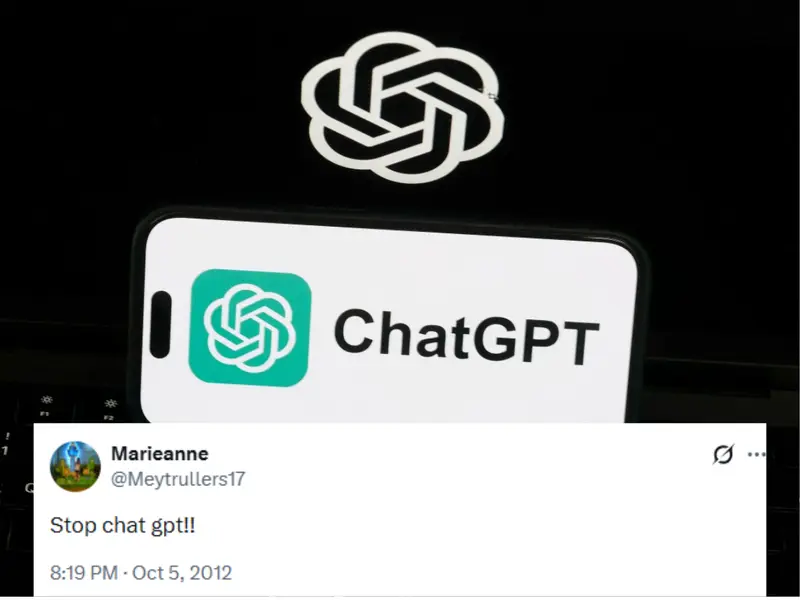
An old X post telling people to “Stop chat gpt!” has gone viral, sparking jokes and conspiracy theories because the message appears to mention ChatGPT more than a decade before the artificial intelligence tool was launched.
The post, shared by the account “Meytrullers17,” is dated October 2012 and has attracted thousands of views as users debate how someone could seemingly have referred to ChatGPT ten years before its public release.
There is, however, a much less mysterious explanation. Some Indonesian-speaking users have pointed out that “gpt” can be used as an abbreviation for “ga penting,” a colloquial Indonesian expression meaning “not important,” “pointless” or “useless.”
Under that interpretation, “Stop chat gpt!” is not a reference to OpenAI’s chatbot at all. It could simply mean something along the lines of “Stop chatting about pointless things” or “stop pointless chatting.”
The original post could not be independently verified in the material provided, so claims about its authenticity and meaning should be treated cautiously.
Why is the 2012 “Stop ChatGPT!” post going viral?
The apparent date is what makes the post so striking.
ChatGPT was publicly launched by OpenAI in November 2022. The viral post, meanwhile, is dated October 2012 — roughly a decade earlier.
That apparent mismatch has turned an otherwise ordinary-looking social media message into a viral curiosity.
Users have been asking variations of the same question: How could someone have told people to stop using or talking to ChatGPT before ChatGPT existed?
Some have interpreted the coincidence as evidence of time travel. Others have suggested that the account owner somehow knew about future technology.
But those theories overlook a basic possibility: the words “chat gpt” may not have referred to the AI product at all.
The Indonesian slang explanation
Several users responding to the viral post said the account belonged to an Indonesian woman and offered a linguistic explanation for the apparent reference to ChatGPT.
In Indonesian internet slang, “ga” is a common informal shortening of “tidak,” meaning “not,” while “penting” means “important.” The phrase “ga penting” therefore conveys the idea of something being unimportant, pointless or irrelevant.
“GPT” can be used as an abbreviation for that phrase in informal Indonesian online communication.
That would give “chat gpt” a completely different reading from the one modern internet users naturally associate with it.
Instead of:
“Stop ChatGPT!”
the phrase could be interpreted approximately as:
“Stop the pointless chatting!”
The distinction matters because language evolves independently of technology. An abbreviation that existed in online slang before ChatGPT’s launch can coincidentally resemble the name of a technology introduced years later.
Did the person know about ChatGPT in 2012?
There is no evidence in the information available that the 2012 poster was referring to OpenAI’s ChatGPT.
In fact, the timeline makes that interpretation highly unlikely. OpenAI introduced ChatGPT publicly in 2022, while the viral post is purportedly from 2012.
The more plausible explanation is that users are applying a modern meaning to an older phrase.
This is a classic example of present-day context changing how people interpret old internet posts. Once ChatGPT became one of the world’s best-known AI tools, the combination of the words “chat” and “gpt” acquired a very specific meaning for millions of people.
A post written before that meaning existed can now look remarkably prescient when viewed through today’s lens.
What are people saying about the viral post?
The apparent connection to ChatGPT has produced two very different reactions.
Some users immediately embraced the mystery.
One commenter joked:
“Someone time travelled to warn us.”
Others took the disappearance of the account as another piece of supposed evidence. One user asked why the account appeared to stop posting after 2013.
Another comment called it “another time traveler caught,” while others asked what the poster supposedly knew about the future.
These comments are largely playful speculation rather than evidence of anything unusual.
Other users say there is no mystery
A separate group of commenters focused on the Indonesian slang explanation.
One user wrote that “gpt” in this context stood for “ga penting,” explaining that it meant something like “pointless” or “useless.”
Another offered a fuller interpretation, saying the 2012 message used Indonesian slang and did not refer to ChatGPT, which did not exist at the time.
That explanation also highlights why viral posts can be difficult to interpret without cultural and linguistic context.
A phrase that looks unmistakably familiar to an English-speaking audience may carry an entirely different meaning in another language.
Why “GPT” can be misleading
The acronym GPT has become strongly associated with generative AI, but the letters themselves did not originate with ChatGPT.
In artificial intelligence, GPT stands for Generative Pre-trained Transformer, a type of language model architecture. OpenAI developed the GPT family before ChatGPT was launched, with the original GPT paper appearing in 2018.
ChatGPT later became the consumer-facing product that made the term “GPT” familiar to a huge global audience.
That history is important when assessing the viral post. Seeing the letters “GPT” in an old message does not, by itself, demonstrate that the writer was referring to an artificial intelligence system.
The meaning has to be established from the context in which the words were originally written.
Could the post still be fake or altered?
Yes, and that is another reason not to treat the viral claim as proof of time travel.
The material surrounding the post does not establish that the screenshot or archived version is authentic, unaltered, and correctly dated. Social media posts can be deleted, edited, misrepresented, or presented without their original context.
The safest conclusion is therefore narrower:
- The viral post is presented as dating from October 2012.
- It contains the words “Stop chat gpt!”
- ChatGPT was publicly launched in 2022.
- Some Indonesian users say “gpt” can mean “ga penting” in slang.
- That interpretation would make the phrase unrelated to OpenAI’s ChatGPT.
- The post’s authenticity and original intent have not been independently established from the information available.
That leaves little basis for treating the post as evidence of a person predicting ChatGPT’s arrival.
Why old posts can suddenly become viral
The episode also demonstrates how social media can transform an obscure post into a global curiosity almost overnight.
A decade ago, “Stop chat gpt!” would likely have meant little to most English-speaking readers. Today, the same three letters immediately evoke one of the world’s most recognizable AI products.
That creates what could be called a retroactive coincidence: an old statement acquires a new apparent meaning because the world has changed around it.
Similar incidents regularly emerge when users discover old posts containing words, phrases, or predictions that appear to describe later events. Once a connection is spotted, social media rewards the surprising interpretation with shares, reposts and comments.
The more people discuss the apparent mystery, the more convincing the coincidence can appear — even when the original context points somewhere else.
The bigger lesson: context matters
The “Stop ChatGPT!” post reminds us that viral screenshots are not necessarily self-explanatory.
Three questions are particularly important before accepting a claim based on an old social media post:
- Is the post authentic?
Can you independently confirm the date, account, and original post? - What did the words mean when they were written?
Slang, abbreviations, and cultural references can change dramatically across languages and communities. - Does the surrounding context support the viral interpretation?
A phrase that resembles the name of a modern technology does not necessarily refer to that technology.
In this case, the Indonesian slang explanation offers a straightforward alternative to the time-travel theories. But because the original post’s authenticity and context have not been independently verified, it should be presented as an explanation rather than an absolute fact.
For now, the viral “Stop chat gpt!” message is best understood as an intriguing internet coincidence, not evidence that someone in 2012 knew ChatGPT was coming.