
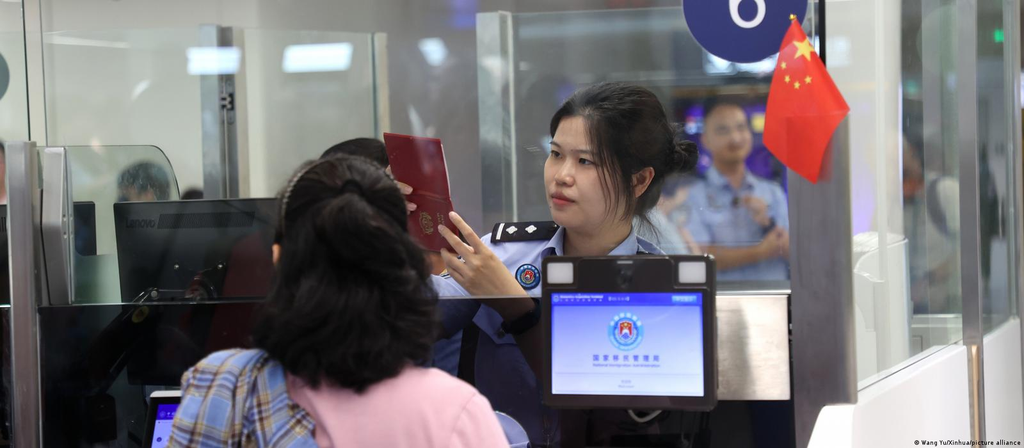
China is tightening controls on the overseas travel of some of its most strategically important artificial intelligence and semiconductor professionals—and the restrictions are reportedly reaching beyond the employees themselves.
Government agencies have begun notifying certain AI and chip executives that their spouses and children may also need official approval before traveling abroad, according to Bloomberg reporting published September 28, 2026. The reported measures affect a select group of startup founders, researchers and executives whose work is considered strategically important.
The development marks a significant expansion of a policy that was already taking shape earlier this year. In May, Bloomberg reported that Chinese authorities had begun restricting overseas travel by selected AI professionals at private companies, including people associated with Alibaba and DeepSeek.
The bigger story is not simply about passports or airport departures. It is about how Beijing increasingly views highly skilled engineers, researchers and founders as part of the country’s strategic technology infrastructure.
What is China’s AI talent travel restriction?
The reported restrictions are not a blanket ban on international travel for China’s technology workforce.
Instead, authorities appear to be identifying individuals considered particularly important to advanced AI or semiconductor development and requiring them to obtain government approval before traveling overseas.
Bloomberg reported in May that the affected group included startup founders, researchers and executives involved in advanced AI work. The selection was reportedly based on the strategic importance of individuals rather than simply their job title or employer.
That distinction matters
China has long imposed travel controls on certain government officials, state-company executives and people with access to sensitive information. What has attracted attention in 2026 is the reported extension of this approach into parts of the private technology sector.
The latest Bloomberg report says the restrictions have now been extended in some cases to direct relatives, including spouses and children of certain AI and semiconductor executives. Those family members may also require official approval for overseas trips.
The precise scope remains unclear. Public reporting does not establish that every employee at every Chinese AI company, or every relative of every restricted worker, is subject to the policy.
Editorial visual suggestion: Consider an infographic showing the reported progression from individual AI professionals → founders and executives → immediate family members.
Why is Beijing restricting AI talent from traveling abroad?
The central issue is technology transfer.
Artificial intelligence expertise is difficult to classify as a conventional physical asset. A semiconductor can be placed under an export-control regime. A server can be tracked. An AI researcher, however, carries knowledge, experience and professional relationships wherever they go.
For Beijing, that makes highly specialized talent strategically important.
China is investing heavily in AI, advanced computing and domestic semiconductor capabilities while facing restrictions on access to some of the world’s most advanced chips. Reuters reported in September that Chinese AI companies are increasing fundraising and investment in computing infrastructure, while Huawei has become a major supplier for advanced AI workloads inside China following U.S. restrictions on high-end chip exports. [Reuters, Sept. 23, 2026]
In that environment, losing a small number of people with expertise in areas such as model architecture, semiconductor design, advanced packaging or AI infrastructure can have consequences beyond the loss of an ordinary employee.
The concern also extends to intellectual property, corporate strategy, research partnerships, and access to foreign investors.
Why are spouses and children being included?
The reported expansion to immediate family members suggests that Beijing’s concern is not limited to what an individual engineer might physically carry across a border.
Family mobility can influence where highly skilled professionals ultimately live and work.
A researcher who can freely move abroad but whose spouse or children face restrictions has fewer practical options for relocating permanently. Similarly, an executive considering a job, investment opportunity or startup abroad may have to factor family travel into that decision.
That does not mean the policy is designed solely to prevent people from emigrating. The available reporting does not establish that as the government’s stated purpose.
But it does create an additional barrier to the international movement of people associated with sensitive technologies.
Bloomberg’s reporting says affected family members include spouses and children of certain AI and chip executives, but the precise criteria for determining which relatives are covered have not been publicly established. [Bloomberg, Sept. 28, 2026]
The May restrictions were the first major signal
The latest move builds on restrictions reported earlier this year.
In May, Bloomberg reported that Chinese authorities had begun limiting overseas travel by selected AI professionals at private-sector companies, including Alibaba and DeepSeek.
Those affected reportedly included founders, researchers and senior executives whose work authorities considered strategically important. Individuals were required to obtain approval before travelling abroad.
The significance was the expansion of a model historically associated more closely with government and state-linked personnel into China’s private technology industry.
The policy also reflected a broader change in how Beijing approaches technological competition.
AI is no longer treated simply as another commercial sector. Advanced AI intersects with computing infrastructure, military capabilities, cybersecurity, industrial automation, scientific research and economic productivity.
That makes control over specialised knowledge increasingly important to national technology strategies.
China is also tightening the legal framework around exit controls.
The reported restrictions on AI professionals come alongside a new national framework governing exit and entry.
China’s State Council issued new provisions on exit and entry administration in July, with the rules taking effect September 15, 2026. The official regulation says “China is establishing and improving a system for managing risks associated with citizens travelling abroad”. [Chinese State Council, July 22, 2026]
The regulation also gives authorities powers concerning people whose conduct is considered relevant to national security and other protected interests.
Reuters reported that the new framework allows authorities to bar Chinese citizens from leaving the country in circumstances involving potential threats to industrial or technological security. The rules can also impose restrictions connected to violations of technology import and export regulations. [Reuters, Sept. 15, 2026]
The Library of Congress’ legal analysis similarly noted that the new provisions strengthen China’s exit-and-entry controls and took effect on September 15. [Library of Congress, Sept. 14, 2026]
This distinction is important: the newly reported family travel restrictions and the formal September exit-and-entry regulations are related developments, but they should not be described as if the State Council regulation itself explicitly created a blanket travel ban on the families of AI executives.
The family restrictions have been reported by Bloomberg through people familiar with the matter.
The Manus case showed where the policy could lead
Another episode earlier this year provided a glimpse into Beijing’s increasing scrutiny of AI companies with international ambitions.
In March, Chinese authorities prevented two executives associated with Manus from leaving China while the company faced scrutiny surrounding its acquisition by Meta, according to reporting by The Washington Post and other outlets.
Manus was founded by Chinese entrepreneurs and later moved operations to Singapore. Meta subsequently agreed to acquire the AI company in a deal reported at roughly $2 billion.
The Washington Post reported that Manus CEO Xiao Hong and chief scientist Ji Yichao were questioned in Beijing and then prevented from leaving the country during the review. [Washington Post, March 25, 2026]
The case was significant because it connected three issues that increasingly overlap in the AI industry:
- Chinese technology developed by founders with roots in China.
- International movement of AI companies and researchers.
- Foreign acquisition and investment in advanced AI businesses.
The episode also demonstrated that an AI company’s corporate structure and geographic location do not necessarily determine whether Chinese authorities retain an interest in its founders or technology.
What does this mean for China’s AI industry?
The policy presents a complicated trade-off.
From a national-security perspective, restricting the movement of strategically important talent can make it harder for sensitive expertise to leave the country.
But AI development also depends heavily on international collaboration.
Researchers attend conferences. Engineers change companies. Founders raise money overseas. Universities collaborate across borders. Startups recruit internationally. Scientists publish research and build professional networks that span multiple countries.
More restrictive travel policies could therefore affect China’s ability to participate in those networks.
Bloomberg’s May reporting noted concerns that such restrictions could make it harder for Chinese AI companies to recruit and retain globally minded talent, particularly engineers who view international mobility as part of their careers.
At the same time, China’s AI industry has continued to expand.
Reuters reported in September that companies including DeepSeek, MiniMax, Z.ai and Moonshot are pursuing additional funding and computing capacity, while Chinese firms and government-backed investors continue putting resources into the sector.
That means the restrictions are emerging alongside—not instead of—rapid investment in AI.
The U.S.-China AI race is increasingly a race over people
For years, the technology rivalry between Washington and Beijing focused heavily on hardware.
The most visible battles involved advanced processors, semiconductor manufacturing equipment, export controls and data-center infrastructure.
The talent question is different.
A leading AI researcher cannot simply be replaced by ordering another piece of equipment. Expertise accumulated over years can influence model efficiency, chip architecture, training methods and the ability to build large-scale AI systems.
That helps explain why both governments increasingly treat human expertise as strategically significant.
The United States has pursued restrictions aimed at controlling technology transfers and access to advanced computing. China, meanwhile, is developing domestic alternatives while strengthening controls around technologies and people considered strategically important.
The result is a technology competition in which borders matter more than they once did.
What happens next?
Several questions remain unanswered.
It is not publicly clear:
- How many AI and semiconductor professionals are covered by the reported restrictions.
- Which government agencies maintain the relevant lists.
- Exactly which family members require approval.
- Whether the family restrictions apply uniformly across companies and regions.
- How long individual approvals typically take.
- Whether the measures are temporary, permanent or subject to periodic review.
- Whether similar controls will expand to additional technology sectors.
Those details will determine whether the latest development remains a targeted national-security measure or becomes a broader system governing the international mobility of China’s technology workforce.
For now, the clearest signal is that Beijing increasingly regards elite technical expertise as more than an economic resource.
It is treating some of that expertise as a strategic asset whose movement across borders may require government oversight.
That is a significant development in the global AI race. The competition is no longer only about who has the fastest chips, the largest data centers or the most capable models.
It is also about who can keep the people capable of building them.