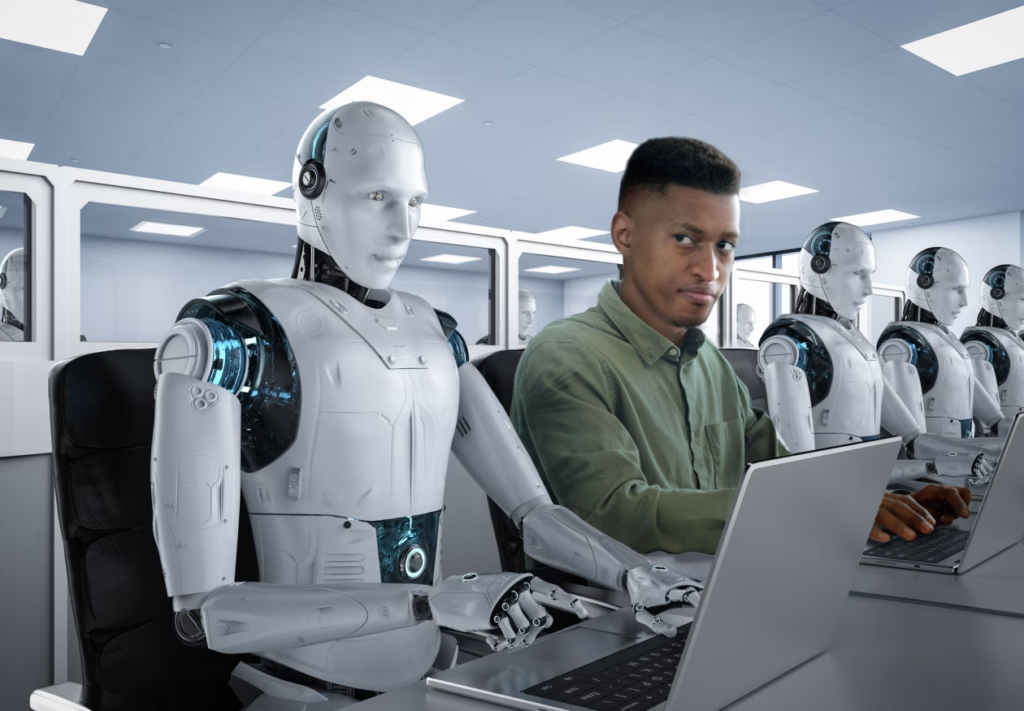
A senior Microsoft AI executive has made one of the boldest workplace predictions yet: most tasks done in white-collar jobs could be automated by artificial intelligence within roughly the next year to year and a half.
In an interview with the Financial Times, Microsoft AI chief Mustafa Suleyman said systems already outperform the majority of human programmers in coding tasks and are rapidly expanding into fields like law, accounting, and project management. His comments land at a moment when companies are experimenting with AI assistants at scale, and workers are trying to understand whether the technology is a tool or a replacement.
Below is what he actually said, what it implies, and what tends to get lost when predictions travel faster than context.
What did the Microsoft AI CEO actually predict?
Suleyman’s core claim is not that companies will fire all office workers immediately. Instead, he argued that most computer-based tasks inside those jobs will become automated.
Jobs he referenced include
- Lawyers
- Accountants
- Project managers
- Software engineers
His timeline:
- 12 to 18 months: automation of most routine tasks
- 2 to 3 years: AI agents managing complex workflows across institutions
That distinction matters. Automation of tasks changes roles before it eliminates them.
Why does he say AI coding already surpasses humans
The strongest part of his argument centers on software engineering.
According to Suleyman, engineers increasingly rely on AI for:
- Generating code
- Debugging
- Refactoring
- Documentation
Human engineers now spend more time on:
- architecture decisions
- system integration
- reviewing AI output
- production deployment
What “better than humans” means in practice
It does not mean AI independently builds entire products reliably.
It means AI excels at:
- Pattern-based programming
- Boilerplate generation
- Repetitive logic writing
But still struggles with:
- ambiguous product goals
- edge-case reasoning
- long-term maintainability judgment
How this affects lawyers, accountants, and managers
White-collar work largely involves structured information processing. That makes it suitable for automation.
Legal work
AI already handles:
- contract review
- clause comparison
- document summarization
- legal research
Human lawyers remain critical for:
- strategy
- negotiation
- courtroom judgment
Accounting
AI performs:
- reconciliation
- compliance checks
- anomaly detection
- reporting
Humans focus on:
- interpretation
- risk assessment
- financial planning
Project management
AI agents can:
- schedule tasks
- assign resources
- track milestones
- generate status reports
Humans still manage:
- stakeholder alignment
- conflict resolution
- decision tradeoffs
The pattern is consistent: execution becomes automated, accountability remains human.
Why this prediction is gaining credibility now
Three technical shifts are converging.
1. Models now interact with software, not just text
Modern AI agents can operate tools:
- code editors
- spreadsheets
- databases
- ticket systems
They no longer only answer questions. They perform actions.
2. Memory and workflow automation
AI systems now maintain persistent context across tasks, enabling ongoing project management rather than single prompts.
3. Falling cost of creating custom AI
Suleyman suggested organizations may soon build specialized models as easily as publishing a blog or podcast. That means companies won’t wait for universal AI; they’ll deploy niche AI tailored to their internal workflows.
Does this mean mass layoffs in a year?
Probably not at the speed headlines imply.
Historically, automation changes job composition faster than job counts.
Examples:
- Spreadsheets reduced the number of bookkeepers but increased the number of finance analysts
- CAD reduced draftsmen but increased engineers
- Email reduced clerks but increased coordinators
The difference today is scope. AI targets cognitive routine work rather than physical routine work.
More realistic short-term outcomes
- fewer entry-level tasks
- smaller teams producing the same output
- hybrid roles combining domain expertise with AI supervision
Microsoft’s broader AI strategy
Suleyman said the company aims to build “superintelligence” and greater self-sufficiency in AI systems. Microsoft recently extended its intellectual property licensing partnership with OpenAI through 2032 while simultaneously developing its own foundation models.
The strategy has two tracks:
- partner for frontier models
- build proprietary models for independence
This dual approach reduces reliance risk while accelerating product deployment.
Why companies are moving quickly
There is a business incentive beyond innovation.
Automation reduces:
- labor costs
- operational delays
- training requirements
It also increases:
- consistency
- compliance accuracy
- scalability
Recent corporate layoffs tied to AI investment have intensified worker concerns, reinforcing the relevance of Suleyman’s comments.
What workers should actually prepare for
The biggest shift is not unemployment but role compression.
One person will manage what previously required multiple specialists.
Skills gaining importance
- decision making
- domain expertise
- problem framing
- oversight and auditing
Skills losing value
- repetitive drafting
- manual reconciliation
- basic coding syntax
- routine reporting
In short, AI handles execution, and humans handle judgment.
TL;DR
- Microsoft AI chief predicts most white-collar tasks will be automated within 12–18 months
- AI already writes large portions of software code
- Jobs will change before they disappear
- Humans shift toward strategy and oversight
- Companies are building custom AI agents to run workflows
- The impact is role transformation more than immediate job extinction