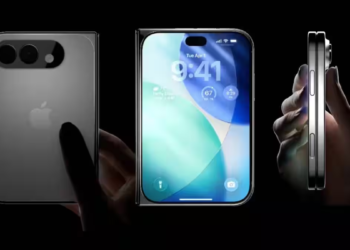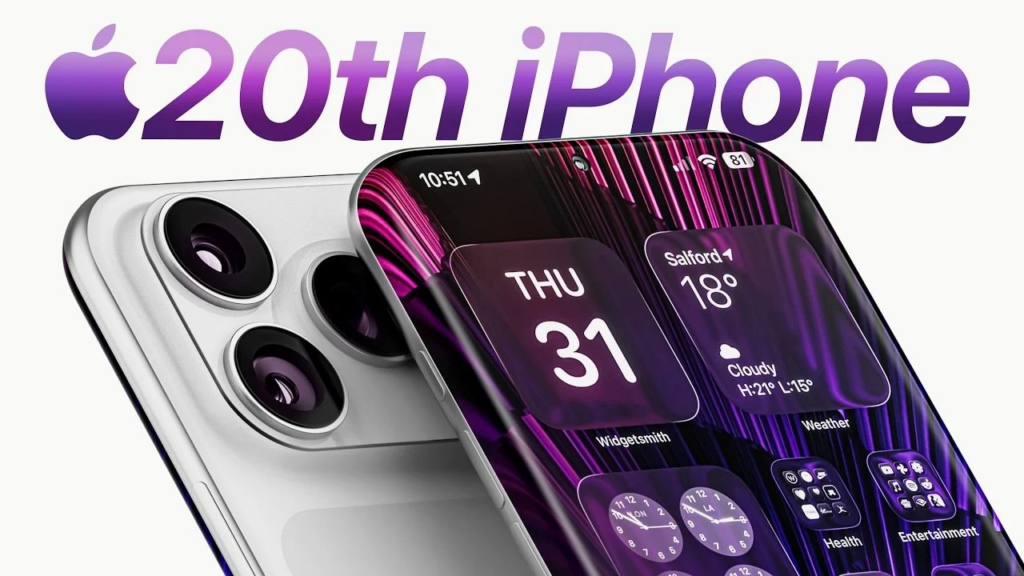
Apple may be preparing its boldest iPhone redesign in a decade—and it’s timing it for maximum impact. According to reporting from The Information, the company is working on a special iPhone with a completely clean front: no bezels, no notch, no Dynamic Island, and no visible camera cutouts. If the plan holds, this device would arrive in 2027, marking 20 years since the original iPhone reshaped consumer technology.
This wouldn’t just be another annual refresh. Internally, Apple reportedly sees this model as a design milestone on par with the iPhone X in 2017—the moment the home button disappeared and the modern iPhone era began.
Below, we break down what Apple is reportedly planning, why it matters, and how the next two years of iPhone releases appear to be building toward this anniversary moment.
What Is Apple’s 20th-Anniversary iPhone?
The rumoured 20th-anniversary iPhone is envisioned as an all-screen device with a seamless glass front. Apple’s goal, according to the report, is a phone that looks like a single slab of curved glass when viewed from the front—no interruptions, no hardware giveaways.
Key design ambitions reportedly include:
- A completely bezel-free display
- No notch, hole-punch, or Dynamic Island
- Under-display cameras and sensors
- Curved glass that flows to the edges
In other words, Apple wants the display to be the product.
This aligns with a long-standing industry goal, often promised by Android manufacturers, rarely delivered cleanly. Apple appears to be taking a slower, more deliberate path, waiting until the technology meets its standards rather than shipping a compromise.
Why Is Apple Targeting 2027 for This Design?
Apple anniversaries matter more than the company likes to admit publicly. The iPhone X launched on the product’s 10th anniversary and introduced Face ID, OLED displays, and gesture-based navigation. It reset expectations.
The 20th anniversary offers a similar narrative opportunity.
A device with a truly uninterrupted front would signal that Apple has moved beyond incremental refinement and into another design era. From a marketing standpoint, it’s also easier to justify a premium price when the product looks fundamentally different.
There’s another reason for the long runway: under-display technology still has trade-offs, especially around camera quality and sensor reliability. Apple’s brand depends on not shipping features that feel half-baked.
How Will Apple Get There? The iPhone 18 Pro is the Bridge
Before Apple can ship a fully clean front, it needs to hide Face ID beneath the display—and that’s expected to happen one year earlier.
Under-Display Face ID Comes First (2026)
The report says Apple plans to introduce under-display Face ID on the iPhone 18 Pro and iPhone 18 Pro Max, expected to launch in September 2026.
What that likely means:
- Face ID sensors move under the display panel
- The Dynamic Island shrinks or disappears
- The front-facing camera remains visible, likely as a small cutout
Interestingly, the front camera is said to shift to the top-left corner of the display. This would be a notable change from Apple’s symmetrical design language and could signal a transitional year rather than a final form.
Why Apple Is Taking a Different Path Than Android Makers
Several Android phones already offer under-display selfie cameras, but the results have been mixed. Images often look softer, and displays can show visible artifacts above the camera area.
Apple’s reluctance to adopt this tech early isn’t hesitation; it’s a strategy.
Face ID isn’t just a camera. It relies on a complex array of infrared sensors, dot projectors, and flood illuminators. Hiding all of that under an OLED panel without sacrificing security or speed is a harder problem than hiding a single RGB camera.
That helps explain the two-step approach:
- 2026: Hide Face ID, leave the camera visible
- 2027: Hide everything
What Else Is Changing? A Major Camera Upgrade Is Coming
Design isn’t the only area seeing big moves. Apple is also reportedly planning a meaningful camera upgrade for the iPhone 18 Pro lineup.
Mechanical Iris: A First for iPhone
According to The Information, at least one rear camera on the iPhone 18 Pro models will feature a mechanical iris. This would allow the camera to physically adjust its aperture, similar to how traditional cameras work.
Why this matters:
- Better low-light performance without relying solely on software
- Improved depth control for photos and video
- More natural background blur
This lines up with earlier reporting from analyst Ming-Chi Kuo, who has said Apple plans to give the 48MP main camera an adjustable aperture.
If accurate, this would mark a shift away from Apple’s heavy reliance on computational photography and toward more optical control—something advanced users have been asking for.
Does a Bezel-Free iPhone Actually Matter?
It’s a fair question. Smartphones are already slabs of glass. How much difference does a truly clean front make?
From Apple’s perspective, quite a lot.
Design as Identity
Apple doesn’t compete on spec sheets alone. Its advantage is emotional attachment—how a device feels, looks, and signals status. A bezel-free iPhone would instantly stand out in a market where most phones look interchangeable.
Practical Benefits
An uninterrupted display also enables:
- More immersive video and gaming
- Cleaner UI layouts without “safe zones.”
- New interface possibilities Apple hasn’t explored yet
It’s not just about aesthetics. It’s about reclaiming control over how apps and content fill the screen.
What This Means for Buyers Over the Next Two Years
If you’re planning an upgrade, the rumored roadmap suggests clear tiers of change:
- iPhone 16 / 17: Incremental improvements
- iPhone 18 Pro (2026): Big internal upgrades, under-display Face ID
- 20th-anniversary iPhone (2027): Major design leap
That doesn’t mean everyone should wait until 2027. But it does suggest that Apple’s most ambitious visual changes are still ahead.
For consumers, this also raises questions about pricing. A landmark design typically comes with a landmark price tag. The iPhone X debuted at $999 and reset the market. Apple could do that again.
What Still Needs Fact-Checking and Confirmation
It’s important to stress that none of this is official. Apple has not commented on these reports.
Before publication, sources should be linked or verified for:
- The original reporting from The Information
- Analyst commentary from Ming-Chi Kuo
- Historical context around the iPhone X launch
TL;DR
- Apple is reportedly planning a completely bezel-free iPhone for 2027
- The device would mark the iPhone’s 20th anniversary
- Under-display Face ID is expected to debut on iPhone 18 Pro models in 2026
- A mechanical iris camera could bring real optical upgrades
- Apple appears to be building toward a major design reset, not rushing it