
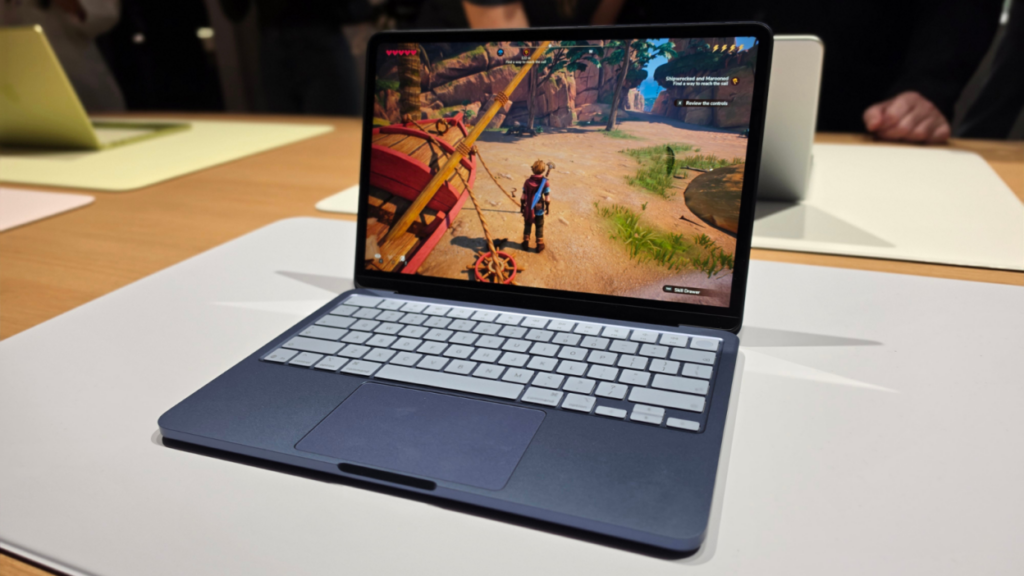
Apple has rarely been associated with “budget.” That’s why the newly announced MacBook Neo—a laptop starting at $599—has quickly become one of the most talked-about tech announcements of the week.
The device, unveiled by Apple, is positioned as the company’s most affordable Mac laptop yet, with student pricing lowering the entry point even further to $499. For comparison, Apple’s current laptop lineup typically starts closer to $1,000, making the Neo a dramatic shift in pricing strategy.
At first glance, the Neo looks like a classic MacBook: sleek aluminum body, bright display, and long battery life. But under the hood, Apple has made one notable change that keeps costs down—an A-series chip more commonly found in the iPhone.
Here’s what the MacBook Neo offers, why Apple priced it so aggressively, and why the internet is both excited and skeptical.
What Is the MacBook Neo?
The MacBook Neo is Apple’s new entry-level laptop aimed at students, casual users, and first-time Mac buyers.
Unlike the company’s premium laptop lineup—such as the MacBook Air and MacBook Pro—the Neo focuses on affordability and portability rather than high-end computing power.
Key specifications
According to Apple, the base model includes:
- 13-inch Liquid Retina display
- Aluminium chassis
- A-series Apple silicon processor
- 8GB unified memory
- 256GB storage
- All-day battery life
- Magic Keyboard and Multi-Touch trackpad
- Built-in camera, microphones, and speakers
The laptop also comes in four colour options:
- Blush
- Indigo
- Silver
- Citrus
Visually, the Neo fits right into Apple’s design language, which is likely intentional: Apple wants it to look and feel like a full MacBook, not a stripped-down alternative.
Why the MacBook Neo Is So Cheap (For Apple)
The biggest reason the MacBook Neo costs $599 lies in its processor.
Instead of using the M-series chips found in Apple’s latest laptops, the Neo uses an A-series processor, the same family used in the iPhone.
What this means
A-series chips are:
- Cheaper to produce
- Highly energy efficient
- Optimized for everyday computing tasks
However, they generally offer less raw performance than Apple’s M-series processors.
For many users—especially students browsing the web, writing papers, or streaming video, the difference may not matter much. But professionals running demanding software may still prefer Apple’s more powerful machines.
This chip choice allows Apple to:
- Keep the laptop thin and lightweight
- Maintain long battery life
- Dramatically lower production costs
Apple’s Strategy: A Mac for the Mass Market
The Neo appears to be part of a broader effort by Apple to expand its customer base.
For years, Apple laptops have been criticized for their high price, especially in education markets where cheaper Windows and Chromebook devices dominate.
By introducing a $599 MacBook and potentially a $499 student version, Apple could:
- Compete more directly with mid-range Windows laptops
- Attract first-time Mac users
- Strengthen its presence in schools and universities
This strategy could also increase adoption of Apple’s broader ecosystem, including services like macOS, iCloud, and Apple Music.
Once users enter that ecosystem, they’re more likely to buy other Apple devices.
Social Media Reaction: Excitement and Scepticism
The announcement has sparked strong reactions online.
Many users were surprised that Apple would release a laptop at a price typically associated with mid-range Windows devices.
One sentiment widely shared on social media captured the shock:
“A $500 MacBook? In this economy?”
Others welcomed the idea of a more accessible Mac, especially for students and young professionals.
But the excitement has also been paired with skepticism.
Questions people are asking
Several themes have emerged in online discussions:
1. Is it basically an iPad with a keyboard?
Because the Neo uses an A-series chip similar to those in Apple’s tablets and phones, some users wonder whether the laptop is closer to an iPad internally.
2. Is the price too good to be true?
Some commentators described the unusually low price as “suspicious,” questioning whether performance compromises might appear after release.
3. Will it run full macOS apps?
Apple says the device runs macOS, but questions remain about how well demanding desktop software will perform on the A-series architecture.
These questions likely won’t be fully answered until the laptop reaches consumers and reviewers.
What Apple Says About the MacBook Neo
In announcing the device, John Ternus, Apple’s senior vice president of hardware engineering, emphasized the company’s goal of making the Mac more accessible.
According to Ternus, the Neo was designed specifically to expand the Mac lineup.
“We’re incredibly excited to introduce MacBook Neo, which delivers the magic of the Mac at a breakthrough price,” he said.
He added that the laptop was “built from the ground up to be more affordable for even more people.”
Apple also highlighted the Neo’s:
- Durable aluminum build
- Bright Liquid Retina display
- All-day battery life
- Integrated camera and audio system
The company says the device combines these features with the power and simplicity of macOS, creating what it describes as a uniquely Apple laptop.
Could the MacBook Neo Disrupt the Laptop Market?
If the MacBook Neo performs well, it could significantly reshape the mid-range laptop market.
For years, Apple has largely competed in the premium laptop segment, leaving budget and mid-range devices to Windows manufacturers.
But a successful $599 MacBook could pressure competitors such as
- Dell
- HP
- Lenovo
Those companies dominate the affordable laptop category.
Apple entering that price tier could force competitors to respond with better hardware or lower prices.
TL;DR
- Apple has announced the MacBook Neo, its cheapest laptop ever.
- The device starts at $599, or $499 for students.
- It features a 13-inch Liquid Retina display, an aluminum design, and 8GB RAM with 256GB storage.
- Unlike other Macs, it runs on an A-series chip similar to the iPhone’s processor.
- The unusually low price has sparked excitement and skepticism across social media.