
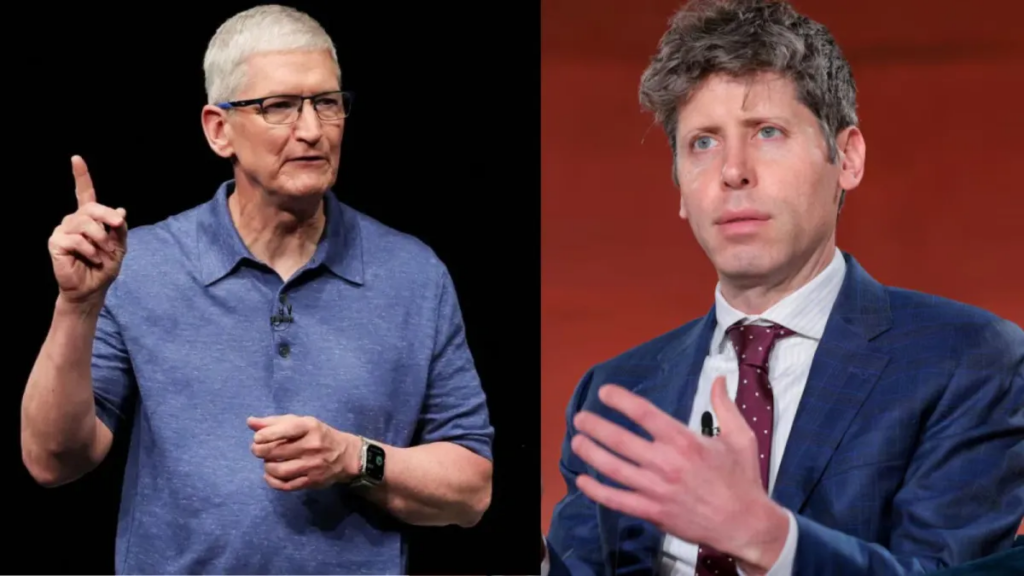
Apple and OpenAI began as collaborators in the race to bring generative AI to consumers. In 2024, Apple chose ChatGPT as a key partner for Apple Intelligence, integrating OpenAI’s chatbot into Siri to fill gaps in Apple’s own AI capabilities. Just two years later, the two companies find themselves on opposite sides of a courtroom, with Apple accusing OpenAI of trade secret theft and improper recruitment of former employees.
The lawsuit marks one of the most significant legal disputes in the AI industry to date, highlighting how quickly alliances can turn into rivalries as companies compete for talent, technology, and the future of AI-powered hardware.
How did Apple and OpenAI become partners?
The relationship between Apple and OpenAI began publicly during Apple’s Worldwide Developers Conference (WWDC) in June 2024.
As part of its Apple Intelligence announcement, Apple revealed that Siri would be able to hand off complex requests to ChatGPT whenever its own AI assistant couldn’t adequately answer a user’s question.
The partnership benefited both companies.
Apple gained immediate access to one of the world’s most capable AI chatbots without building every capability internally, while OpenAI dramatically expanded ChatGPT’s reach by making it available across millions of iPhones.
At the time, the collaboration appeared to strengthen both companies’ positions in the rapidly evolving AI market.
Timeline: How the Apple-OpenAI relationship changed
June 2024: Apple integrates ChatGPT into Siri
Apple unveiled Apple Intelligence at WWDC 2024, making ChatGPT an optional extension of Siri.
The integration allowed users to access OpenAI’s chatbot seamlessly within Apple’s ecosystem while maintaining Apple’s emphasis on user privacy and consent.
The announcement was widely viewed as a strategic partnership rather than a competitive relationship.
2025: OpenAI enters the AI hardware race
The relationship began shifting when OpenAI expanded beyond software.
In 2025, the company acquired io, an AI hardware startup co-founded by former Apple design chief Jony Ive along with former Apple executive Tang Tan and others.
The acquisition, reportedly valued at approximately $6.5 billion, signaled OpenAI’s ambition to create dedicated AI hardware rather than relying solely on smartphones and computers built by other companies.
This marked OpenAI’s biggest acquisition and suggested that it intended to compete directly in consumer hardware.
OpenAI recruits Apple engineers
As OpenAI accelerated its hardware ambitions, it increasingly recruited engineers with experience designing consumer devices.
According to reports, OpenAI hired more than two dozen Apple employees during 2025, significantly more than the previous year.
Many reportedly came from teams responsible for:
- Hardware engineering
- Wearables
- Manufacturing
- Camera systems
- Audio technology
Several high-profile former Apple executives also became associated with OpenAI’s expanding hardware efforts.
The growing talent migration intensified competition between the two companies.
July 2026: Apple files a lawsuit
The partnership officially broke down when Apple filed a lawsuit in federal court alleging that OpenAI improperly obtained confidential information through former Apple employees.
Apple named former executives Tang Tan and Chang Liu as defendants alongside claims involving OpenAI.
According to Apple’s complaint, former employees allegedly shared confidential information relating to Apple’s hardware development after joining OpenAI.
Apple further claimed that recruits were encouraged to avoid drawing attention during the hiring process and that confidential company materials were improperly requested.
OpenAI has denied the allegations.
The company stated that it has no interest in competitors’ trade secrets and remains focused on developing its own technology.
The claims remain allegations and have not been proven in court.
What is Apple accusing OpenAI of?
At the center of the lawsuit are allegations involving trade secrets rather than the ChatGPT partnership itself.
Apple argues that confidential information relating to future hardware projects was improperly transferred after employees left the company.
Among Apple’s allegations are claims that:
- Former employees disclosed confidential hardware information.
- Proprietary engineering knowledge was improperly shared.
- OpenAI encouraged employees to retain or disclose confidential materials.
- Certain recruits were instructed to avoid attracting attention during the hiring process.
These allegations will ultimately need to be examined through the legal process.
How has OpenAI responded?
OpenAI has rejected Apple’s accusations.
A company spokesperson said OpenAI is reviewing the complaint but emphasized that it has no interest in obtaining another company’s confidential information.
Instead, the company says it remains focused on building innovative AI technologies and developing its own products.
At this stage, no court has ruled on the merits of either side’s claims.
Why this lawsuit matters
The dispute extends well beyond employee recruitment.
It reflects the growing competition over who will define the next generation of computing.
Apple continues to build AI into existing products like the iPhone, iPad, and Mac through Apple Intelligence.
OpenAI, meanwhile, appears to be pursuing an AI-first hardware strategy designed around artificial intelligence from the ground up.
That difference in vision makes the companies natural competitors despite their earlier collaboration.
The case also raises broader questions for the technology industry:
- Where is the line between recruiting talent and acquiring proprietary knowledge?
- How should trade secrets be protected in an industry where engineers frequently change employers?
- Can AI companies compete aggressively without crossing legal boundaries?
These issues could influence future hiring practices across Silicon Valley.
Could this affect Apple’s AI strategy?
The lawsuit itself is unlikely to affect existing ChatGPT integrations immediately unless either company decides to alter their commercial relationship.
However, the legal dispute may encourage Apple to reduce its reliance on third-party AI providers over time as it continues investing in its own large language models.
Likewise, OpenAI’s push into hardware suggests it wants greater control over how users interact with AI rather than depending on platforms owned by companies like Apple.
The two companies increasingly appear to be pursuing competing long-term visions.
What happens next?
The case is still in its early stages.
Apple will need to prove that confidential trade secrets were improperly taken or used, while OpenAI will have the opportunity to challenge those claims in court.
Potential outcomes could include:
- Dismissal of some or all claims.
- Financial damages if Apple prevails.
- Injunctions restricting the use of certain information.
- A confidential settlement before trial.
Given the importance of AI hardware and engineering talent, the case is likely to be closely watched across the technology industry.
The bigger picture
The Apple-OpenAI dispute illustrates how quickly strategic partnerships can evolve into intense competition in the AI era.
Just two years ago, the companies worked together to bring ChatGPT to millions of iPhones.
Today, they are battling over engineers, intellectual property, and the future of AI-powered devices.
Regardless of how the lawsuit ends, it highlights a broader reality: as artificial intelligence becomes central to consumer technology, competition is no longer limited to software. It now extends to hardware, talent, intellectual property, and the platforms that could define the next generation of computing.
TL;DR
- Apple and OpenAI partnered in 2024 to integrate ChatGPT into Siri through Apple Intelligence.
- OpenAI’s move into AI hardware in 2025 changed the competitive landscape.
- The company recruited several former Apple engineers and executives.
- Apple sued OpenAI in July 2026, alleging trade secret theft and improper recruitment practices.
- OpenAI denies the allegations, and the case has not yet been decided in court.
- The lawsuit could shape future legal standards around AI hiring, intellectual property, and competition.