
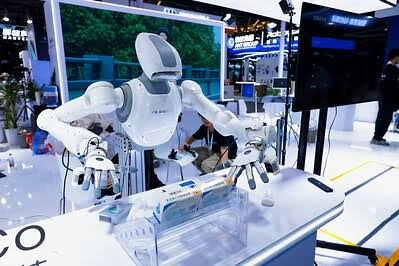
Chinese neurotechnology company BrainCo has unveiled what it calls the world’s first integrated “brain-to-robot” platform, a system that enables users to control robots using only their brain signals—without moving a single muscle.
The platform was introduced at the World Artificial Intelligence Conference (WAIC) 2026 in Shanghai, highlighting China’s growing ambitions in embodied AI, a field focused on giving artificial intelligence the ability to perceive, learn, and interact with the physical world through robots.
If the technology performs as demonstrated and proves reliable in real-world applications, it could mark a significant step forward in brain-computer interfaces (BCIs) and human-machine interaction.
TL;DR
- Chinese company BrainCo unveiled a brain-controlled robot platform at WAIC 2026.
- Users wear an EEG (electroencephalogram) headset that captures brain signals.
- AI algorithms decode those signals into commands for robots.
- The platform can control robotic arms, humanoid robots, robot dogs, and other compatible hardware.
- The technology is part of the rapidly growing field of embodied AI, which combines artificial intelligence with physical machines.
What Is BrainCo’s Brain-to-Robot Platform?
BrainCo’s new system combines brain-computer interface (BCI) technology with artificial intelligence to allow users to operate robots through thought alone.
Instead of relying on joysticks, keyboards, voice commands, or hand gestures, the platform interprets electrical activity generated by the brain and converts it into machine-readable instructions.
To use the system, a person wears an EEG headset, which detects tiny electrical signals produced by neurons in the brain. AI models then analyse those signals to infer the user’s intended action before sending commands to a connected robot.
For example, a user can think about reaching for an object, and the system may direct a robotic arm to pick up a cup or move another item without any physical movement from the user.
How Does the Technology Work?
The platform operates in several stages:
Step 1: Brain Signal Collection
The user wears an EEG headset, which measures electrical brain activity through sensors placed on the scalp.
Unlike invasive brain implants, EEG devices are non-surgical and record signals externally.
Step 2: AI Signal Processing
The collected brain signals are analysed using AI-powered algorithms trained to recognise patterns associated with different user intentions.
The system attempts to distinguish between various mental commands and filter out background neural activity.
Step 3: Robot Execution
Once an intention is identified, the decoded command is transmitted to a robot, which performs the requested action.
This process allows users to control machines without pressing buttons or making physical movements.
What Is Embodied AI?
BrainCo’s platform is part of the rapidly expanding field of embodied AI.
Traditional AI systems typically operate in digital environments, processing text, images, or data. Embodied AI extends those capabilities into physical machines that can sense, reason, and interact with the real world.
Examples include:
- Humanoid robots
- Robotic arms
- Autonomous warehouse robots
- Robot dogs
- Household service robots
The goal is to create intelligent machines capable of understanding their surroundings and performing increasingly complex physical tasks.
What Robots Can It Control?
According to BrainCo, the platform is designed to work with a broad range of third-party robotic hardware.
Compatible systems include:
- Robotic arms
- Humanoid robots
- Quadruped robot dogs
- Other industrial and research robots
The company says its platform is hardware-agnostic, meaning developers can integrate it with different robotic systems rather than being limited to a single device.
Why This Technology Matters
Brain-computer interfaces have been studied for decades, but advances in artificial intelligence have significantly improved researchers’ ability to interpret brain signals.
Potential applications extend far beyond robotics demonstrations.
Healthcare
People with paralysis or severe mobility impairments could eventually use similar systems to operate:
- Prosthetic limbs
- Wheelchairs
- Communication devices
- Assistive robots
Manufacturing
Workers may one day direct robotic systems more efficiently in factories without relying on traditional control interfaces.
Research
Scientists could use brain-controlled robots to better understand how humans interact with intelligent machines.
Consumer Technology
Although still in its early stages, future applications could include smart home control, immersive virtual reality experiences, and next-generation human-computer interfaces.
How Does BrainCo Compare With Other Brain-Computer Interface Companies?
BrainCo joins a growing number of companies exploring brain-computer interfaces.
Approaches vary widely across the industry.
Some companies focus on non-invasive systems, like EEG headsets worn externally, while others are developing implantable brain chips capable of capturing higher-resolution neural signals.
Non-invasive systems generally offer greater accessibility because they do not require surgery, although they often capture less detailed neural information than implanted devices.
The field remains highly competitive, with research organizations and technology companies worldwide racing to improve signal accuracy, response times, and real-world usability.
Challenges Ahead
Despite the excitement surrounding brain-controlled robotics, several hurdles remain before the technology sees widespread adoption.
Key challenges include:
- Improving the accuracy of brain signal interpretation.
- Reducing delays between thought and robot action.
- Accounting for differences in brain activity between users.
- Ensuring long-term comfort of wearable EEG devices.
- Addressing privacy and cybersecurity concerns related to neural data.
Experts also caution that many demonstrations occur in controlled environments, and broader commercial deployment will require extensive real-world testing.
The Bigger Picture
BrainCo’s unveiling comes as global investment in embodied AI accelerates. Advances in generative AI, robotics, and brain-computer interfaces are increasingly converging, opening new possibilities for how humans interact with machines.
If BrainCo’s platform proves scalable and reliable, it could help expand the use of brain-controlled systems in healthcare, manufacturing, research, and personal robotics.
While the technology is still evolving, it reflects a broader shift toward more intuitive forms of human-machine interaction—where thoughts, rather than physical controls, may eventually become a practical way to command intelligent robots.