
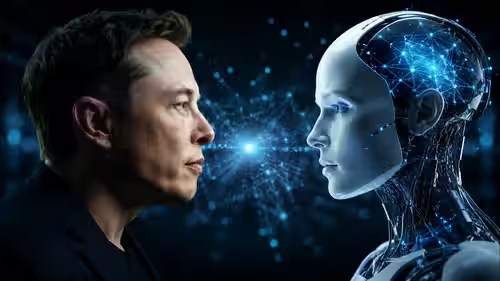
Elon Musk has offered an ambitious vision of the future of artificial intelligence, predicting that AI could exceed the combined intelligence of humanity within five years and usher in what he describes as an “age of amazing abundance”.
Speaking in an interview with The Economist, the billionaire entrepreneur said advances in AI and humanoid robotics could dramatically reshape the global economy, making many forms of labour unnecessary and creating unprecedented material prosperity.
While Musk’s outlook is highly optimistic, other economists and AI researchers caution that the technology’s impact remains uncertain, with potential outcomes ranging from rapid economic growth to significant labour market disruption.
What Did Elon Musk Predict?
During an interview with The Economist, Musk outlined several forecasts for the coming years.
He said he believes:
- AI could exceed the combined intelligence of humanity within approximately five years.
- Humanoid robots could become widespread, with between 100 million and one billion deployed globally.
- Rapid automation could significantly increase economic productivity.
- Artificial intelligence may eventually perform nearly every task more effectively than humans, except for uniquely human experiences.
Musk also suggested that, barring a major global catastrophe, advances in AI could create what he described as an “age of amazing abundance”.
These remarks represent Musk’s personal forecasts rather than established scientific consensus.
How Could AI Change the Economy?
Musk argues that widespread deployment of AI systems and autonomous robots could dramatically expand economic output.
He has previously suggested the following:
- Automation could perform much of today’s physical and intellectual work.
- Productivity gains could significantly increase global economic output.
- Scarcity of many goods and services could decline as production becomes increasingly automated.
Supporters of this vision argue that lower production costs could make housing, healthcare, transportation, and other essential services more affordable.
However, economists note that whether those benefits are broadly shared will depend on public policy, market competition, and ownership of AI technologies.
What Is an “Age of Abundance”?
The concept refers to a future in which advanced AI and robotics make producing goods and services dramatically cheaper and more efficient.
In such a scenario:
- Automation performs much of the world’s work.
- Goods become less expensive.
- Productivity rises substantially.
- People may work fewer hours or pursue different types of employment.
Some technology leaders have suggested that governments may eventually need new economic models, including forms of universal basic income (UBI), if automation significantly reduces demand for human labour.
Whether such a future materialises remains a subject of active debate.
What Do Other Experts Say?
Experts hold a wide range of views about AI’s long-term impact.
Geoffrey Hinton
AI pioneer Geoffrey Hinton has warned that AI could replace many forms of routine knowledge work, potentially leading to significant job displacement.
Mustafa Suleyman
Microsoft AI CEO Mustafa Suleyman has argued that AI systems may eventually perform many professional computer-based tasks, fundamentally changing knowledge work.
Erik Brynjolfsson
Stanford economist Erik Brynjolfsson and a group of Nobel laureates have urged governments and businesses to prepare for rapid economic transformation, emphasising both the opportunities and the risks of increasingly capable AI.
David Autor
MIT economist David Autor argues AI is more likely to reshape occupations than eliminate them entirely.
He expects some jobs and skills to disappear while entirely new professions emerge, much as occurred during previous technological revolutions.
Rocky Scopelliti
Futurist Rocky Scopelliti argues that the central challenge may not be automation itself but how societies distribute the wealth created by AI.
He suggests future debates will increasingly focus on ownership of AI systems, governance, and ensuring technology benefits society broadly.
What Do Major Organisations Forecast?
Several international organisations have published projections about AI’s impact on employment.
According to recent estimates:
- The International Monetary Fund (IMF) says roughly 40% of jobs worldwide could be affected by AI, rising to about 60% in advanced economies.
- Goldman Sachs has estimated that automation could affect hundreds of millions of full-time jobs globally.
- The World Economic Forum projects both significant job displacement and substantial job creation over the coming decade, with a net increase in total employment.
These projections differ because they rely on varying assumptions about technology adoption, economic growth, regulation, and labor market adaptation.
What Are the Biggest Uncertainties?
Although AI capabilities continue to improve rapidly, experts say several questions remain unresolved:
- How quickly will advanced AI systems develop?
- Will new jobs emerge as quickly as others disappear?
- Who will own and control increasingly powerful AI technologies?
- How should governments regulate AI?
- How can societies ensure that productivity gains benefit a broad population?
The answers to these questions are likely to shape AI’s long-term economic and social impact.
Why This Matters
Artificial intelligence is already influencing industries including healthcare, finance, manufacturing, software development, education, and customer service.
As AI becomes more capable, policymakers, businesses, and workers are increasingly preparing for changes that could reshape labor markets, productivity, and economic growth.
While forecasts vary widely, there is broad agreement that AI will play an increasingly important role in the global economy over the next decade.
The Bottom Line
Elon Musk believes artificial intelligence could surpass human intelligence within five years and lead to an era of unprecedented abundance powered by AI and humanoid robots. While many researchers agree AI will transform the economy, opinions differ sharply on the pace of development and its effects on employment and society. Most experts emphasize that the outcome will depend not only on technological progress but also on governance, regulation, and how the benefits of AI are distributed.
TL;DR
- Elon Musk predicts AI could surpass human intelligence within five years.
- He believes humanoid robots could number between 100 million and one billion within that timeframe.
- Musk says AI could drive an “age of abundance” in which goods and services become far more accessible.
- Many experts agree AI will transform the economy but disagree on how quickly those changes will occur.
- Researchers continue to debate AI’s impact on jobs, productivity, governance, and wealth distribution.